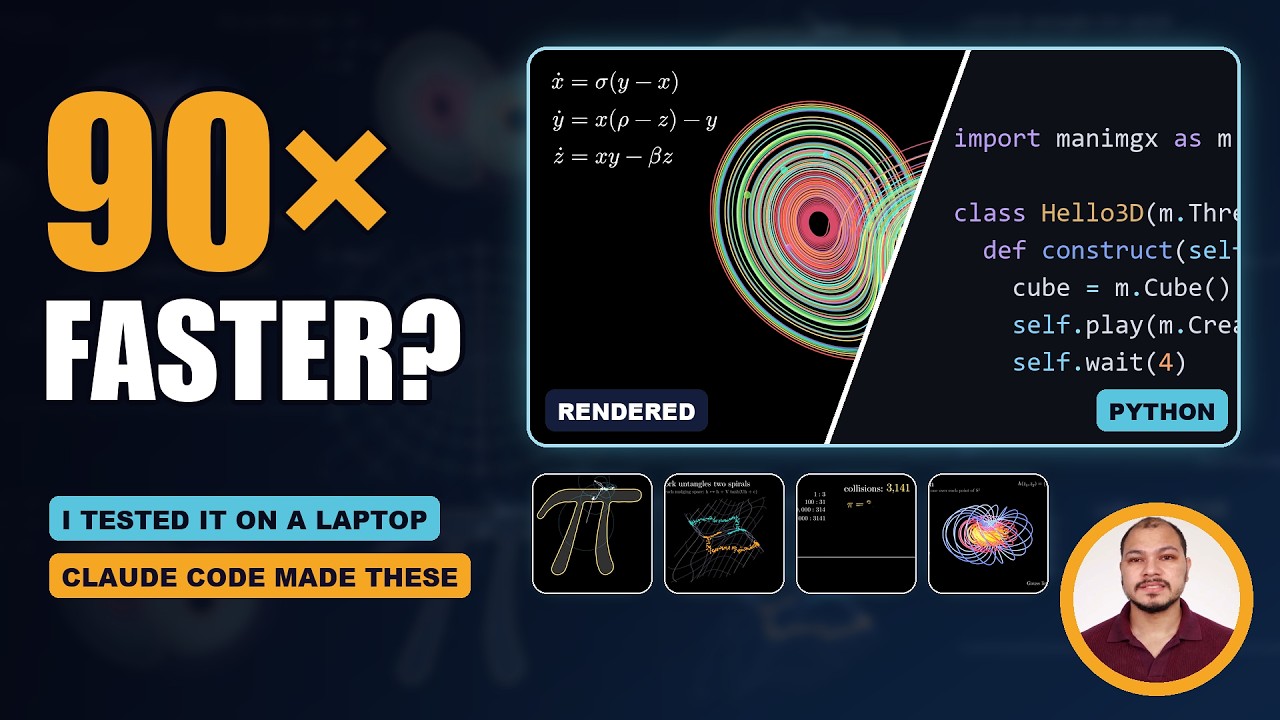
The video introduces ManimGX, a new open-source animation engine with a Rust core designed for creating math and 3D videos rapidly. It maintains the familiar Python API from the original Manim library but replaces the renderer with a GPU-accelerated Rust-based system, promising up to 90 times faster rendering than Manim Community Edition (CE). The presenter tests this claim on a Windows laptop, highlighting how Claude Code, an AI agent, can generate and render a 3D video from a single prompt in about 40 seconds, showcasing the potential for fast, automated video creation.
ManimGX’s GitHub repository is relatively new but has quickly gained attention, with a clear MIT license and documentation tailored for AI agents, including plain text files and API cheat sheets. The installation process is straightforward, requiring only Python 3.13 or newer, and notably does not depend on external tools like LaTeX or FFmpeg, as these are bundled within the package. However, users should be aware of licensing nuances due to the inclusion of the x264 encoder, which is GPL3 or later.
The video demonstrates ManimGX’s capabilities through various tests, including rendering simple animations like a square transforming into a circle in just over a second. The presenter also explores the system’s error detection and correction features, showing how an AI agent can identify and fix issues in the code automatically. While some limitations exist, such as ignored color keywords in certain shapes, the integration with type checkers helps catch these problems early, improving the development workflow for agents.
Benchmark comparisons reveal that ManimGX significantly outperforms Manim CE, especially on complex 3D scenes, with speedups ranging from about six to over 130 times depending on the scene. Although the exact 90× speedup claim varies depending on hardware, the overall trend is clear: ManimGX offers a substantial improvement in rendering times. The presenter’s tests on a Ryzen 7 laptop with an RTX 4060 GPU confirm these gains, making it particularly appealing for users who rely on iterative video creation with AI agents.
Finally, the video showcases a gallery of example animations, ranging from mathematical visualizations to neural network demonstrations, with render times mostly under a minute. It emphasizes that while ManimGX accelerates rendering, the complexity of the Python scene code itself remains a significant factor in total processing time. The presenter concludes that ManimGX is ideal for those using AI agents to create explainer videos quickly but advises users dependent on specific Manim CE plugins or styles to continue using the older version for now. The video encourages viewers to try ManimGX themselves and provides links to the repository and documentation.
Useful Links