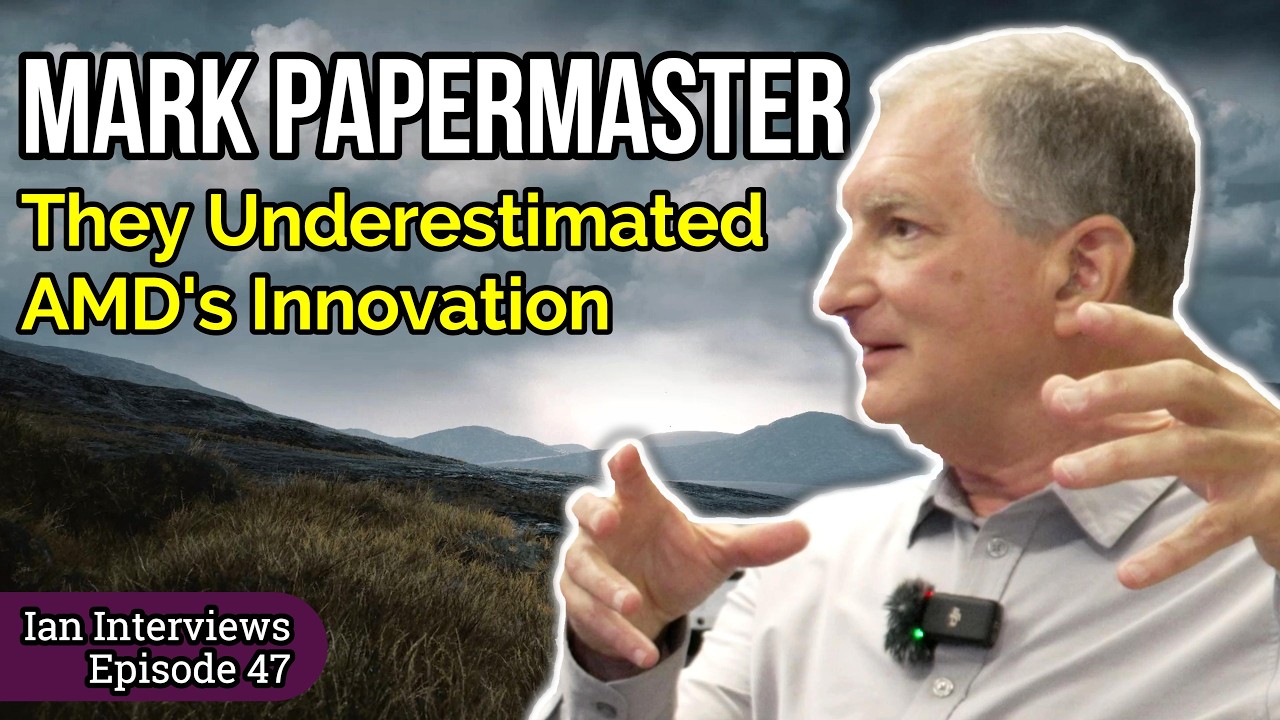
In this interview, Ian Cutress speaks with Mark Papermaster, AMD’s Chief Technology Officer, reflecting on AMD’s transformation since their first meeting in 2016. Papermaster recounts the company’s journey from a struggling competitor to a major industry player, highlighting the pivotal role of the Zen CPU architecture and the strategic leadership of CEO Lisa Su. He emphasizes how AMD’s vision to become an agile, customer-focused solution provider has materialized, with the company now offering a broad portfolio of CPUs, GPUs, and AI hardware. The conversation underscores how AMD’s early investments in chip infrastructure and innovation laid the groundwork for their current success in the AI era.
Papermaster discusses the challenges and milestones of AMD’s Zen processor development, describing the first two generations as “proving ground years” that established AMD’s credibility as a sustained innovator. He explains that it took three generations for the industry to recognize AMD’s consistent delivery of leadership performance, which led to significant market gains and financial success. The interview also touches on the importance of AMD’s Infinity Fabric and chiplet technology, both of which were bold bets that enabled scalability and flexibility across product lines. Papermaster notes that these innovations were initially controversial within the company but ultimately proved transformative.
The conversation delves into the technical challenges of maintaining performance improvements amid the slowing of Moore’s Law and the increasing complexity of chip design. Papermaster expresses confidence in AMD’s engineering teams and their ability to co-optimize with foundry partners like TSMC, leveraging advances in process nodes and architectural innovation. He highlights the integration of AI capabilities into CPUs, such as the upcoming ACE engine in Zen 7, and the importance of balancing compute, memory, and I/O for heterogeneous computing. The discussion also covers AMD’s culture of “healthy contention,” which encourages debate and critical evaluation to drive better decisions and continuous improvement.
Papermaster reflects on his long career, including 26 years at IBM, and the enduring lessons of cross-disciplinary innovation and co-design with manufacturing partners. He observes a renewed interest in hardware among students and young engineers, driven by the rise of AI-native chip design. Papermaster predicts that AI will fundamentally disrupt chip design practices, enabling “first-time right” silicon and tighter integration between hardware and algorithms. He stresses the ongoing need for general-purpose CPUs and GPUs, even as specialized solutions become more prevalent, and describes AMD’s strategy of supporting a broad ecosystem, including FPGAs and custom silicon for select customers.
Looking ahead, Papermaster discusses AMD’s recent acquisitions, such as ZT Systems, which enhance the company’s capabilities in rack-scale design and AI infrastructure. He addresses the engineering challenges posed by increasing power consumption and the shift toward liquid cooling and photonics for high-density clusters. Papermaster emphasizes AMD’s commitment to modularity and open ecosystems, enabling flexible solutions for a wide range of customers. He concludes by expressing excitement for 2026, anticipating major advances in AI-driven chip design, broader enterprise adoption of AI, and the emergence of indispensable AI applications in everyday life.