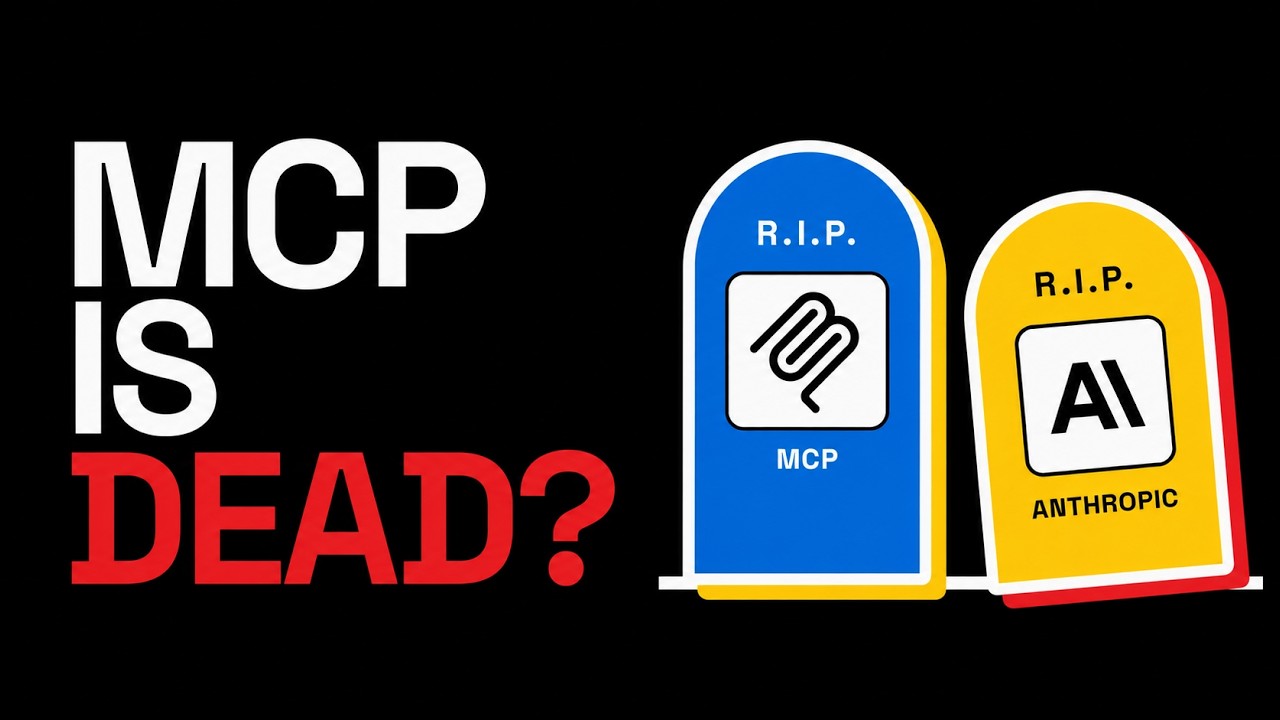
The creator initially panicked upon hearing “MCP is dead” due to issues like context bloat and inefficiencies in the Model-Connector Protocol, but was reassured by a major update that made MCP stateless and more scalable, proving its ongoing evolution and adoption. Ultimately, the video concludes that while the ideal of seamless tool-model integration is unrealistic, MCP remains a vital, actively developing infrastructure embraced by many despite challenges.
The video begins with the creator sharing a personal experience of discovering the phrase “MCP is dead” while doomscrolling AI Twitter late at night. Having spent two weeks integrating MCP servers into their AI content production pipeline, the news initially caused panic. MCP, or the Model-Connector Protocol, promised a unified way for AI models to interact with various tools and APIs without custom coding. The creator was excited by this potential and connected multiple servers, including GitHub and databases, to streamline their workflow.
However, problems quickly emerged as the number of connected servers increased. The AI model began forgetting instructions, calling incorrect tools, or freezing altogether. The root cause was identified as context bloat—each connected server dumped extensive tool definitions into the model’s context window, consuming valuable processing space before any actual task began. Attempts to scale the system on cloud servers only exacerbated these issues, revealing significant challenges with statefulness and load balancing in the original MCP design.
The narrative around MCP’s demise gained traction after an infrastructure engineer publicly criticized it, favoring traditional command-line interfaces for their reliability and simplicity. This criticism was echoed by investors and industry insiders who noted that a large portion of the model’s context was consumed by tool definitions, making MCP inefficient. Despite these critiques and a serious security vulnerability discovered in April, MCP’s usage statistics told a different story: downloads and adoption were climbing, major companies were integrating it, and competitors were adopting the protocol rather than creating alternatives.
What convinced the creator to continue using MCP was the maintainers’ proactive response. In late July, a major protocol update was released that addressed key issues by making MCP stateless at the protocol layer, improving load balancing, caching, and modularizing heavier features as optional extensions. This rewrite demonstrated that MCP was not dying but evolving to meet the needs of both small creators and large enterprise teams, who have very different requirements and experiences with the protocol.
In conclusion, the creator reflects that what truly died was the unrealistic fantasy that any tool could be seamlessly connected to any model without engineering trade-offs. MCP itself remains a vital and growing infrastructure, undergoing necessary refinements as it matures. The video ends by encouraging viewers who have struggled with or abandoned MCP to share their experiences, emphasizing that while the hype may have cooled, MCP’s real-world use and development continue robustly.