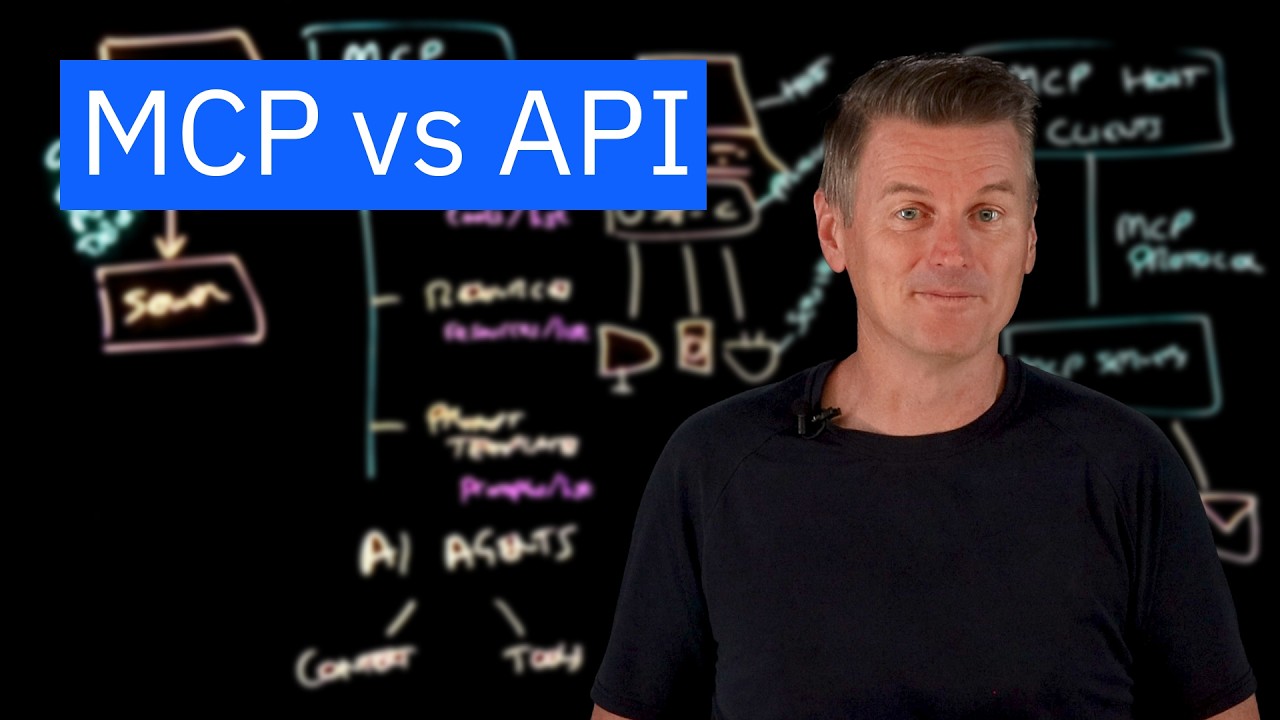
The video explains the emerging standard called Model Context Protocol (MCP), introduced by Anthropic in late 2024, which aims to simplify how AI applications, particularly large language models (LLMs), interact with external data sources and tools. MCP is compared to a USB-C port, serving as a universal interface that standardizes connections between AI agents, external data servers, and tools. It involves a host (the AI application) and multiple servers (data sources or tools), communicating via JSON RPC 2.0 sessions, allowing for flexible and scalable integration similar to plugging various peripherals into a laptop’s USB-C port.
MCP addresses two main needs for AI agents: providing external context and enabling tool usage. It allows AI agents to retrieve data such as documents or database records and to execute actions like web searches or calling external services. MCP servers advertise their capabilities through primitives—tools (discrete functions like weather or calendar services), resources (read-only data like files or database schemas), and prompt templates (predefined prompts). These primitives can be discovered and invoked at runtime, enabling AI agents to adapt dynamically to available functionalities without requiring code redeployment.
In contrast, APIs are a more general mechanism for system integration, defining rules and protocols for requesting data or services. Most commonly, APIs follow the RESTful style, communicating over HTTP with standard methods like GET and POST, and often exchanging data in JSON format. While APIs abstract internal system details and facilitate integration, they are not specifically designed for AI applications. Both MCP and APIs operate on a client-server model, providing layers of abstraction that simplify system interactions, but they differ significantly in purpose and flexibility.
A key difference highlighted is that MCP is purpose-built for AI and LLM integration, whereas APIs are general-purpose tools. MCP supports dynamic discovery, allowing AI agents to query a server for its available capabilities at runtime, which enables automatic adaptation to new or changed functionalities. Traditional REST APIs lack this feature, requiring manual updates to client code when endpoints or capabilities change. Additionally, MCP standardizes interfaces across different servers, meaning that once an MCP client is built, it can interact with multiple MCP servers without needing custom adapters, unlike APIs, which often have varied formats and protocols.
Finally, the video notes that many MCP servers are built as wrappers around existing APIs, translating MCP calls into native API requests. This layered approach means MCP enhances existing services like GitHub, Google Maps, or Spotify by providing a more AI-friendly interface while leveraging the underlying API infrastructure. MCP is not replacing APIs but rather complementing them, creating a standardized, flexible layer that improves integration and discovery for AI applications. This development promises to make external data and tools more accessible and manageable for AI agents, fostering more powerful and adaptable AI systems.