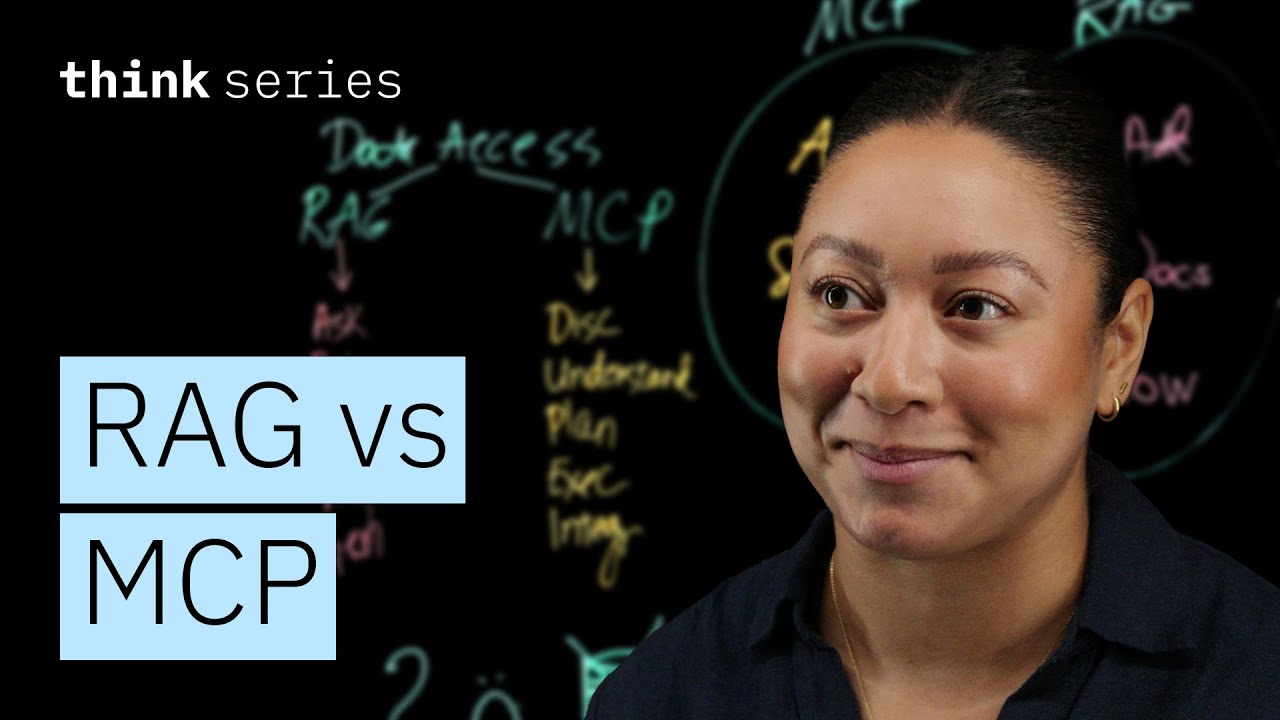
The video explains how Retrieval Augmented Generation (RAG) enhances large language models by retrieving relevant external information to provide accurate, context-rich responses, while Model Context Protocol (MCP) enables AI agents to interact with external systems and perform actions through APIs and tools. It highlights that RAG focuses on enriching knowledge, MCP on executing tasks, and that combining both approaches can create more powerful, secure, and scalable AI solutions.
The video explores two key methods—Retrieval Augmented Generation (RAG) and Model Context Protocol (MCP)—that enable AI agents and large language models (LLMs) to connect effectively to external data and systems. It begins by highlighting a common misconception: while LLMs are powerful, they do not inherently have access to all information or your specific data. Instead, they rely heavily on the data provided to them, which is why integrating external knowledge sources or systems is crucial for accurate and actionable AI responses.
RAG focuses on enhancing the knowledge of LLMs by retrieving relevant information from external knowledge bases such as documents, PDFs, or manuals. Its primary purpose is to provide additional context so that the AI can generate grounded and authoritative answers. The process involves five steps: the user asks a question, the system retrieves relevant data, returns the passage, augments the prompt with this information, and finally generates a response. For example, RAG can help an employee understand vacation policies by pulling details from an employee handbook or payroll documents.
In contrast, MCP is designed to enable AI agents to take action by connecting them to external systems and tools. MCP acts as a communication protocol that allows the AI to discover available APIs or tools, understand their inputs and outputs, plan which tools to use, execute calls securely, and integrate the results to complete tasks or workflows. Using the vacation example, MCP could retrieve an employee’s available vacation days from an HR system and even submit a time-off request on their behalf, thus going beyond just providing information to performing actions.
While RAG and MCP share similarities—both access external data rather than relying solely on the LLM’s internal knowledge, and both help reduce hallucinations by grounding responses in real information—they differ fundamentally in their goals. RAG is about “knowing more” by enriching the model’s context with static or semi-structured data, whereas MCP is about “doing more” by enabling the AI to interact dynamically with live systems and execute workflows.
The video concludes by emphasizing that these two approaches are not mutually exclusive and can complement each other. MCP can leverage RAG to improve information retrieval as part of its toolset. For anyone planning AI projects, the key takeaway is to understand when to use retrieval for knowledge and when to call tools for action, while also considering important factors like security, governance, and scalability in the system architecture.