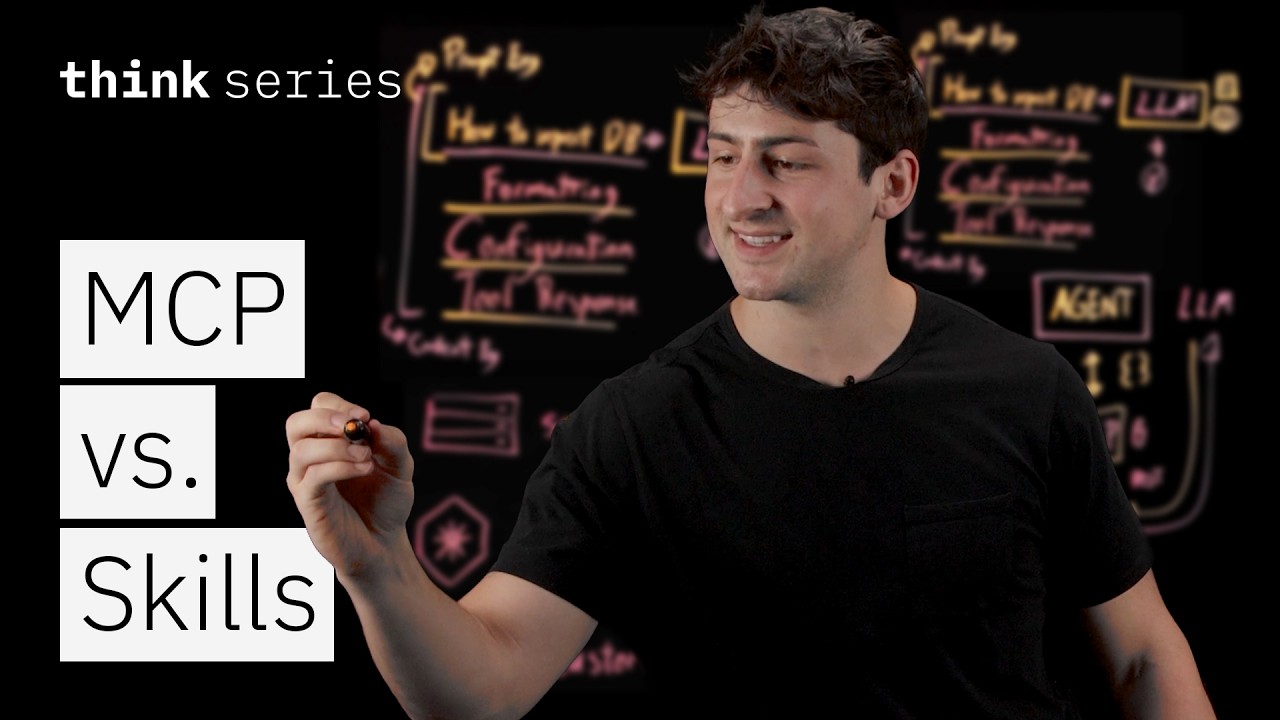
The video explores how to enhance Large Language Models (LLMs) by integrating MCP servers and skills to add custom and unique data for various use cases, such as coding assistance or building AI agents. While LLMs are general-purpose and trained on vast information, providing the right context is crucial for accurate responses. This process, known as context engineering, involves supplying additional data and formatting instructions to the LLM, going beyond simple prompt engineering.
MCP, or Model Context Protocol, standardizes communication between AI models and external data sources like CRMs. Instead of manually feeding data or API documentation to the LLM, MCP servers abstract these APIs into an LLM-friendly format, handling authentication and translating LLM requests into service calls. This creates a seamless, secure, and standardized layer that enables AI agents to access real-time data efficiently, supported by most AI tools.
However, MCP alone does not address the need for consistent domain-specific knowledge or repeatable task execution. This is where skills come in. Skills are lightweight packages containing prompts, metadata, and scripts that teach the LLM how to perform specific tasks reliably, such as formatting CRM data in a particular way or debugging code. Skills can be auto-loaded into the LLM’s context window as needed, providing tailored capabilities without the complexity of setting up MCP servers.
Choosing between MCP and skills depends on the use case. MCP is ideal for applications requiring controlled, permissioned access to live data and integration with external tools, such as monitoring virtual machines or retrieving customer information. Skills are better suited for adding reusable, custom capabilities that guide the LLM’s behavior in a consistent manner, especially when real-time data access is not necessary.
Both MCP and skills are open source, widely adopted, and can be used locally, enhancing the functionality of AI agents and LLMs. The video also hints at future content about using command-line interfaces (CLIs) for building agents, inviting viewers to engage and share their preferences between MCP servers and skills. Overall, these tools empower developers to tailor AI models effectively for diverse and practical applications.