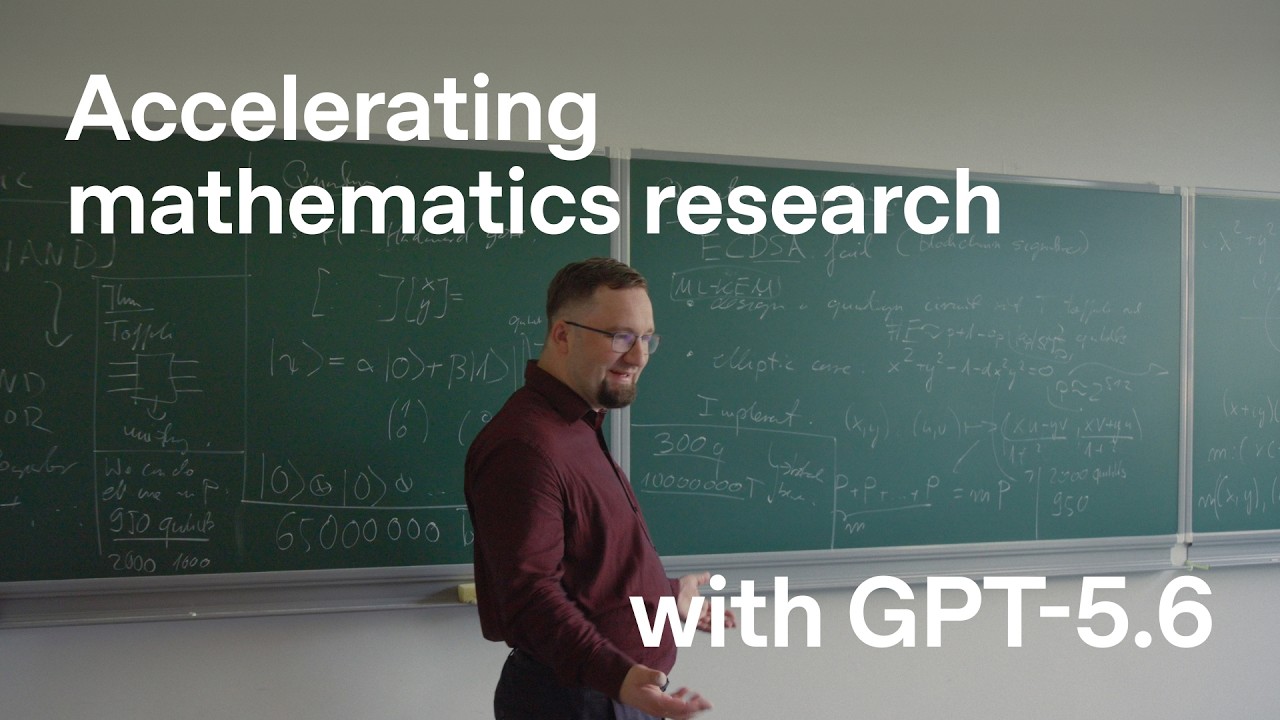
A mathematician shares how using the advanced AI tool Codex 5.6 enabled them to solve a longstanding algebraic problem by autonomously handling complex computations, leading to the disproof of a major conjecture. They highlight the synergy between human creativity and AI assistance, emphasizing that such technology empowers researchers to achieve breakthroughs while maintaining a balanced and enjoyable approach to their work.
The mathematician begins by describing their approach to tackling difficult math problems, emphasizing the importance of taking breaks and immersing themselves in thought, often spending time in their garden to relax. This mental reset allows them to return to their work with fresh perspective, where they then use Codex, an AI programming tool, to handle complex explorations and technical computations that would otherwise take weeks to complete.
Reflecting on their lifelong passion for coding, the mathematician shares that they have been engaged with computer programming since a very young age. Over the past three years, they and their team have been working on a challenging problem related to algebraic surfaces, trying various methods including traditional pen-and-paper approaches, programming, and earlier AI models, but none yielded satisfactory results.
The breakthrough came when they decided to use the latest version of Codex, version 5.6. This advanced AI model generated a completely new idea that led to disproving a long-standing conjecture they had been trying to prove. Specifically, they discovered that 14/5 is actually greater than 8/3, revealing that the conjecture was false. The mathematician expresses great excitement about this discovery, highlighting the joy and fun inherent in scientific exploration.
They praise Codex 5.6 for its natural ability to manage complex computational tasks autonomously, spawning subagents to handle different parts of the problem without explicit instructions. This capability allows the mathematician to focus more on the creative and conceptual aspects of their work, rather than getting bogged down in tedious calculations. They see AI tools like Codex as empowering resources that enhance human potential.
Finally, the mathematician reflects on the broader implications of using AI in research. They emphasize that with the right mindset and willingness to tackle big challenges, the computational demands can be effectively managed with AI assistance. This opens the door to many exciting discoveries ahead, enabling researchers to balance their professional passions with personal life, and fostering a future filled with innovation and enjoyment in the field of mathematics.