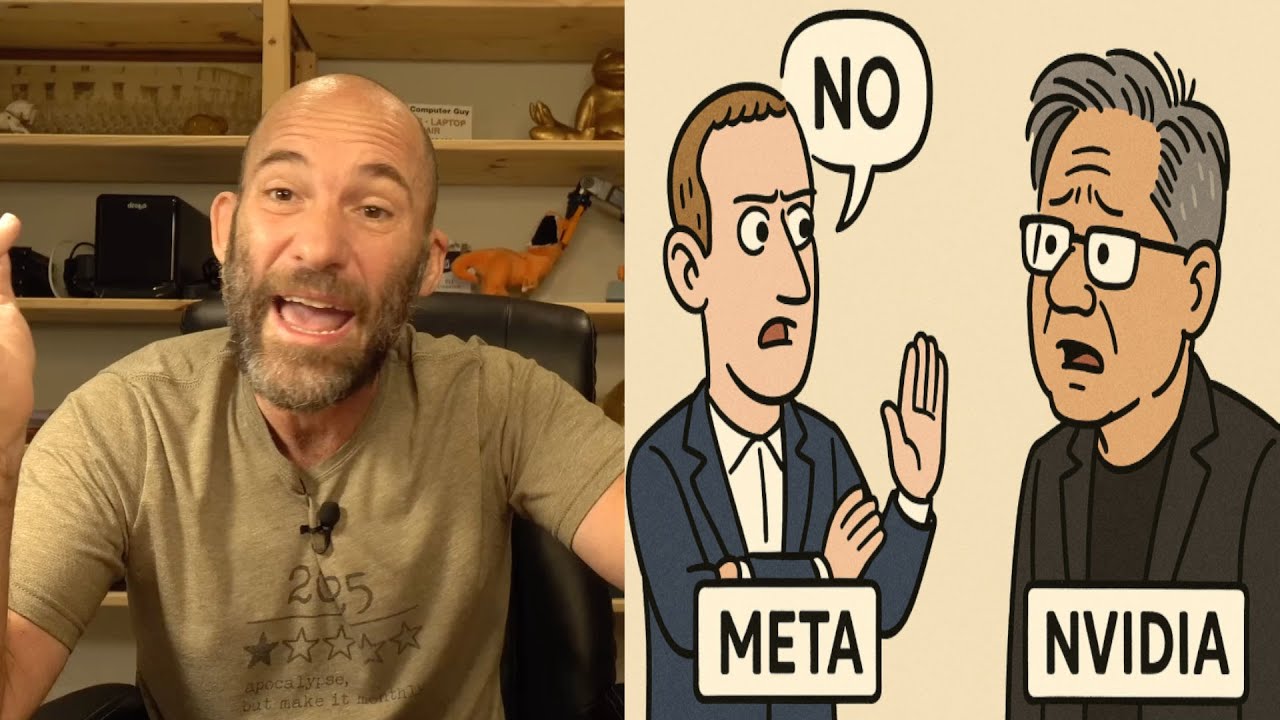
In this video, Eli the Computer discusses the evolving landscape of AI hardware, focusing on the recent developments involving Meta and Google’s Tensor Processing Units (TPUs). Eli highlights the common misconception that current market leaders like Nvidia will dominate the AI space indefinitely. He reminds viewers that many once-dominant tech companies like Yahoo and Xerox eventually declined, emphasizing that the AI hardware race is still very much open. Nvidia currently holds a significant market share with its versatile GPUs, but Eli warns that this could change as more specialized hardware solutions emerge.
Eli explains the difference between Nvidia’s GPUs and Google’s TPUs, which are application-specific integrated circuits (ASICs) designed for particular AI tasks. While Nvidia’s GPUs offer flexibility to run various AI models, TPUs are optimized for specific workloads, often at a lower cost and higher efficiency. This specialization could become more attractive as AI workflows stabilize over the next few years, reducing the need for flexible but expensive hardware. Eli points out that Google’s TPUs, which have been around for about a decade, are now gaining renewed attention, especially since Google’s Gemini Pro AI model was reportedly trained entirely on TPUs.
The video also covers Meta’s potential multi-billion dollar deal with Google to secure large quantities of TPUs for AI development. This deal could mark a significant shift in the AI hardware market, as Meta has traditionally relied on a mix of CPUs and GPUs from various vendors. Meta’s interest in diversifying its hardware, including exploring RISC-V processors, signals a broader strategy to reduce dependence on Nvidia. Eli notes that Google has historically restricted TPU access to internal use or cloud rentals, but Meta’s large investment might push Google to sell TPUs directly, which would be a notable change in business practice.
Eli further discusses the importance of software and developer tools in this ecosystem. He emphasizes that hardware alone is not enough; having accessible frameworks and interfaces, like Meta’s open-source projects and tools such as Olama, is crucial for widespread adoption. If Meta commits to Google’s TPUs and supports the developer community with robust software, it could accelerate the shift away from Nvidia’s GPUs by making TPU deployment easier and more attractive for AI practitioners.
In conclusion, Eli suggests that while Nvidia currently dominates the AI hardware market, the landscape could change dramatically within the next five years. The collaboration between Meta and Google on TPUs, combined with Meta’s strong developer ecosystem, might challenge Nvidia’s monopoly. He invites viewers to consider these developments and share their thoughts on the future of AI hardware, while also promoting his Silicon Dojo educational initiative that offers free, hands-on tech classes to empower learners in Durham, North Carolina.