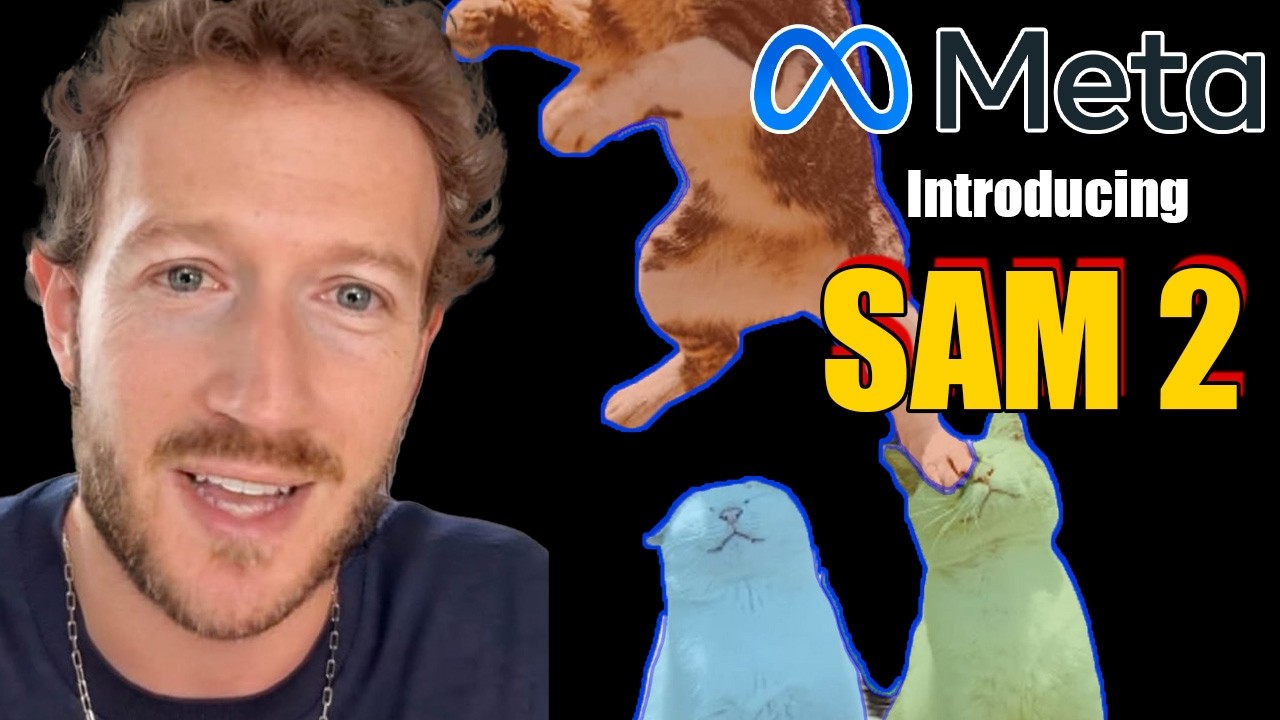
In a recent announcement, Mark Zuckerberg and Meta’s AI team unveiled the Segment Anything Model 2 (SAM 2), which is positioned as a significant advancement in open-source AI technology. This model is part of Meta’s ongoing commitment to open-source AI, which Zuckerberg emphasized during a public conversation with Jensen Huang from Nvidia. With the release of SAM 2, users can access both the model and an extensive dataset under the Apache 2.0 license, enabling developers to create their own applications and experiences. The dataset provided is notably larger than previous offerings, boasting 4.5 times more data and over 50 times more annotations than the largest existing video segmentation dataset.
SAM 2 represents a leap forward in object segmentation capabilities, allowing for real-time segmentation in images and videos. Unlike earlier models that required specific training to recognize certain objects, SAM 2 employs a “zero-shot” approach, enabling it to identify and track any object without needing prior examples. This means that users can select an object in a video or image and the model will maintain its focus on that object, even if it moves significantly or is partially obscured. This enhanced functionality has broad implications, particularly in fields such as robotics, self-driving technology, and creative video effects.
The previous version of the Segment Anything Model was already utilized in diverse applications like marine science and medical imaging. With the release of SAM 2, these capabilities are set to expand further, making advanced segmentation techniques accessible to a wider audience. The open-source nature of this model allows researchers and developers to innovate without the financial barriers typically associated with proprietary technology. Zuckerberg’s vision for open-source AI suggests that it can democratize access to powerful tools, fostering creativity and scientific advancement.
During a demonstration of SAM 2, various tracking scenarios were showcased, highlighting its ability to segment and follow objects, such as a child’s shoe and a cat in an alley. The model was able to maintain tracking even when the object was not visible, illustrating its advanced capabilities. Users can also customize the model for specific scenarios, enhancing its performance for particular tasks. The demonstration reinforced the effectiveness of SAM 2 in real-world applications, showcasing its potential for both entertainment and practical uses.
Overall, the release of SAM 2 marks a significant milestone in Meta’s AI development, contributing to the ongoing conversation about the future of open-source technology. As companies like Meta continue to push the boundaries of AI capabilities, the potential for innovation in various industries—ranging from healthcare to robotics—becomes more promising. The emphasis on open-source models reflects a growing recognition of their importance in driving progress and accessibility in the rapidly evolving AI landscape.