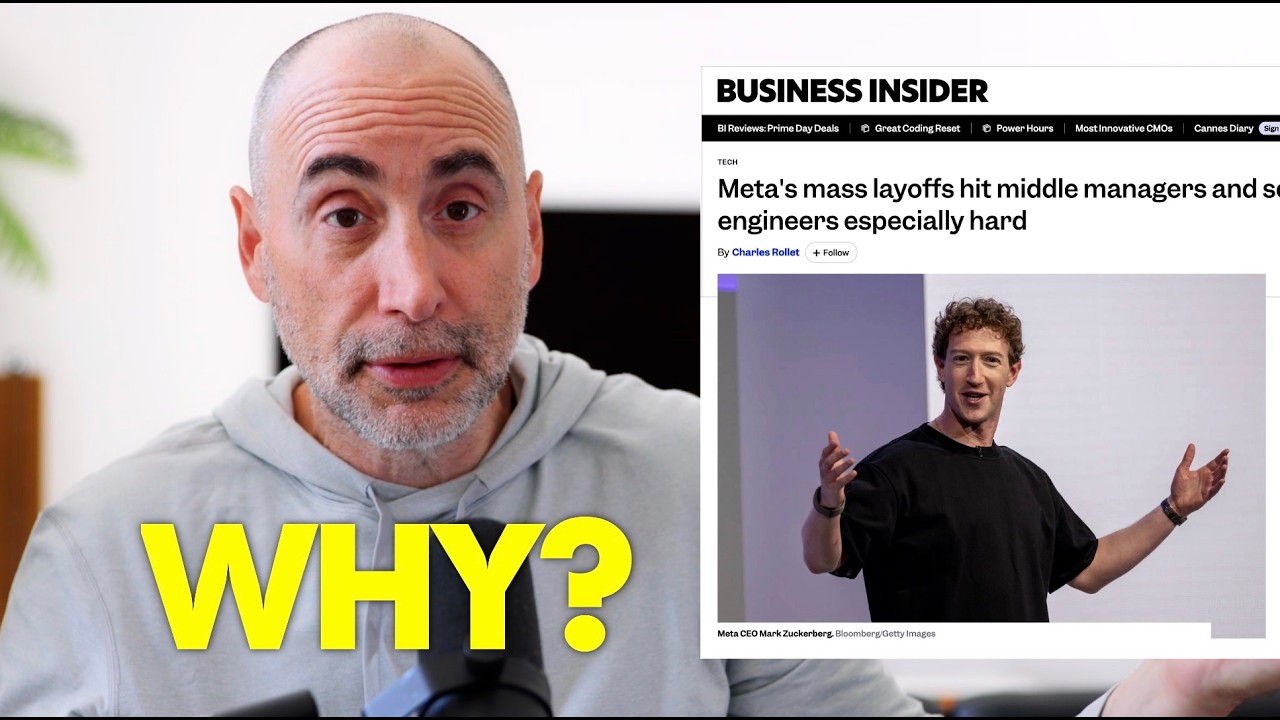
Meta’s recent layoffs of 10% of its workforce were primarily due to the failure of its costly metaverse investment rather than AI advancements, with the company instead pivoting to integrate AI skills within new roles. The speaker emphasizes that in the ever-evolving tech industry, developers must combine strong foundational skills with AI knowledge and adaptability to thrive amid ongoing innovation and inevitable failures.
The recent layoffs at Meta, which involved about 10% of its workforce, were not primarily driven by AI advancements as many might think. Instead, the main reason was the failure of Meta’s significant investment in the metaverse, which reportedly cost around $80 billion. As a result, the company had to restructure and retool its operations. Developers with AI skills were likely repositioned into new roles within the company, reflecting a strategic pivot towards AI rather than a direct cause of job cuts.
The technology landscape is constantly evolving, and the key to staying relevant as a software developer is adaptability and strong fundamentals. The speaker draws on decades of experience to highlight how technologies that were once in high demand can become obsolete within a few years. For example, web development skills from the 1990s had to drastically change by the early 2000s due to new standards and paradigms. This pattern of rapid change continues today with AI becoming the dominant technology to learn and master.
Understanding AI today goes beyond just using popular tools like ChatGPT or Gemini. Developers need to grasp a broad range of concepts including large language models, local versus cloud models, AI deployment, agents, and prompting techniques. However, fundamental software development principles such as design patterns, system architecture, and refactoring remain crucial. Those who combine these fundamentals with AI knowledge will be the most effective and in-demand professionals in the evolving tech landscape.
The speaker emphasizes that many AI companies and technologies will fail, just as many web-based companies and frameworks did in the past. This is a natural part of the technology cycle, where innovation is accompanied by trial and error. Historical examples like Netscape, Borland, and Corel illustrate how even once-dominant companies can disappear. The key takeaway is not to panic over failures but to focus on continuous learning and adaptability.
In conclusion, the tech industry is inherently volatile, and success depends on being nimble and open-minded. Developers must build strong foundational skills that allow them to pivot quickly as new technologies emerge. AI represents the current wave of innovation, but the principles of software development remain timeless. By embracing change and focusing on fundamentals, developers can thrive despite the ups and downs of the tech world.