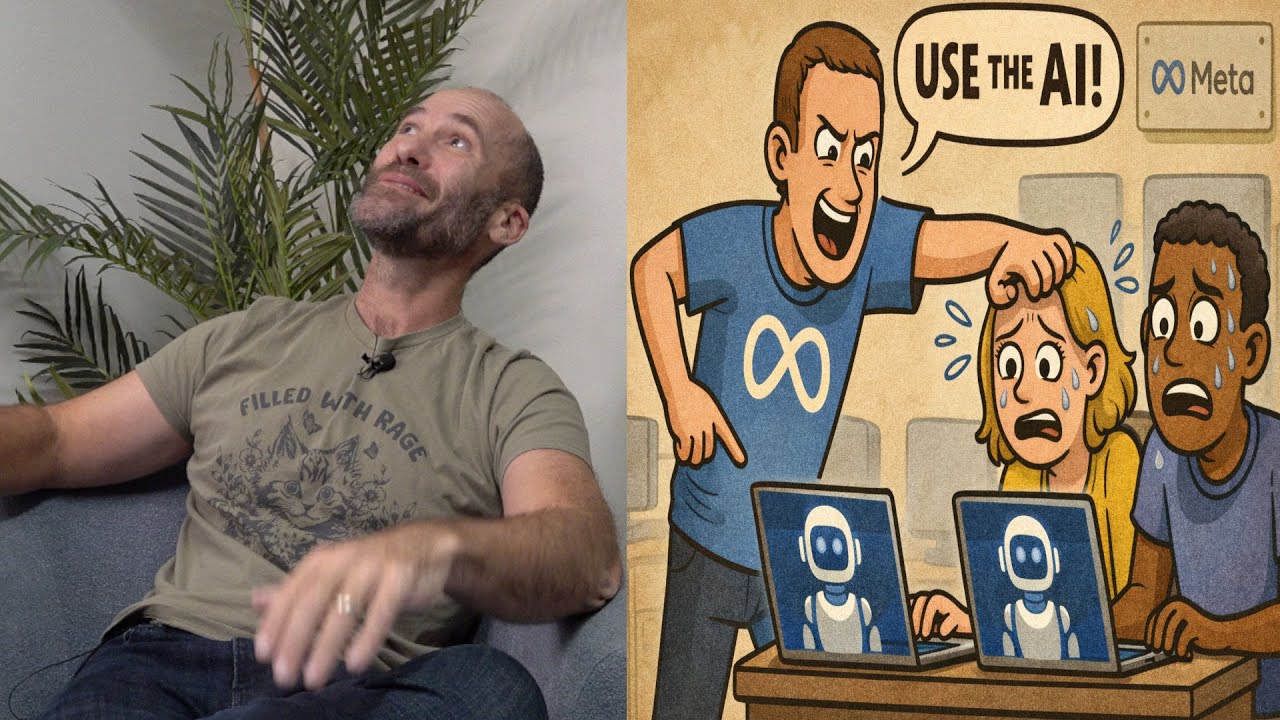
Eli the Computer Guy critiques Meta’s aggressive push for AI adoption among employees, highlighting the company’s reliance on third-party AI tools and lack of a clear, coherent strategy under Mark Zuckerberg’s leadership. He contrasts this with Amazon’s in-house AI approach, expressing skepticism about Meta’s heavy investment without defined goals and questioning the effectiveness of their “AI-first workplace” rhetoric.
In this video, Eli the Computer Guy discusses Meta’s current approach to artificial intelligence (AI) and critiques the company’s strategy under Mark Zuckerberg’s leadership. Eli is on location at American Underground in Durham, North Carolina, where he is teaching a class on AI computer vision. He uses this setting to introduce his thoughts on how Meta is aggressively pushing AI adoption among its employees without a clear understanding of its practical value or direction. Eli compares the tech industry’s rush into AI to dogs chasing a toy without knowing what the toy is, highlighting the lack of clarity in Meta’s AI ambitions.
Eli points out that Meta is making AI a core part of how employees work, but the company is relying heavily on third-party AI tools from competitors like Google and OpenAI rather than solely using its own models. He contrasts this with Amazon’s approach, which is to pull back from third-party AI vendors and focus on building AI capabilities in-house to avoid funding competitors and to maintain control over data and infrastructure. Meta, on the other hand, is encouraging employees to use AI tools broadly and is even tying employee performance reviews to AI usage, regardless of whether the AI actually improves efficiency or outcomes.
The video highlights internal challenges at Meta, including dissatisfaction with their own AI model, Llama, which Eli bluntly describes as underperforming compared to other models. Meta employees reportedly have access to a variety of AI tools, including Google’s Gemini 3 Pro and OpenAI’s ChatGPT-5, reflecting the company’s strategy of integrating multiple external AI solutions. Eli criticizes this approach as unfocused and driven more by a desire to appear AI-forward than by a coherent plan to leverage AI effectively.
Eli also shares insights from conversations with current and former Meta employees, who seem uncertain about the company’s AI strategy. While some employees mention the potential value of artificial general intelligence (AGI) and the massive market opportunity it represents, Eli suggests that Meta’s leadership lacks a clear vision and is essentially throwing money at AI projects in the hope that something valuable will emerge. He expresses skepticism about the wisdom of investing billions without a defined direction, describing the situation as a potential disaster waiting to unfold.
In conclusion, Eli questions whether Meta truly understands how to integrate AI into its operations or if it is simply spinning in circles. He critiques the buzzword-heavy rhetoric around creating an “AI-first workplace” as meaningless without concrete results. Despite his criticisms, Eli clarifies that he is not against AI itself but is concerned about the scale of investment and the lack of strategic clarity at Meta. He invites viewers to share their thoughts on Meta’s AI strategy and promotes his own educational offerings in technology and AI.