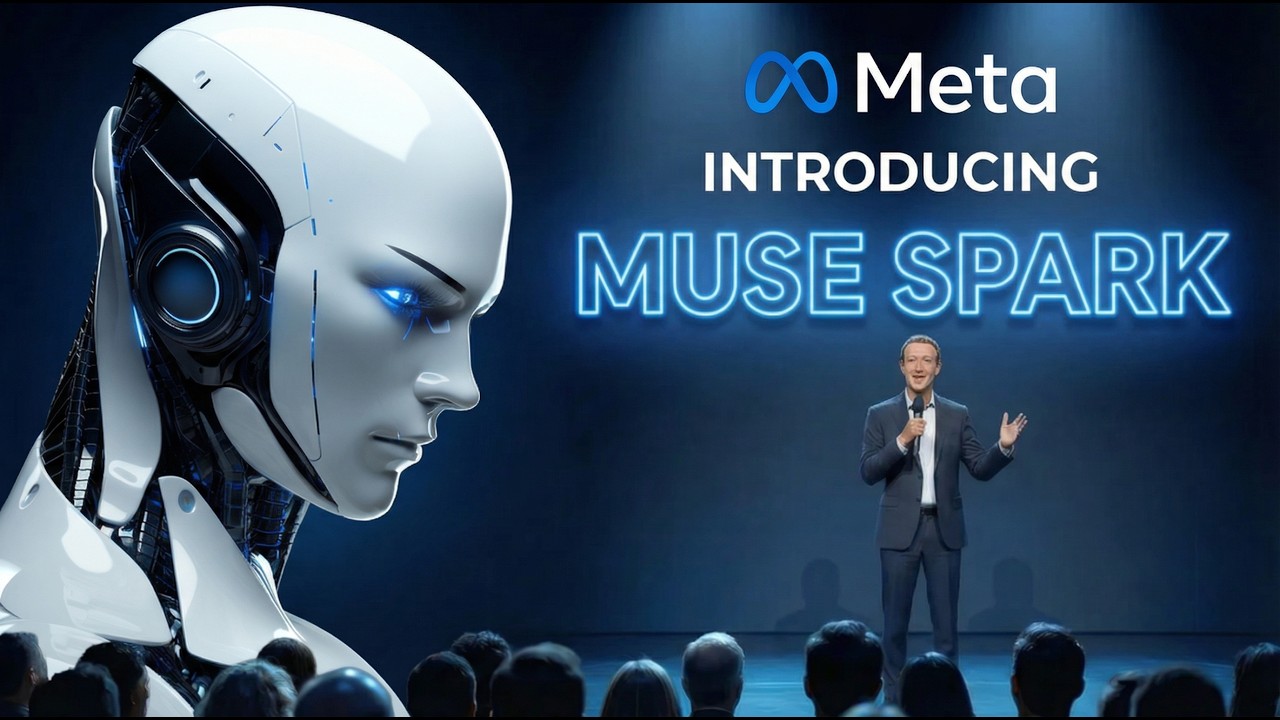
Meta has released its new AI model, Muse Spark, marking a significant advancement from its previous Llama models. Muse Spark is notable for being natively multimodal, designed from the ground up to understand and process video, images, audio, and text. This multimodal capability allows it to outperform many competitors in tasks involving multiple data types, such as interpreting complex visual inputs like handwritten chalkboard menus. While it may not surpass models like GPT-4 or Gemini 3 in every benchmark, Muse Spark excels particularly in multimodal reasoning and real-time data retrieval, such as accurately providing up-to-date stock prices.
One of Muse Spark’s standout features is its “contemplating mode,” an innovative agentic system where multiple AI agents collaborate in parallel to solve complex scientific reasoning problems. This multi-agent approach improves accuracy and token efficiency, showing competitive performance with other advanced models like Gemini Deepthink and GPT Pro. The model’s ability to scale with more agents suggests a promising future direction for AI reasoning, where collective agent collaboration could become a standard for handling intricate queries.
Meta has also demonstrated Muse Spark’s practical multimodal applications, such as analyzing images of a fridge’s contents to provide personalized dietary recommendations based on health conditions like high cholesterol. The model can localize recommendations visually and provide detailed nutritional information, showcasing its effective integration of multimodal understanding with real-world utility. Additionally, Muse Spark can analyze video content natively, a capability currently rare among large language models, positioning it alongside models like Gemini in this domain.
From a technical perspective, Meta has introduced a novel training technique called “thought compression,” which encourages the model to reason more efficiently by penalizing overly long thought processes. This results in the model solving problems using fewer tokens without sacrificing accuracy, leading to faster, cheaper, and more efficient AI performance. Meta’s revamped training recipe also significantly reduces the compute resources needed to achieve high-quality results, offering a substantial cost and speed advantage over competitors, which is critical given the scale at which Meta operates.
Despite these advancements, Meta’s benchmark presentations have been somewhat misleading, with all their models highlighted uniformly to suggest state-of-the-art performance across the board. In reality, Muse Spark excels mainly in specific areas like agentic search, open-ended health queries, and multimodal reasoning, while other models like Gemini 3 Pro lead in broader benchmarks. Muse Spark does not natively generate images but integrates with Midjourney for image creation, which prioritizes aesthetic quality over precise visual accuracy. Overall, Muse Spark represents a frontier-class model with strong multimodal capabilities and innovative training methods, signaling Meta’s commitment to pushing AI development forward.