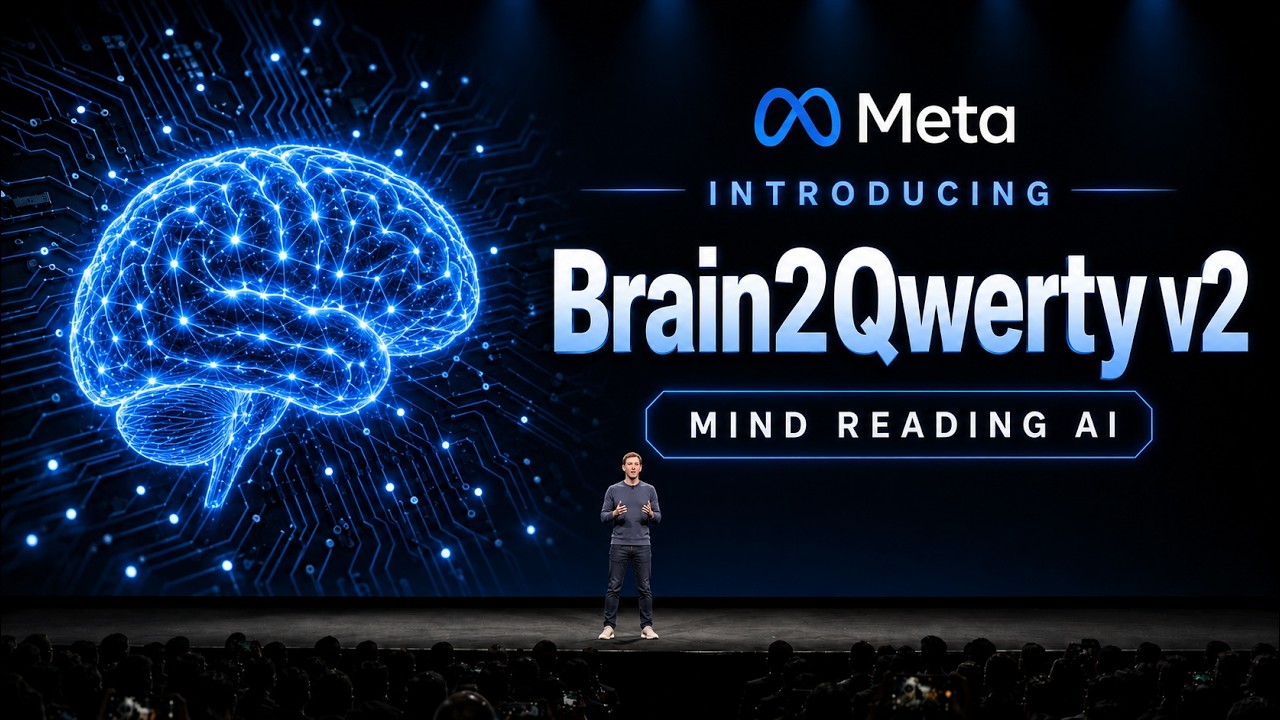
Meta has unveiled an AI system called Brain2QWERTY V2 that can decode brain activity into text without invasive procedures like implants or surgery. Using an external magnetoencephalography (MEG) scanner, the system interprets brain signals while participants perform a controlled typing task. This breakthrough is significant because it offers a non-invasive approach to brain-computer interfaces, potentially aiding people who cannot communicate physically. However, it is important to clarify that this technology is not general mind-reading and cannot extract random thoughts or silent internal dialogue.
The system achieves an average word accuracy of 61%, with the best participant reaching 78%, which is impressive given the noisy and weak signals recorded non-invasively from outside the skull. Meta’s approach involves a sophisticated AI pipeline combining an encoder, aligner, and language model that leverages semantic context to improve decoding accuracy. This multi-step process allows the AI to interpret brain signals more effectively by considering the structure and meaning of language, rather than just isolated letters or words.
Despite these advances, the research has limitations. The dataset was small and highly controlled, involving only nine healthy, right-handed, native English-speaking volunteers who typed sentences they heard without visual feedback or corrections. This controlled environment differs significantly from real-world communication, especially for patients who would benefit most from this technology but may not be able to provide similar training data. Additionally, the hardware used—a large, expensive MEG scanner—is not practical for everyday use, though future developments in wearable sensors may improve accessibility.
Another challenge is that the system currently decodes sentences after they are fully formed rather than word-by-word in real time, which limits its practicality for live communication. However, the research shows promise as decoding accuracy improves with more data, suggesting that scaling up neural data collection and refining AI models could lead to better performance. Meta is supporting this progress by releasing training code and datasets to the research community, although collecting high-quality brain data remains complex and resource-intensive.
The broader implications of this technology extend beyond technical hurdles. As brain decoding systems become more accurate and widespread, issues of consent, privacy, and control over neural data will become critical. Brain data is uniquely sensitive, tied to intentions and cognitive states, requiring robust ethical frameworks to prevent misuse. Meta’s Brain2QWERTY V2 represents a major research milestone that brings non-invasive brain-to-text closer to reality, offering hope for transformative communication tools while also highlighting the need for careful regulation as AI and neuroscience converge.