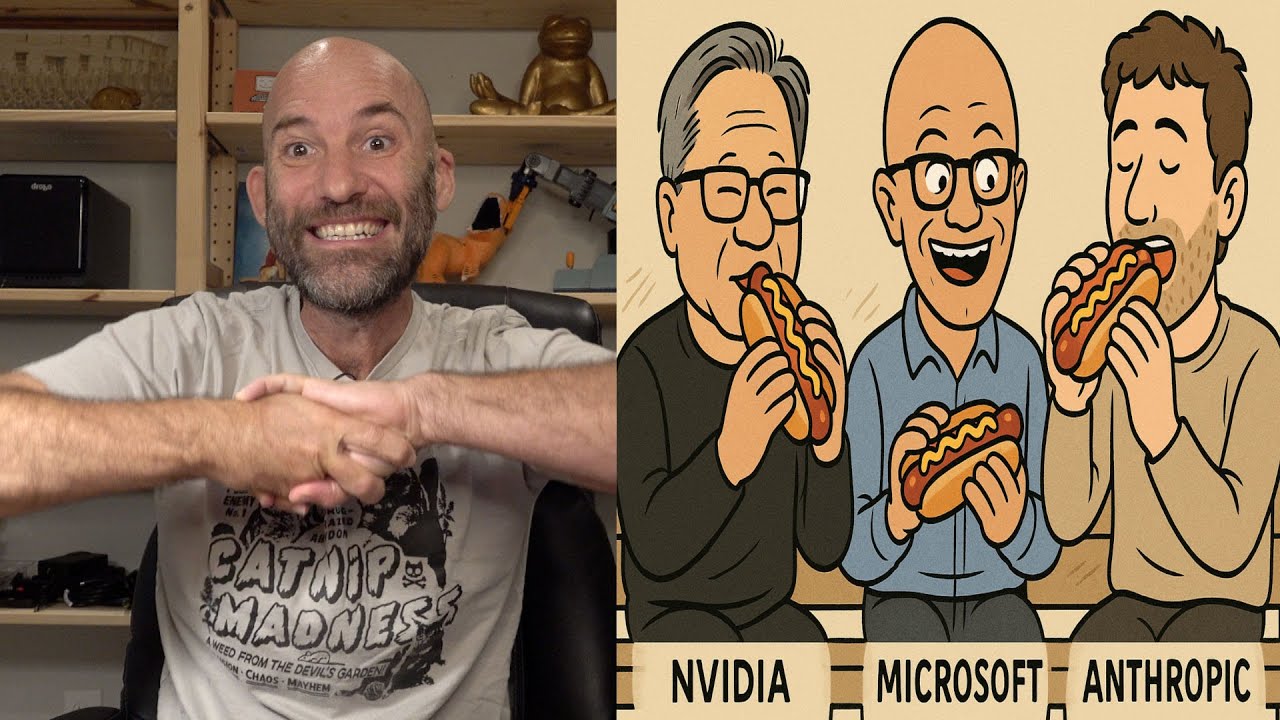
In this video, Eli the Computer Guy delivers a critical commentary on the current state of the AI industry, focusing on the recent strategic partnerships announced between Microsoft, NVIDIA, and Anthropic. Eli clarifies that he is not against AI as a technology but is deeply skeptical about the astronomical valuations and massive capital expenditures associated with AI companies. He argues that while AI is a valuable tech stack, the hype around its worth—such as OpenAI being valued at $500 billion and Anthropic at $200 billion—is disproportionate and borders on economic fraud. He suggests that these companies are engaged in a cycle of mutual financial support that inflates their valuations without a solid business rationale.
Eli contrasts the current AI industry dynamics with the traditional competitive tech landscape he grew up with, where companies fought fiercely against each other. He recalls how Microsoft once killed Netscape by integrating Internet Explorer into Windows, a move that disrupted the market. In contrast, today’s AI companies appear to be collaborating closely, with Microsoft, NVIDIA, and Anthropic essentially funding each other through complex financial arrangements. For example, Anthropic has committed to spending $30 billion on Microsoft Azure compute capacity, while Microsoft and NVIDIA are investing billions back into Anthropic. Eli sees this as a circular flow of money that sustains the illusion of success.
The video also highlights the unsustainable economics of AI development. Eli points out that even high-paying customers of AI services like OpenAI are not enough to cover the enormous costs, leading these companies to burn through cash rapidly. He draws parallels to the WeWork fiasco, where SoftBank repeatedly led funding rounds to prop up an overvalued company, ultimately resulting in collapse. Eli warns that AI companies face a similar risk because they cannot attract enough independent investors, relying instead on vendors and partners to fill funding gaps, which undermines the credibility of their valuations.
Eli further critiques the broader tech industry’s desperation for a new “iPhone moment”—a revolutionary breakthrough that drives massive growth and profits. He argues that previous attempts, such as VR and blockchain, failed to deliver, and AI is now being hyped as the next big thing despite lacking clear, widespread value to consumers. He emphasizes that the hype is largely driven by corporate and political interests rather than genuine technological breakthroughs. Moreover, he warns that open-source AI developments, especially from China, could disrupt the market by offering free or low-cost alternatives, challenging the inflated valuations of Western AI companies.
In conclusion, Eli expresses concern that the AI industry’s current trajectory is a form of self-deception and financial fraud, with companies believing their own exaggerated narratives. He urges viewers to critically assess the hype and financial maneuvers behind AI investments. Despite his criticisms, he acknowledges AI’s technical significance and continues to teach AI-related courses through Silicon Dojo, promoting accessible technology education. Eli invites viewers to share their thoughts on the AI partnerships and the state of capitalism reflected in these business dealings, underscoring the need for transparency and realism in evaluating AI’s true impact and value.