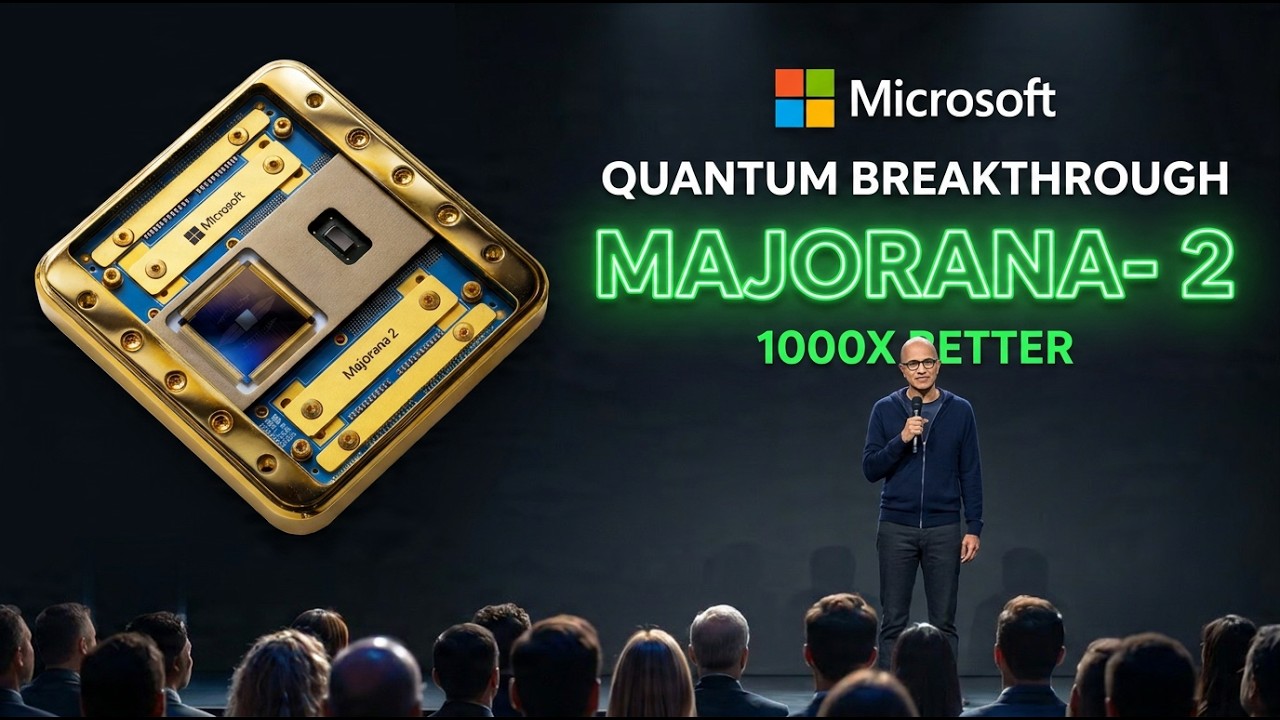
Microsoft has announced a groundbreaking advancement in quantum computing with their new quantum chip, Majorana 2, unveiled at Microsoft Build 2026. This chip boasts qubits that are 1,000 times more reliable than those in their previous generation, Majorana 1. Unlike classical bits that represent either 0 or 1, qubits can hold complex quantum states, but their extreme fragility has been a major barrier to practical quantum computing. Majorana 2’s qubits can maintain their quantum state for an average of 20 seconds, with some lasting up to a minute, a massive improvement over the microsecond lifetimes typical in current quantum systems.
The key challenge in quantum computing has been noise—external disturbances like heat, vibrations, radiation, and even cosmic rays that disrupt qubits and cause errors. To combat this, Microsoft switched the superconductor material in their chip from aluminum to lead. Lead’s natural radiation shielding properties help protect the qubits from these disturbances, significantly enhancing their stability. This material innovation, rather than a flashy new invention, is a crucial factor behind the leap in qubit reliability and represents a smart, foundational change in quantum chip design.
What sets this breakthrough apart is Microsoft’s use of AI agents in the research and development process. These AI systems, part of a platform called Microsoft Discovery, analyzed nearly two decades of scattered research data, automated measurements, optimized manufacturing, and identified design flaws that human researchers had missed—such as a miscalibrated temperature sensor skewing results. This demonstrates how AI is not just a tool for communication but a powerful assistant accelerating scientific discovery by handling complex data and spotting subtle errors that slow progress.
The implications of this advancement are significant. Microsoft now expects to develop a scalable, commercially viable quantum computer chip by 2029, cutting their original timeline in half. A functional quantum computer could revolutionize fields like medicine, materials science, energy, logistics, and finance by solving problems beyond the reach of classical supercomputers. Alongside the chip, Microsoft has made the AI research platform Microsoft Discovery generally available, enabling other organizations to leverage AI-driven research tools, signaling a broader shift in how science and technology development will be accelerated.
Despite the excitement, experts urge caution. The claims of 1,000 times better qubit reliability need independent verification, and it remains to be seen if these results hold under varied conditions or scale as promised. The history of quantum computing is filled with promising breakthroughs that struggled to transition from lab demos to practical machines. Nonetheless, Microsoft’s announcement marks a major milestone, highlighting both a quantum hardware leap and the transformative role AI can play in speeding up complex scientific research.