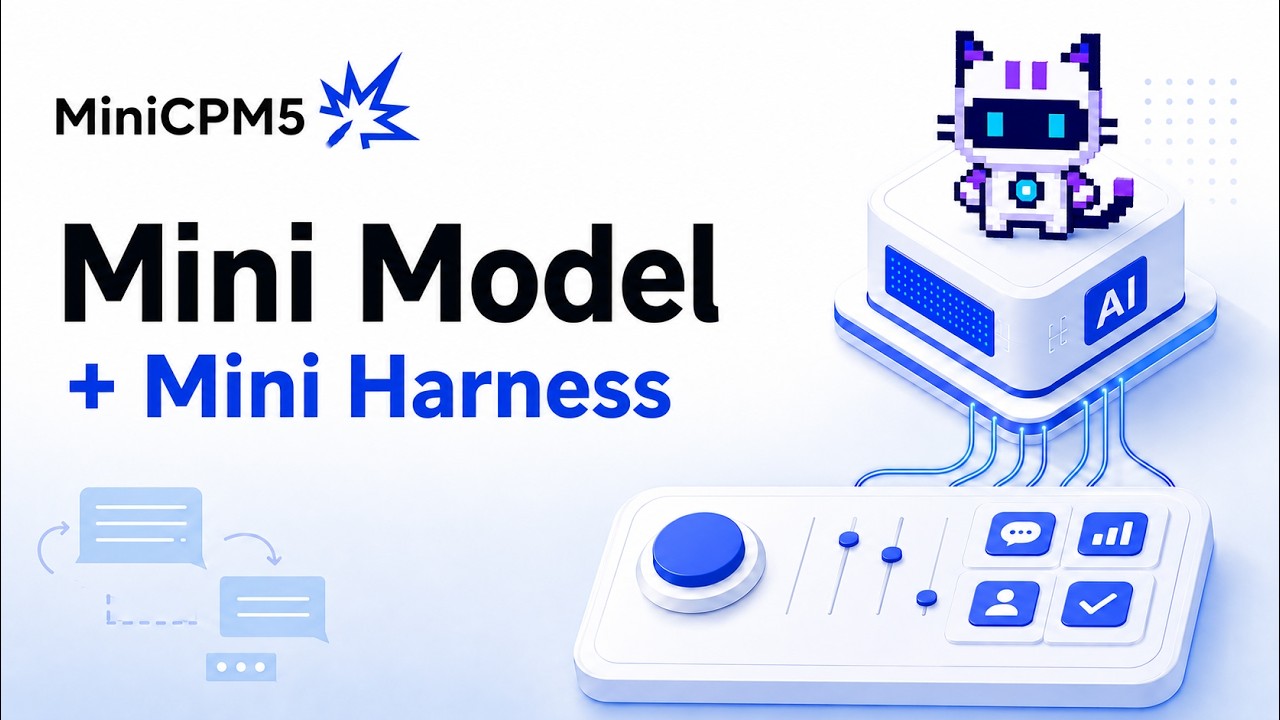
The video discusses the concept of a “cognitive core” small language model, as advocated by Andre Kapathy, which is a compact model around one billion parameters designed to focus on reasoning, tool use, and the ability to look things up rather than memorizing encyclopedic knowledge. The presenter agrees with this approach, noting that many large proprietary models now emphasize tool integration, but smaller models have struggled with effective tool use and agentic applications. The idea is that a small, efficient model could run on a wide range of devices, including older smartphones, and be customized for specific tasks through fine-tuning.
The main focus is on Mini CPM5, a 1B parameter dense model from OpenB, which follows a LLaMA-style architecture and supports an impressive 128K token context window. This model is open-source under the Apache 2 license and comes in several versions: a base pre-trained model, a supervised fine-tuned (SFT) model trained on 400 billion tokens, and a fully trained version incorporating reinforcement learning and on-policy distillation. The latter techniques help improve reasoning, instruction following, and reduce overly long responses, which is a common issue in small models.
Benchmark results show Mini CPM5 performs well compared to other models of similar size, particularly in token efficiency and hallucination avoidance. It uses significantly fewer tokens than larger reasoning models like Quen 3.52B and scores better on benchmarks that penalize hallucinations by effectively recognizing when it does not know an answer. This capability supports better decision-making about when to use external tools, enhancing its agentic abilities. The model’s transparency is also notable, with training data and recipes publicly available, which is rare among open and proprietary models.
The video also highlights practical applications and mini harnesses built around Mini CPM5, such as a Rust-based smart home assistant and a desktop pet app that runs the model locally. These examples illustrate how small models can add intelligence to devices and applications that previously lacked it. While the model shows promise in tool use and multi-step reasoning, it still struggles with very long chains of thought and complex tasks, sometimes getting stuck in loops or running out of tokens. However, it performs well on simpler tasks and demonstrates the potential for on-device AI.
In conclusion, Mini CPM5 represents a significant step toward the cognitive core vision, offering a compact, efficient, and capable model for on-device use. The presenter anticipates further developments, including vision-enabled versions and more fine-tuning options, which could expand its utility. For those interested in deploying text-only AI on limited hardware, Mini CPM5 is a compelling option. Future videos will explore competing models, and the presenter encourages viewers to engage with the content by liking and subscribing.