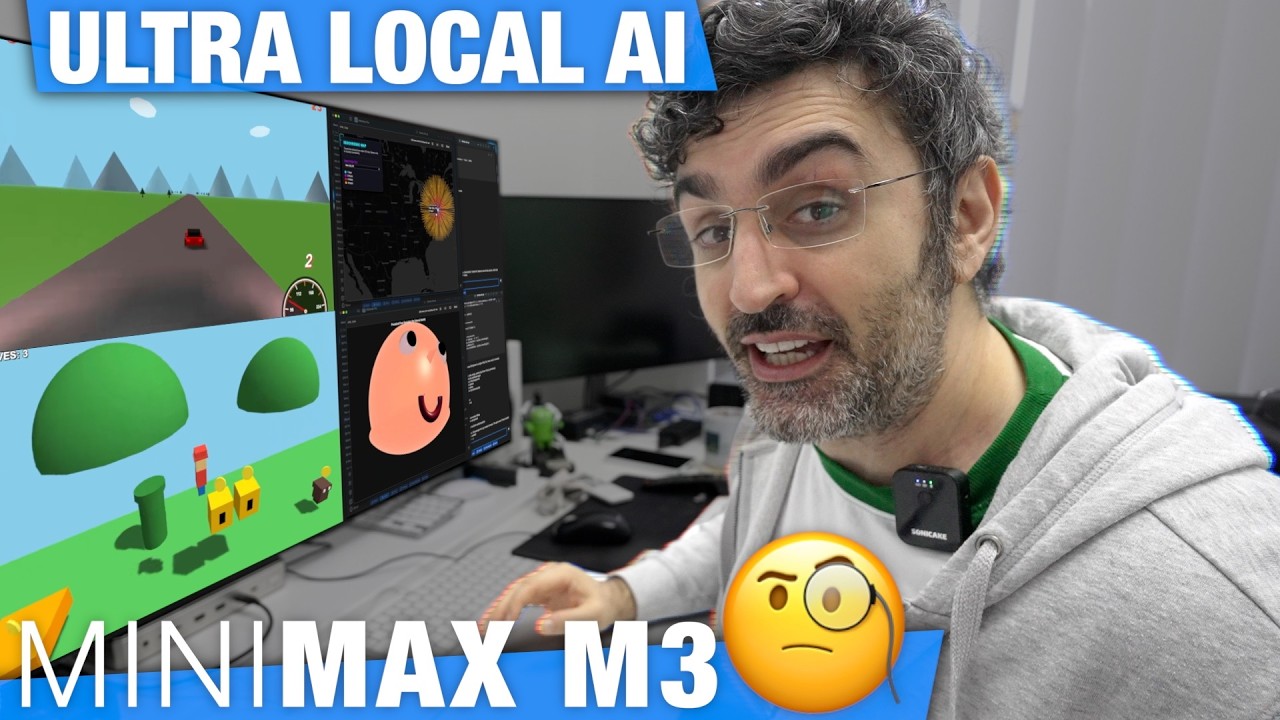
The video explores the capabilities and performance of the MiniMax M3 AI model, comparing it extensively with its predecessor MiniMax M2.7 and other large models like Qwen, GLM, and Opus. The M3 version is significantly larger and slower but introduces enhanced image understanding capabilities, allowing it to process and interpret images rather than just generate text. Benchmarks suggest that M3 outperforms several prominent models, although the presenter remains cautious about these claims. The licensing terms are noted as somewhat restrictive, particularly regarding commercial use, which viewers are advised to consider carefully.
In practical tests, MiniMax M3 demonstrates improved visual understanding by generating 3D voxel animations from images, such as cats and bears, with varying levels of “thinking” modes that influence the quality and complexity of outputs. While M3 is slower than M2.7, it produces more detailed and coherent results, especially when adaptive or enabled thinking modes are used. However, some animations show imperfections like z-fighting or disconnected body parts, indicating room for refinement. The model also struggles with certain tasks like piano generation and Flappy Birds, where outputs are often broken or incomplete.
The video further showcases MiniMax M3’s ability to generate photorealistic human faces and complex Minecraft-like environments, with mixed results. M3 tends to produce more tokens and requires more memory, but its adaptive thinking mode helps it avoid repetitive loops and enhances output quality. The presenter highlights that while M3 is slower and more resource-intensive, it offers richer and more nuanced generations compared to M2.7. Some tests, such as procedural planet generation and city visualization, reveal bugs and slow performance, but also demonstrate the model’s potential for creative and interactive content.
Gaming-related tests like recreations of classic games Outrun and Super Mario show that MiniMax M3 can produce playable, though imperfect, versions with basic mechanics and animations. The model’s ability to handle complex tasks like map visualizations and UI generation is also explored, revealing improvements over M2.7 but still facing challenges with speed and functionality. The presenter notes that M3’s large token context window allows for extensive reasoning and code generation, though sometimes at the cost of verbosity and slower response times.
In conclusion, the MiniMax M3 represents a significant step forward in AI model capabilities, particularly with its vision integration and adaptive thinking modes. While it is slower and more resource-demanding than its predecessor, it delivers more sophisticated and varied outputs, positioning itself well among large open-source models. The presenter expresses mixed feelings, appreciating the intelligence gains but missing the speed of M2.7. The video ends with an open question about the model’s licensing and commercial use, inviting viewers to share insights and thoughts on MiniMax M3’s future potential.