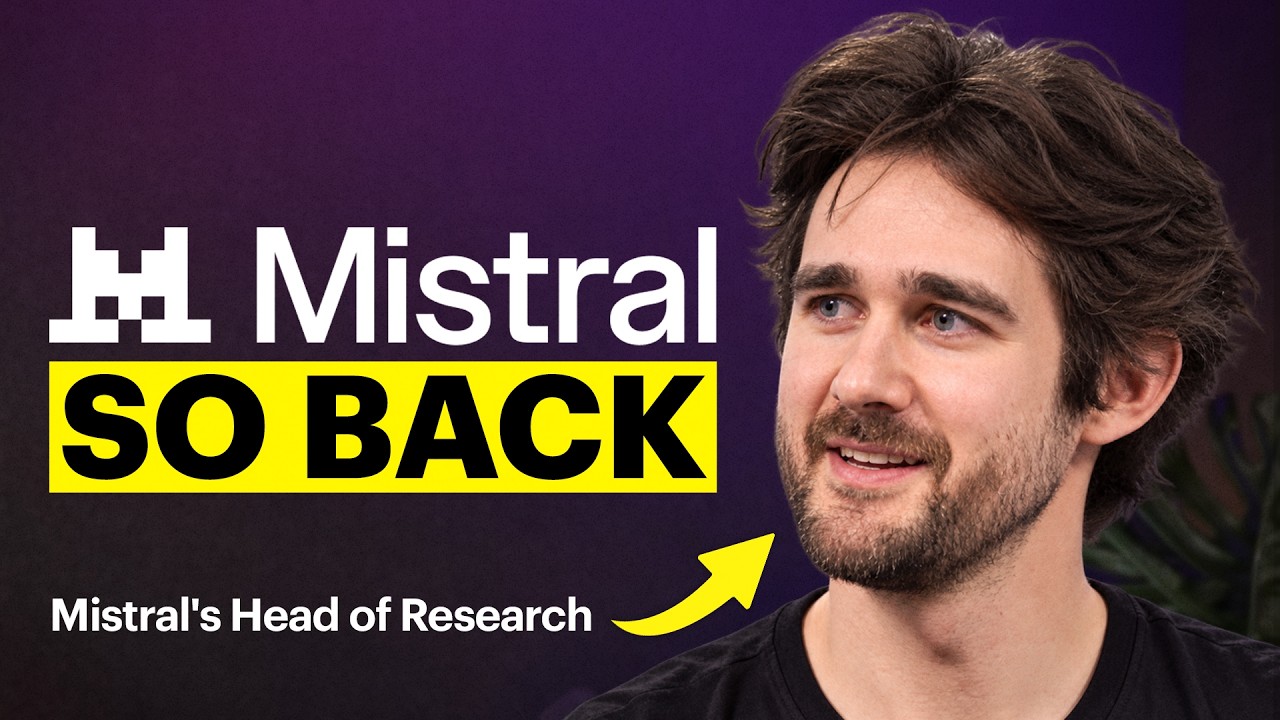
The discussion centers on Mistral’s significant comeback in the Western open-source AI landscape with their latest model, Mistral 4 (nicknamed LChonk or Lunk), a trillion-parameter mixture of experts (MoE) model trained on 3,800 Nvidia Grace Blackwell GPUs in their own European data centers. The conversation highlights the structural shift in open-source AI, moving beyond the previously dominant Chinese models to a more diverse ecosystem including Western contributions. Mistral emphasizes the importance of open-weight models for AI sovereignty, likening AI access to electricity, where reliance on a few closed-source providers risks control and continuity.
Mistral’s approach combines frontier research with robust infrastructure, enabling them to train large-scale models efficiently despite using less compute than some competitors. Their proprietary data centers provide technical and regulatory advantages, allowing close collaboration between compute and research teams to optimize training throughput and stability. The company balances open-weight models with some closed-source capabilities, particularly carving out sensitive features like cybersecurity, while maintaining a commitment to openness to foster community research and innovation.
The core architecture of Mistral 4 is a mixture of experts model, which activates only a subset of parameters per token, enabling a trillion-parameter capacity with inference costs similar to a much smaller dense model. This design requires sophisticated training techniques to manage issues like dead experts and token routing, but offers significant advantages in scalability and performance. Mistral also integrates native multimodal capabilities, training the model from scratch on both text and images to excel in complex domains such as satellite imagery and industrial manufacturing.
Reinforcement learning (RL) plays a crucial role in Mistral’s training pipeline, enhancing the model’s ability to reason, code, and perform domain-specific tasks like cybersecurity and finance. The RL process is carefully calibrated to present problems of appropriate difficulty, rewarding partial progress and penalizing undesirable behaviors such as infinite loops. Despite ongoing RL training post-release, Mistral has already demonstrated strong performance, with RL helping to amplify existing capabilities and discover new behaviors. The company also invests heavily in synthetic data generation to overcome limitations in available training data.
Finally, Mistral’s vision extends beyond flagship models to specialized AI solutions like time series forecasting and OCR, supporting diverse industrial applications. They emphasize a culture of ownership and continuous improvement, drawing on their roots at FAIR and European research talent. Looking ahead, Mistral 5 is already in pre-training, aiming to push boundaries further with enhanced agentic capabilities for cybersecurity, engineering, and finance. The company remains committed to open-weight principles, transparency, and empowering users to maintain sovereignty and security in AI deployment.