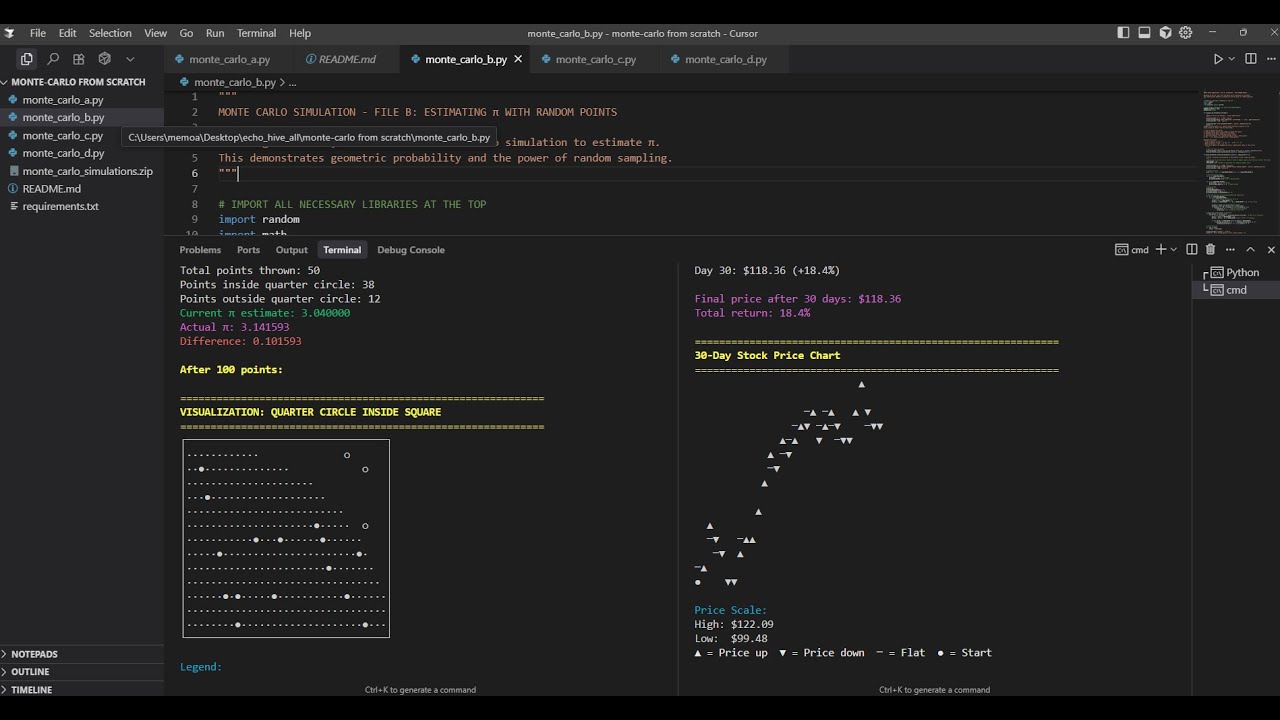
The video provides a clear introduction to Monte Carlo simulations, illustrating their use in estimating probabilities and mathematical constants through random sampling, and explaining key statistical concepts that underpin their reliability. It also demonstrates advanced applications in financial modeling, showing how simulations of stock price movements help assess risks and expected returns in uncertain markets.
The video provides an engaging introduction to Monte Carlo simulations, explaining their purpose and demonstrating their applications through various examples. Monte Carlo simulation is described as a method that uses random sampling to solve complex problems and estimate probabilities when direct calculation is difficult. The video begins with a simple example of simulating rolls of a fair six-sided die, showing how increasing the number of rolls leads to a distribution that closely matches the expected probability of each outcome, illustrating the law of large numbers.
Next, the video explores estimating the value of pi using a Monte Carlo method involving throwing darts at a square with an inscribed quarter circle. By counting how many darts land inside the quarter circle versus the total number thrown, the simulation approximates pi. The accuracy improves as the number of darts increases, demonstrating convergence and the reduction of error with larger sample sizes. This example highlights how Monte Carlo simulations can approximate mathematical constants through random sampling.
The video then delves into statistical concepts fundamental to Monte Carlo simulations, such as sample mean, variance, standard deviation, and the law of large numbers. Using dice rolls and coin flips, it shows how the sample mean approaches the true mean as the number of trials increases, and how variance measures the spread of results around the mean. These concepts explain why Monte Carlo simulations become more reliable with more samples and how statistical confidence intervals help quantify the certainty of the results.
In the final and most advanced section, the video demonstrates how Monte Carlo simulations are applied to stock market modeling through random walks and geometric Brownian motion. It explains that stock prices follow statistical patterns rather than predictable paths, with daily price changes modeled as random variables influenced by factors like volatility, drift (long-term trend), and normal distribution of returns. By running thousands of simulations of stock price paths over time, one can estimate expected returns, risks, and probabilities of various outcomes, which is a common practice in finance for portfolio risk analysis and option pricing.
Throughout the video, the presenter emphasizes the practical value of Monte Carlo simulations in diverse fields, from simple probability estimation to complex financial modeling. The accompanying code files are made available on Patreon, along with additional resources and consulting services. The video encourages viewers to explore Monte Carlo methods further, highlighting their power in understanding uncertainty and making informed decisions based on statistical analysis.