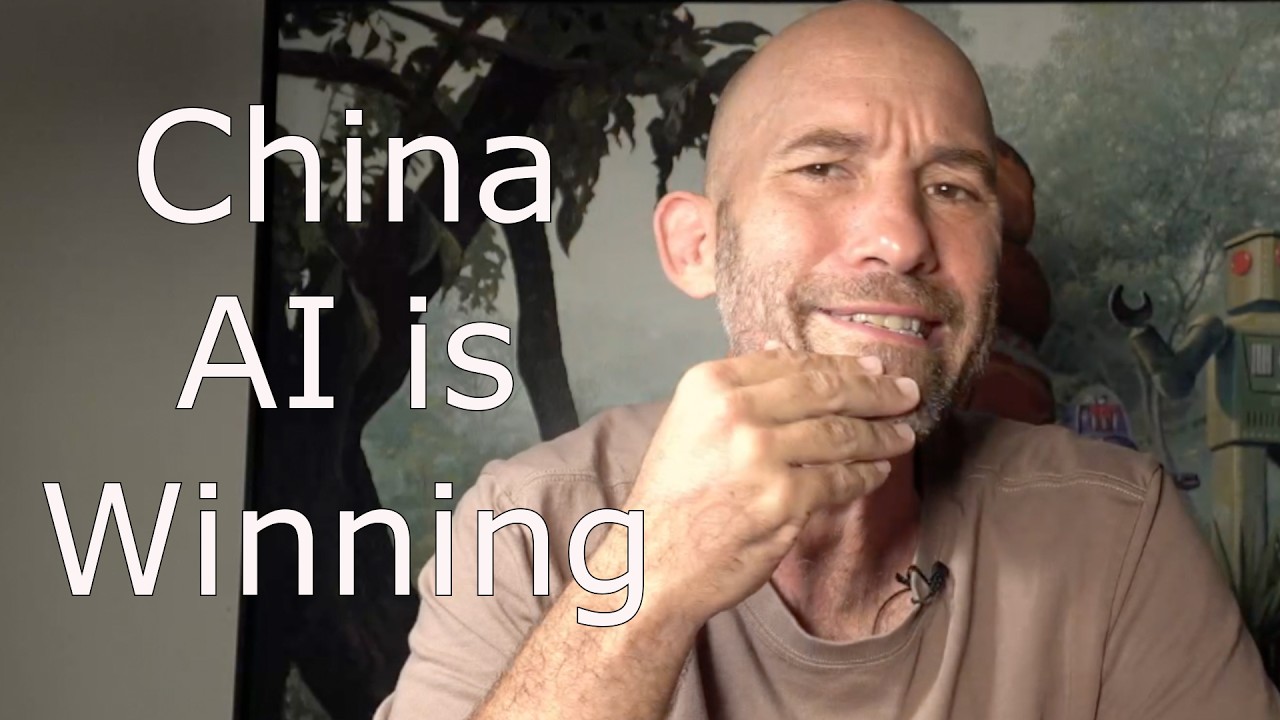
China’s Moonshot AI has developed the open-source Kimmy K3 model with 2.8 trillion parameters, outperforming leading American AI models like Claude Fable 5 and GPT 5.6, signaling a shift in AI dominance and raising concerns among U.S. policymakers. The video critiques the American AI ecosystem’s political and regulatory challenges, advocates for transparency and control through open-source alternatives, and questions the high valuations of U.S. AI startups amid China’s rapid technological advancements.
The video discusses the recent breakthrough by China’s Moonshot AI with their Kimmy K3 model, which has outperformed leading American AI models like Anthropic’s Claude Fable 5 and OpenAI’s GPT 5.6 in several benchmarks. Notably, Kimmy K3 is an open-source model boasting 2.8 trillion parameters, potentially making it the largest open-weight model once fully released. This development signals a significant challenge to the dominance of American AI companies and highlights China’s growing prowess in AI technology, which is causing concern among U.S. policymakers and industry leaders.
The speaker reflects on the ongoing AI competition between the U.S. and China, criticizing the American political mindset that tries to limit China’s technological progress out of fear. He suggests that Chinese developers continue to work diligently without being deterred by political pressures, while American companies and politicians struggle with internal chaos and regulatory uncertainty. This dynamic is leading some American and international tech professionals to consider adopting Chinese open-source AI models, which offer greater transparency, control, and predictability compared to the opaque and politically fraught American AI ecosystem.
A key point raised is the skepticism toward OpenAI and its CEO Sam Altman, especially given recent controversies and the company’s ambition to become a utility-like service for all intelligence needs. The speaker warns against blindly trusting centralized AI providers, emphasizing the importance of risk mitigation, transparency, and control in deploying AI systems. He notes that many CIOs and CTOs worldwide are increasingly wary of relying solely on American AI stacks and are instead exploring Chinese alternatives that they can manage more effectively.
The video also critiques the obsession with benchmarking AI models, arguing that small performance differences are less important than practical considerations like scalability, disaster recovery, and resource management. The speaker compares the current AI landscape to the database market, where multiple solutions coexist and the best choice depends on specific needs rather than headline performance metrics. He suggests that frontier AI models have reached a level of maturity where incremental improvements matter less, and open-source models like Kimmy K3 are already competitive enough for most real-world applications.
Finally, the speaker questions the lofty valuations of American AI startups like OpenAI and Anthropic, especially in light of China’s rapid advancements and the broader economic context. He points out that while companies like SpaceX have seen their stock prices decline post-IPO, Chinese AI firms are quietly gaining ground with powerful open-source models. The video ends by inviting viewers to reflect on the implications of these developments for the future of AI and global technological leadership, highlighting the shifting balance of power in the AI industry.