The video explores the capabilities and limitations of the MOSS-Image-SFT model, a recently released open-source image generation model designed to create complex scenes from detailed text prompts. The presenter tests the model by generating an image of about 35 women on a superyacht deck using a highly detailed JSON prompt that specifies body types, hair styles, outfits, seating arrangements, and even hidden tiny text on two shirts. The model, a supervised fine-tuned version of the base MOSS-Image model, boasts a 5 billion parameter backbone and supports prompts up to 4,000 tokens, with claims of strong layout control and text rendering.
Running the model requires substantial GPU resources due to its size—27 GB for the weights alone—and the computational cost of 50 steps with two transformer passes per step, effectively doubling the workload. The presenter’s laptop with an RTX 4060 and 8 GB VRAM was insufficient to run the model comfortably, recommending instead a 48 GB GPU like the RTX A6000 or A40 for smooth operation. Using a cloud GPU rental service, the presenter ran the model at 1536x1024 resolution, which took about 125 seconds per image and cost roughly 2 cents per image, demonstrating that while expensive for casual use, it is affordable for occasional testing or batch runs.
The generated images largely met expectations, with accurate crowd size, natural group layouts, distinct faces, and detailed scene elements such as clothing and background. The model handled complex crowd scenes well, maintaining believable photorealism and diverse poses. However, some minor issues appeared, including overly glossy skin textures and less detailed anatomy for figures farther from the camera. The model also struggled with the tiny text Easter egg embedded in the prompt, failing to reproduce the exact phrase “plasm zero” on the shirts, instead generating approximate or mirrored text in plausible locations, highlighting a weakness in rendering small, precise text within dense scenes.
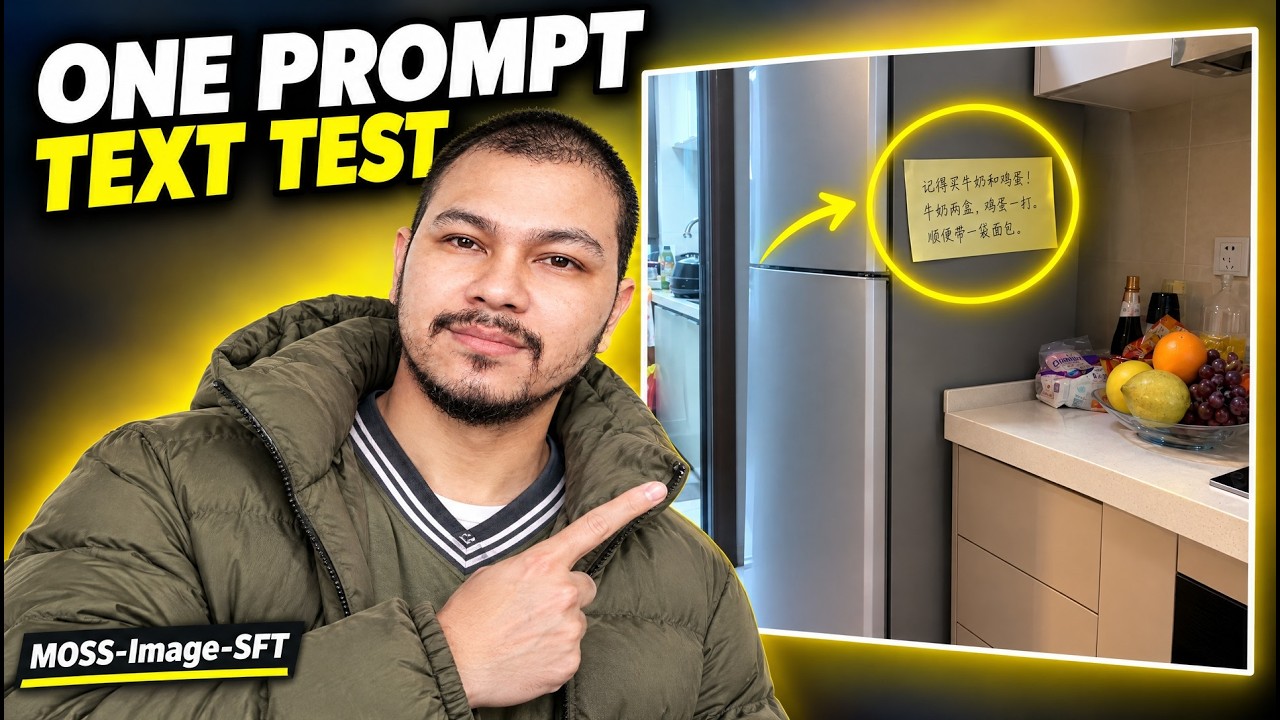
Additional tests with simpler prompts, such as a refrigerator with a handwritten Chinese sticky note, showed the model’s strength in rendering clear and accurate text when the text is larger and less crowded. The presenter also discussed the model’s ecosystem, mentioning community efforts like distilled versions with fewer steps, fine-tuning tools requiring less VRAM, and a ComfyUI plugin for easier integration and offloading on smaller GPUs. These developments suggest growing accessibility and optimization options for users with varying hardware capabilities.
In conclusion, MOSS-Image-SFT is a powerful open-source model capable of generating complex, photorealistic crowd scenes with strong text rendering for larger text, but it requires high-end hardware or cloud resources to run effectively. Its main weaknesses lie in rendering tiny text within busy scenes and some minor visual polish issues. The model’s Apache 2.0 license and active community support make it a promising tool for professional and creative use, especially for those who can leverage its detailed prompt capabilities and layout control. The presenter invites viewers to suggest other models for comparison and recommends RunPod for affordable GPU rentals.
Useful Links