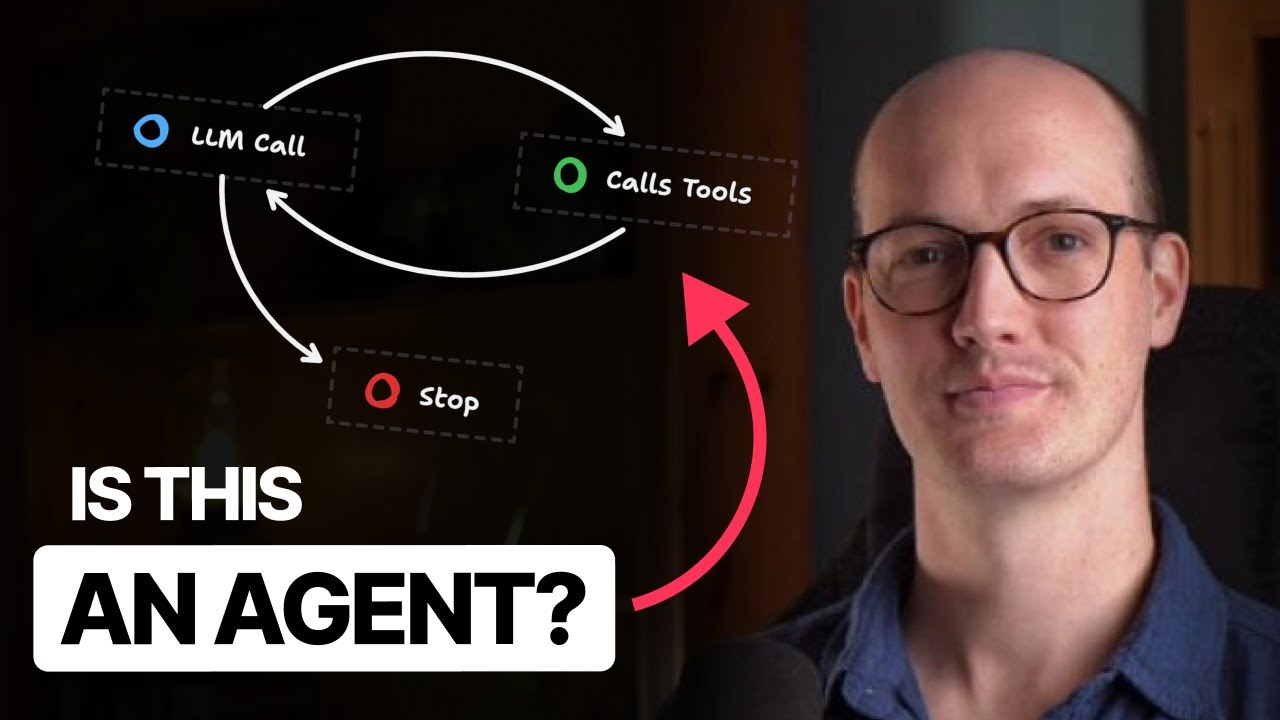
The video discusses the recent introduction of OpenAI’s Agent Kit, a toolset designed to help developers and enterprises build, deploy, and optimize agents. While the presenter finds the product itself not particularly compelling for personal use, they are intrigued by how OpenAI defines “agents.” The presenter argues that what OpenAI calls an agent is more accurately described as a workflow—a series of deterministic steps with predetermined code paths—rather than a true agent. This sparks a broader discussion about the difference between agents and workflows, highlighting that the AI community has not yet settled on a universal definition.
To clarify the distinction, the presenter references Anthropic’s influential article “Building Effective Agents,” which defines an agent as a loop where the language model (LLM) decides when to stop, continuously calling tools and updating its knowledge based on new information. In contrast, workflows are linear, predetermined sequences of steps without loops, where the flow is directed by code rather than the LLM. Workflows can include conditional logic and parallel processing, making them highly optimizable since the entire path is known upfront.
The key difference between agents and workflows lies in who controls the stopping condition. In agents, the LLM itself decides when to stop, making them well-suited for tasks where the solution path is unclear or requires improvisation, such as coding assistants that must adapt to diverse codebases and problems. Workflows, on the other hand, are ideal when the solution path is known and repetitive, allowing for optimization and efficiency, akin to classical music compared to the improvisational nature of agents, which are likened to jazz.
The presenter also emphasizes that agents and workflows exist on a spectrum rather than as strict categories. Many systems blend elements of both, such as agents that incorporate workflows as tools or workflows that include loops. Practical implementations often include safeguards like maximum step limits to prevent agents from running indefinitely. Understanding this spectrum helps developers think about AI system design in terms of patterns and trade-offs, rather than rigid definitions.
Finally, the presenter expresses some frustration with the inconsistent use of the term “agent” in the AI community, advocating for clearer definitions like those proposed by Anthropic. They believe that maintaining a clear distinction between agents and workflows is valuable for teaching, communication, and building effective AI systems. The video concludes with a brief mention of the presenter’s upcoming project, aihero.dev, which aims to combine AI and TypeScript to empower developers to create powerful AI applications.