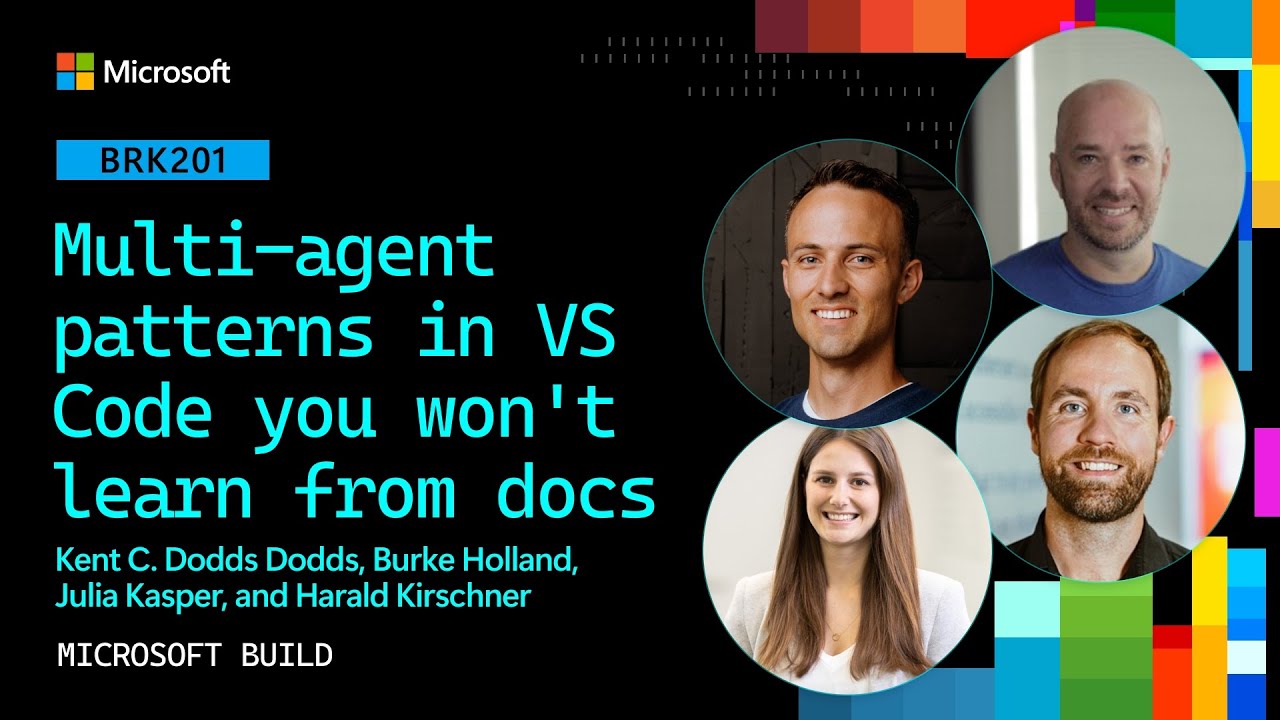
The video presents a live coding competition focused on building a cloud-based collaborative markdown editor using multi-agent patterns in Visual Studio Code (VS Code). The hosts introduce the contestants, each using different tools and approaches such as VS Code local agents, Copilot CLI, the new Copilot app, and the agent app. The challenge is inspired by a real user need for a Google Docs-like collaborative markdown editor, emphasizing practical problem-solving with AI rather than simple game projects. The hosts also plan to build a voting app to let the audience vote on the best solution.
The competition kicks off with the hosts discussing the development environment and approach. They emphasize iterative development, starting with a minimal homepage and gradually adding features like QR code access for mobile voting. The hosts highlight the benefits of using AI agents for rapid prototyping and iterative design, noting that AI allows developers to start vague and refine the product through conversation and feedback. They also discuss technical challenges such as integrating QR code generation and ensuring real-time updates via WebSockets.
Throughout the session, the contestants share their progress and strategies. Julia from the VS Code team uses GPT-5.5 with high reasoning to scaffold her app, focusing on user experience features like split-screen editing and edit tracking. Chris employs an orchestrator agent pattern with GPT-5 and codecs for implementation, working in the CLI with multiple tabs. Pierce uses the new Copilot app to build a markdown editor with real-time collaboration and emoji support, while Harold takes a research-driven approach, combining multiple agents to prototype and refine the design and architecture.
As the competition nears its end, the hosts demonstrate the voting app they built, which allows attendees to vote for their favorite contestant’s solution via a QR code. They discuss the importance of persistence and real-time synchronization in the voting system, opting for a JSON file backend and planning WebSocket integration. The contestants present their final demos, showcasing various features such as live collaboration, user avatars, commenting, and activity logs. The audience actively participates in voting, with Harold emerging as the winner based on the votes.
The session concludes with reflections on the power of AI-assisted development and agent-based workflows. The hosts highlight how AI enables rapid iteration, design exploration, and collaborative coding, transforming traditional software development. They encourage attendees to explore related sessions on GitHub Copilot and agent development, emphasizing the evolving landscape of AI tools in programming. The event wraps up with gratitude to the participants and audience, celebrating the innovative solutions created during the competition.