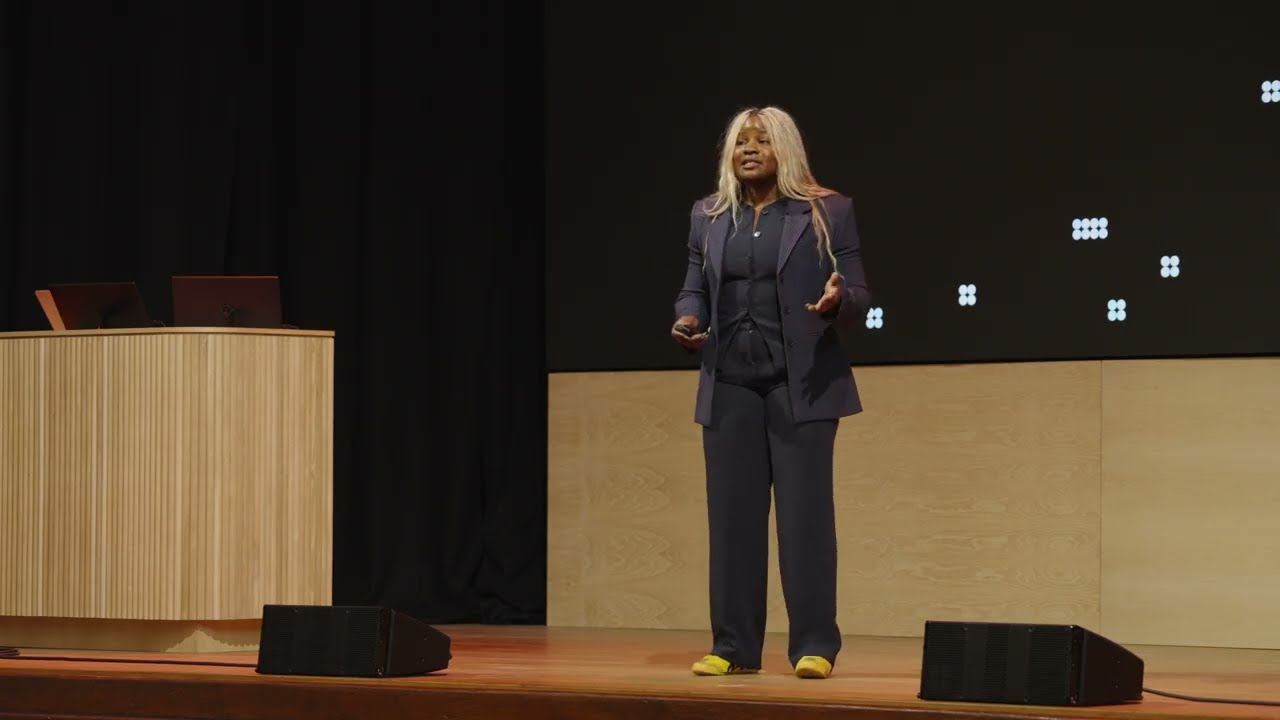
Stephanie Anani, a Solutions Engineer at OpenAI, discusses how AI, particularly ChatGPT, can significantly enhance individual workforce productivity by automating repetitive tasks that do not require human judgment. She emphasizes that AI frees employees to focus on higher-value work, increasing their operating capabilities. A recent survey highlighted that 75% of ChatGPT users achieved tasks they previously could not, demonstrating AI’s potential to elevate job performance beyond mere speed improvements.
Stephanie outlines five key dimensions necessary for employees to maximize AI benefits, focusing specifically on why ChatGPT is ideal for financial services. Central to this is access to trusted, up-to-date information, which OpenAI supports through app connectors to reputable financial data sources like Dow Jones, LSEG, and S&P. Recognizing the importance of Excel in financial workflows, OpenAI has integrated ChatGPT directly into Excel, allowing users to interact with spreadsheets using natural language commands. These capabilities are powered by the advanced GPT-5.5 model, which uniquely embeds financial services processes within its intelligence, validated through the OpenAI Banker Bench benchmarking tool.
In a practical demonstration, Stephanie role-plays as an investment analyst tasked with preparing for an investment committee meeting. She uses ChatGPT to gather comprehensive context on a company, QXO, pulling in trusted sources such as SEC filings and earnings transcripts to create a detailed investment dossier. ChatGPT then helps translate this research into a financial model by generating an Excel workbook tailored to Blossom Bank’s specific three-statement modeling approach, complete with formulas and audit comments, enabling transparency and ease of review.
Further, Stephanie shows how ChatGPT can quickly analyze different investment scenarios—bear, base, and bull cases—by processing contextual inputs and delivering summarized insights and key financial metrics. This rapid turnaround, which traditionally would take hours or days, now happens in minutes, allowing financial professionals to keep pace with fast-moving markets. The final step involves transforming the analysis into a polished presentation deck using a custom skill that aligns with the bank’s preferred style, complete with charts and presenter notes that explain decision rationales, ensuring clarity and auditability.
Overall, Stephanie highlights that AI is not a replacement for human judgment but a powerful tool that automates routine tasks and accelerates workflows. By integrating trusted data, advanced modeling, and presentation capabilities, ChatGPT empowers financial professionals to make informed decisions more efficiently. This end-to-end AI-driven process—from research to modeling to decision presentation—demonstrates how AI can multiply workforce impact and drive business value in financial services.