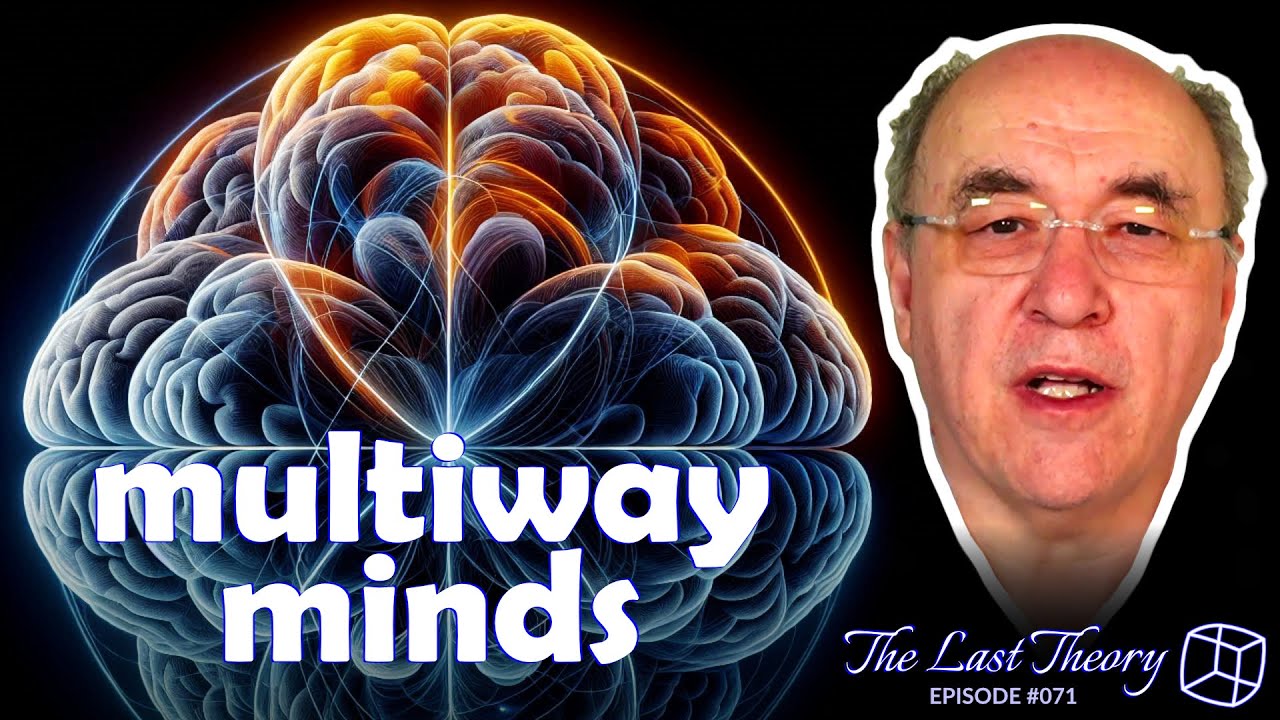
In the video, Stephen Wolfram explores the concept of a “multi-way mind,” a state in which multiple threads of history or possibilities coexist and interact. He explains that in many cases, different sequences of events or operations can merge back into the same outcome, making it easy to think in terms of a single, unified history. However, there are exceptional situations, akin to Schrödinger’s cat in quantum mechanics, where the divergence in possible outcomes is so significant that choosing one branch over another leads to fundamentally different realities. This creates a challenge for the mind to reconcile or hold multiple conflicting experiences simultaneously.
Wolfram suggests that most humans typically do not maintain awareness of multiple divergent threads of experience at once. If we could, our understanding of phenomena like quantum computing would be radically different, as we would perceive answers not as single definitive outcomes but as a collection of all possible histories. This idea has practical implications in computing, where Wolfram Language incorporates constructs that handle multiple threads of history as manipulable objects, only resolving them into a single answer at the end. This approach offers a new way to conceptualize and work with complex, branching processes.
A particularly intriguing application of the multi-way mind concept arises near black holes, specifically at the entanglement horizon. Wolfram describes how, at this boundary, the usual process of merging historical threads breaks down, preventing the formation of classical, definitive thoughts. Observers or minds at this horizon become stuck in a state where time appears to freeze, and it becomes impossible to determine which branch of history was followed. This phenomenon parallels the idea that from an outside perspective, nothing ever truly falls into a black hole but instead appears frozen at its surface.
Despite these extreme cases, Wolfram notes that most of the time, minds successfully form classical thoughts by converging on a single thread of experience. He extends this idea to collective consciousness, such as societies, which aggregate individual decisions into collective outcomes. The comparison between decision-making at the neuronal level and at the societal level raises fascinating questions about how consciousness and consensus emerge from complex networks of interacting agents.
Finally, Wolfram highlights the potential of modern AI as a model system to explore these ideas further. Unlike biological brains, AI systems allow researchers to observe and manipulate individual elements and their interactions more transparently. This capability provides a valuable opportunity to study how multi-way minds might function, how decisions form from multiple possibilities, and how collective consciousness might arise, offering new insights into both fundamental science and practical computing.