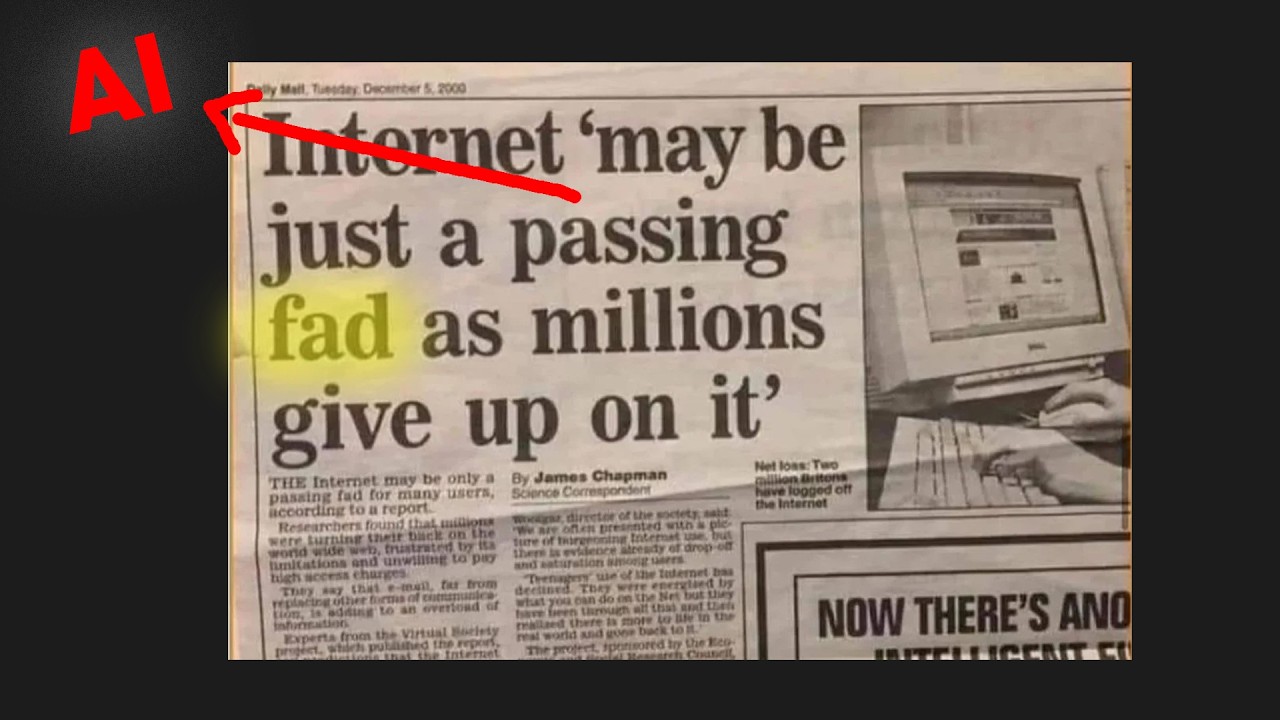
The speaker begins by expressing frustration with the challenges faced while trying to record the video, including technical issues and personal discomforts like sunburn and a stretched shirt collar. They introduce the topic of AI skepticism, clarifying that their critique is directed at Thomas’s friends who dismiss AI as a fad, comparing this skepticism to past dismissals of the internet. The speaker emphasizes that AI, particularly large language models (LLMs), is a significant technological advancement, unlike fleeting trends like NFTs, which lacked substantial practical use cases.
The core of the discussion revolves around the current state and potential of AI-assisted programming. The speaker highlights how companies like Microsoft, Nvidia, and others are investing billions into AI, contrasting this with the hype around NFTs. They argue that AI’s impact is more akin to the internet’s transformative effect rather than a passing craze. The speaker also stresses that many talented developers are already using advanced AI agents that can read codebases, run tests, and author files, making AI a powerful tool for boosting productivity and handling tedious tasks.
A significant portion of the video is dedicated to debunking misconceptions about AI in coding, such as hallucinations and trustworthiness. The speaker claims that hallucination issues are largely solved in the context of coding, where AI systems rely on fixed syntax and specific programming paradigms. They advocate for responsible use—reviewing and understanding AI-generated code—and emphasize that developers remain responsible for the quality and security of their code, regardless of AI assistance. The importance of integrating AI into workflows to handle mundane or repetitive tasks is underscored as a way to free human developers for more meaningful work.
The speaker also discusses broader societal and industry implications, including the displacement of jobs and the importance of adapting to AI-driven changes. They criticize the hypocrisy of some industry professionals who oppose AI’s impact on creative and technical fields while benefiting from it themselves. The conversation touches on issues like intellectual property, piracy, and the cultural value of art, noting that AI-generated content often blurs lines of originality and ownership. They argue that AI’s ability to produce “good enough” work is a positive force that raises the baseline quality of code and art, even if it doesn’t replace human creativity entirely.
In conclusion, the speaker advocates for a pragmatic and realistic approach to AI, emphasizing its inevitability and utility in software development and beyond. They dismiss exaggerated fears of AGI and stress that AI is a tool that, when used responsibly, can significantly enhance productivity and innovation. The overall message is that AI is here to stay, and industry professionals should embrace it rather than resist, focusing on how to leverage its capabilities to solve practical problems and improve their work. The video ends with a nod to Thomas’s insightful article and a call for more rational discussions about AI’s role in society.