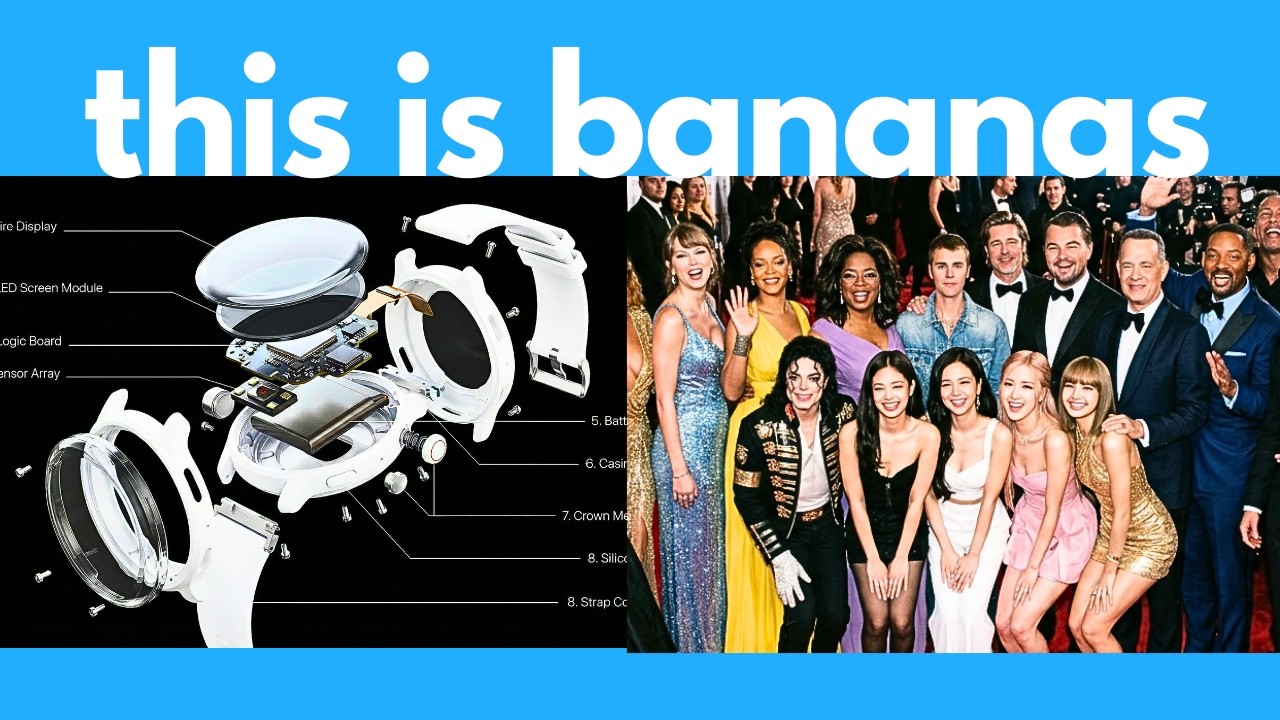
Google has released NanoBanana 2, a major upgrade to its image generation and editing model, now available for free on platforms like the Gemini app and Google AI Studio. Compared to the previous NanoBanana Pro, NanoBanana 2 is significantly faster, offers improved world understanding, better consistency, and stronger adherence to prompts. The video demonstrates NanoBanana 2’s capabilities through a series of challenging tests, including generating group selfies of celebrities and cartoon characters, handling complex prompts, and producing images with multiple references. The model excels at recognizing and accurately depicting a wide range of real and fictional characters, even in crowded or stylistically diverse scenes.
The video puts NanoBanana 2 through a variety of difficult tasks to test its limits. These include generating grids of human emotions, Pokémon by Pokédex number, and “Where’s Waldo?”-style images filled with meme characters. While NanoBanana 2 generally outperforms its predecessor in realism and prompt-following, both models struggle with extremely niche or ambiguous prompts, such as rare Pokémon or endangered frog species. In some cases, NanoBanana Pro produces more detailed or accurate results, especially for highly complex or data-driven tasks.
NanoBanana 2’s editing capabilities are also showcased, such as filling out worksheets with realistic handwriting, solving math problems, colorizing and translating manga pages, and converting data tables into charts. The model demonstrates strong performance in tasks like handwriting simulation and translation, but sometimes makes errors in labeling or data visualization. NanoBanana 2 is particularly praised for its speed and ability to handle multiple reference images, as well as its new support for panoramic aspect ratios up to 4:1 and 8:1, enabling the creation of ultra-wide images.
The video also discusses NanoBanana 2’s technical foundation, noting that it is based on Gemini 3.1 Flash, which prioritizes speed over the slightly higher quality of the Pro version. Despite this, NanoBanana 2 maintains high image quality and prompt adherence, making it suitable for most creative and professional uses. The model is ranked number one for text-to-image generation on independent leaderboards and is also more affordable than its predecessor. However, for image editing tasks, NanoBanana Pro sometimes retains an edge in accuracy.
Finally, the video highlights how NanoBanana 2 is seamlessly integrated into Google’s ecosystem, including Gemini and AI-powered Google Search, making advanced image generation accessible to a wide audience. The presenter encourages viewers to try NanoBanana 2 for themselves and participate in an Nvidia GPU giveaway by attending the GTC 2026 event. Overall, NanoBanana 2 is positioned as one of the best and most accessible image generation models currently available, offering a compelling mix of speed, quality, and versatility.