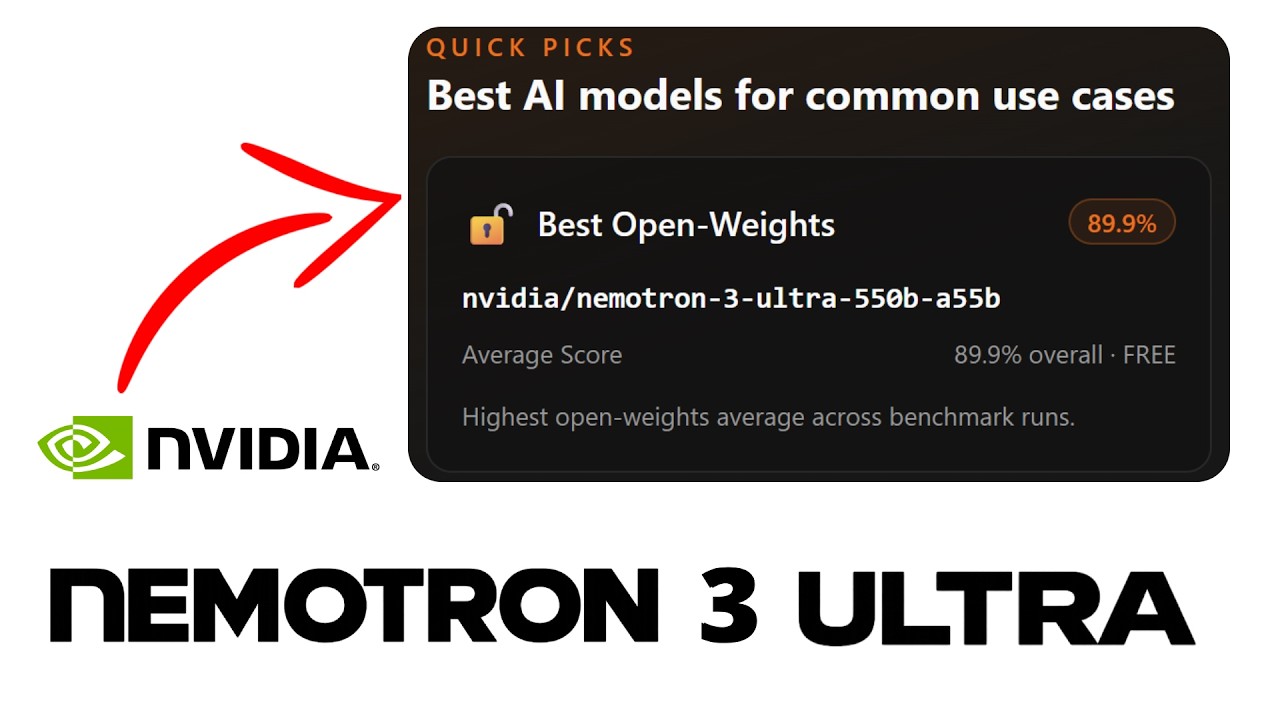
Over the past year, the landscape of open-weight large language models (LLMs) has been dominated by impressive Chinese models like Kimmy, Zim, and Miniax. However, Nvidia has recently introduced the Neotron 3 Ultra, a 550 billion parameter model that outperforms many larger trillion-parameter models on agent benchmarks. What sets Nvidia’s model apart is not just its performance but the transparency in sharing the training recipes and datasets, making it a compelling choice for developers building agent-based applications. This openness allows organizations to fine-tune the model for specific tasks, potentially replacing proprietary models from companies like OpenAI and Anthropic.
Nvidia’s Neotron 3 Ultra is the flagship in their Neotron 3 series, following earlier models like the Nano and Super, which focused on efficiency and multi-agent applications respectively. The Ultra model is a massive mixture-of-experts architecture with 550 billion parameters and 55 billion active parameters, designed specifically for agentic tasks such as coding, tool use, and multi-step reasoning. It aims to compete with leading models from Frontier Labs, Anthropic, and Google’s Gemini Pro, offering a powerful yet more accessible alternative for enterprise use.
A key innovation in Neotron 3 Ultra’s development is the use of multi-teacher policy distillation. Nvidia trains specialized teacher models for tasks like coding, tool use, and instruction following, then distills their knowledge into a single, versatile model. This approach yields a stronger final model than training one model on all tasks simultaneously. Additionally, Nvidia emphasizes post-training on agent harnesses—training the model on task completion trajectories that include error correction and tool usage—further enhancing its agent capabilities. Nvidia also plans to release many of the RL environments and datasets used, benefiting the broader open-source community.
Benchmark results show that Neotron 3 Ultra performs exceptionally well, often surpassing larger models like GLM 5.1 and Kimmy 3.5, especially in agent-focused benchmarks like Pinchbench. While proprietary models like Anthropic’s Claude still lead overall, Nvidia’s model offers a competitive, cost-effective alternative with faster inference speeds. This makes it particularly attractive for companies looking to deploy efficient, customizable agent models at scale without the high costs associated with some proprietary solutions.
In practical demonstrations, the Neotron 3 Ultra excels at reasoning and tool use, supporting features like multi-token prediction and a million-token context window. It integrates seamlessly with OpenAI-style APIs and can be fine-tuned for various agent tasks, including calculator functions and querying GPU specs. The model offers configurable reasoning depth, balancing speed and thoroughness. Overall, Nvidia’s Neotron 3 Ultra represents a significant step forward in open-weight LLMs, combining strong performance, transparency, and flexibility, making it a valuable tool for developers and enterprises building sophisticated AI agents.