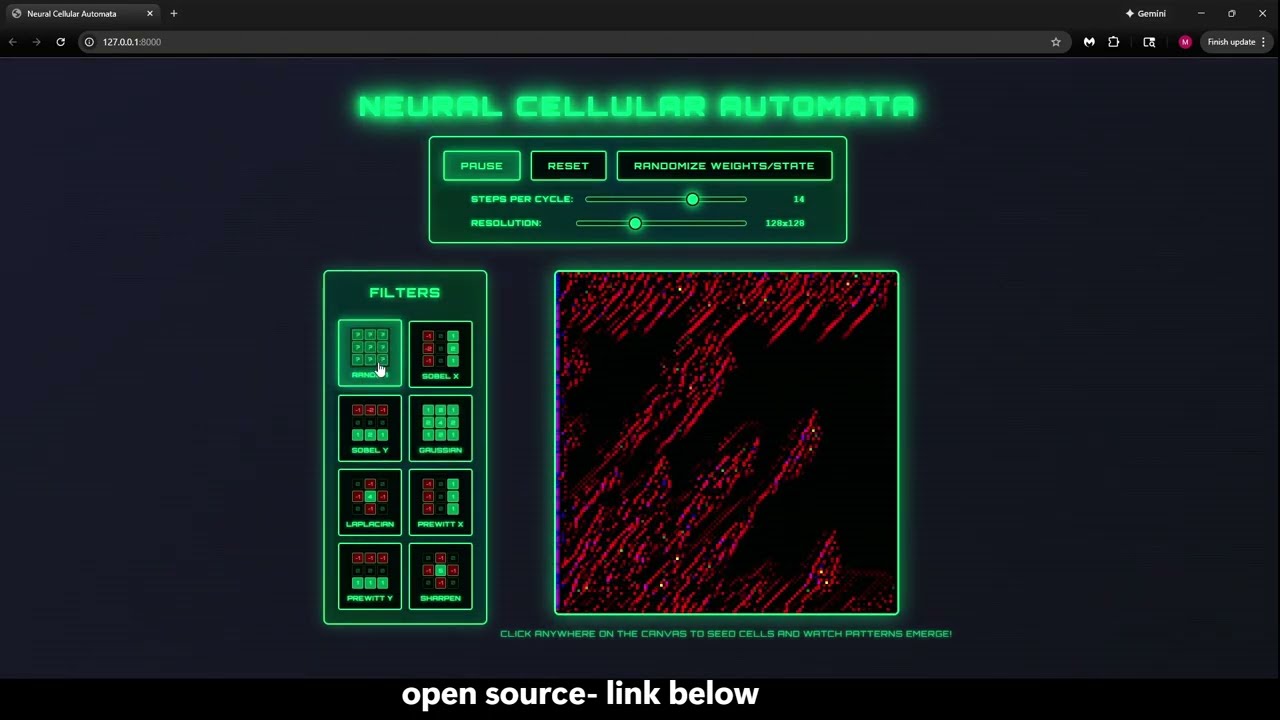
The video showcases how convolutional neural networks can be integrated with cellular automata to create adaptive, self-organizing systems that generate complex patterns and exhibit artificial regeneration, supported by open-source code for experimentation. Accompanied by ambient music, it provides clear explanations of the training process, applications, and broader implications, encouraging collaboration and exploration in this innovative field.
The video titled “Neural Convolutional Cellular Automata - with Music - Open Source” explores the fascinating intersection of neural networks and cellular automata, showcasing how convolutional neural networks can be used to simulate cellular automata behavior. The presenter begins by explaining the basic concept of cellular automata—grids of cells that evolve over discrete time steps according to a set of rules based on the states of neighboring cells. By integrating neural networks, specifically convolutional layers, the system can learn complex update rules that govern the evolution of the automaton, enabling more dynamic and adaptable patterns.
Throughout the video, the presenter demonstrates various examples of neural convolutional cellular automata in action. These examples highlight how the system can generate intricate and self-organizing patterns that resemble natural phenomena such as growth, regeneration, and pattern formation. The use of convolutional layers allows the automaton to process spatial information effectively, capturing local interactions between cells and enabling the emergence of global structures from simple local rules. The visuals are accompanied by ambient music, enhancing the immersive experience of watching these evolving patterns.
The video also delves into the training process of the neural cellular automata. Using open-source code, the presenter shows how the model is trained to reproduce target patterns or behaviors by minimizing a loss function that measures the difference between the current state and the desired outcome. This training enables the automaton to learn robust update rules that can recover from perturbations or damage, demonstrating a form of artificial regeneration. The open-source nature of the project encourages viewers to experiment with the code, modify parameters, and explore new applications.
In addition to the technical aspects, the video touches on the broader implications and potential applications of neural convolutional cellular automata. These systems could be used in fields such as artificial life, procedural content generation, and even biological modeling. Their ability to self-organize and adapt makes them promising tools for simulating complex systems and understanding emergent behaviors. The presenter emphasizes the importance of open-source collaboration in advancing research and innovation in this area.
Overall, the video provides an insightful and visually captivating introduction to neural convolutional cellular automata. By combining neural networks with cellular automata principles, it opens up new possibilities for creating adaptive, self-organizing systems. The inclusion of music and clear explanations makes the content accessible and engaging, inviting viewers to explore the open-source resources and contribute to this exciting field of study.