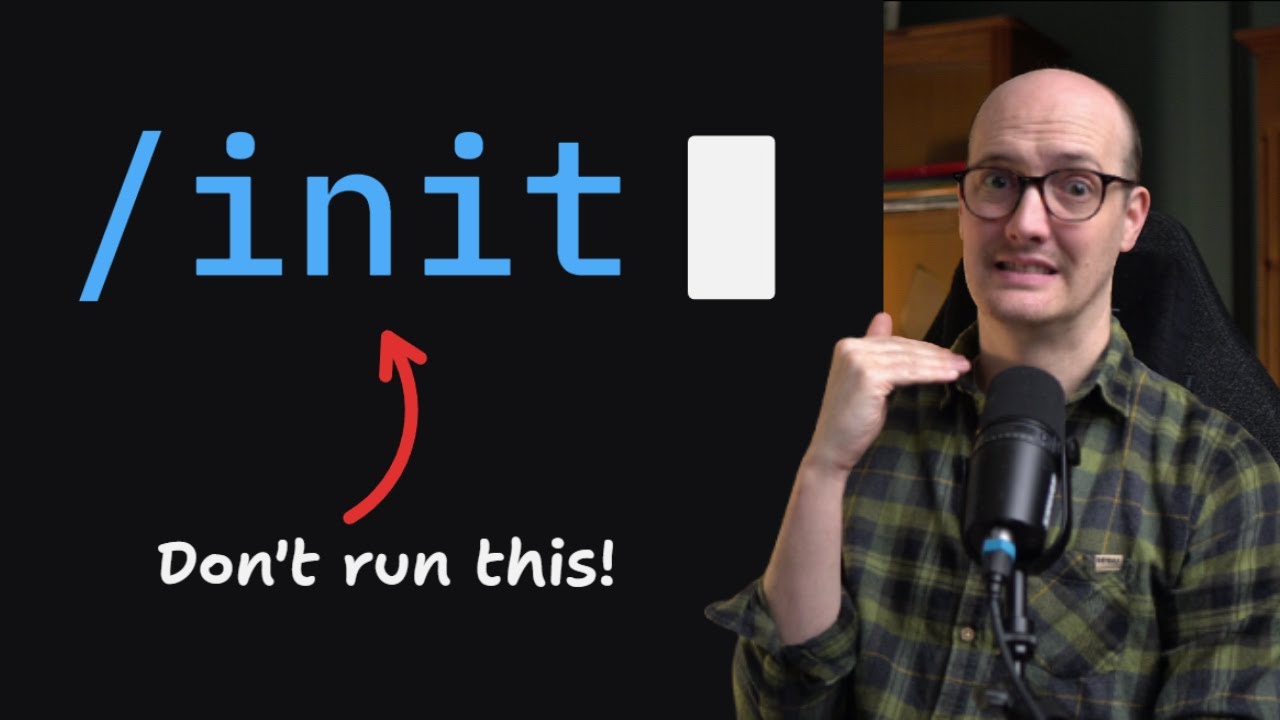
The video warns against using commands like “claude /init” to generate global context files (e.g., claw.md) for coding agents, as these files waste valuable context space, quickly become outdated, and often include unnecessary information. Instead, it recommends keeping the system prompt minimal and letting the agent gather relevant context as needed, reserving global context only for truly essential, non-obvious setup details.
The video strongly advises against running the “claude /init” command or similar initialization commands for coding agents like Claw. The creator explains that these commands generate files such as claw.md or agents.md, which are intended to provide code-based documentation for the agent. However, these files end up consuming valuable tokens, distracting the agent, and quickly becoming outdated. The speaker references a research paper that evaluated the usefulness of repository-level context files for coding agents, concluding that unnecessary requirements from such files actually make tasks harder, and that human-written context files tend to only describe minimal, essential requirements.
To illustrate the point, the creator demonstrates running the init command in a large work repository. The process involves the agent exploring the codebase and summarizing it in a global context file. The video breaks down how an agent uses its context window: part of it is reserved for the system prompt (which includes the contents of claw.md), while the rest is used for exploring the codebase, implementing changes, and testing. The system prompt is inflexible and always present, so anything added to it reduces the space available for actual work and increases costs. The advice is to keep the system prompt as small as possible to maximize efficiency.
The speaker reviews the contents of the generated claw.md file and criticizes it for including trivial or easily discoverable information, such as available commands (which can be found in package.json) and architectural details (which are evident from the codebase itself). The creator points out that much of this information is not needed for every request and that including it globally is wasteful. Furthermore, referencing specific files or implementation details in the documentation is risky, as these can quickly become outdated and conflict with the actual state of the codebase.
The video emphasizes that global context files like claw.md should not be used to store steering instructions or detailed documentation, as these are often irrelevant to most tasks and can overwhelm the agent. Instead, the creator suggests that useful steering information should be placed in “skills” that the agent can access as needed, rather than loading them into the global context by default. The only exception the speaker makes is for truly essential, non-obvious setup information—such as specifying that the environment is WSL on Windows—which can help the agent avoid common pitfalls.
In conclusion, the creator recommends deleting any automatically generated claw.md or agents.md files and relying on the agent’s built-in exploration phase to gather context just in time for each task. This approach keeps the global context lean, reduces token usage, and avoids the problem of documentation rot. The video ends with an invitation to check out the creator’s newsletter and upcoming course for more insights on working with AI coding agents, and encourages viewers to ask questions or suggest future topics.