The video presents Diffuse-cloc, a novel AI animation technique that combines physical realism with user controllability, enabling characters to move naturally and responsively in dynamic environments. This method excels in generalization, smooth pose transitions, and resilience to disruptions, offering a versatile and efficient solution that advances animation for gaming, VR, and robotics without requiring extensive retraining.
The video discusses a groundbreaking new AI animation technique designed to solve one of the hardest problems in animation: creating controllable yet physically realistic character motion. Traditional animation methods require artists to painstakingly craft every motion, while existing AI-based techniques either offer controllability without physical realism or realism without easy control. This new method, called Diffuse-cloc, successfully combines both, enabling characters to move in a way that is both believable and responsive to user input.
Diffuse-cloc is trained on a diverse set of motion capture data without explicit instructions on how to combine or use these motions in new scenarios. Remarkably, it learns to anticipate future movements, much like a dancer who feels the rhythm ahead of time, allowing it to improvise gracefully rather than blindly follow choreography. This results in seamless, natural animations that can adapt dynamically to changing environments and user commands.
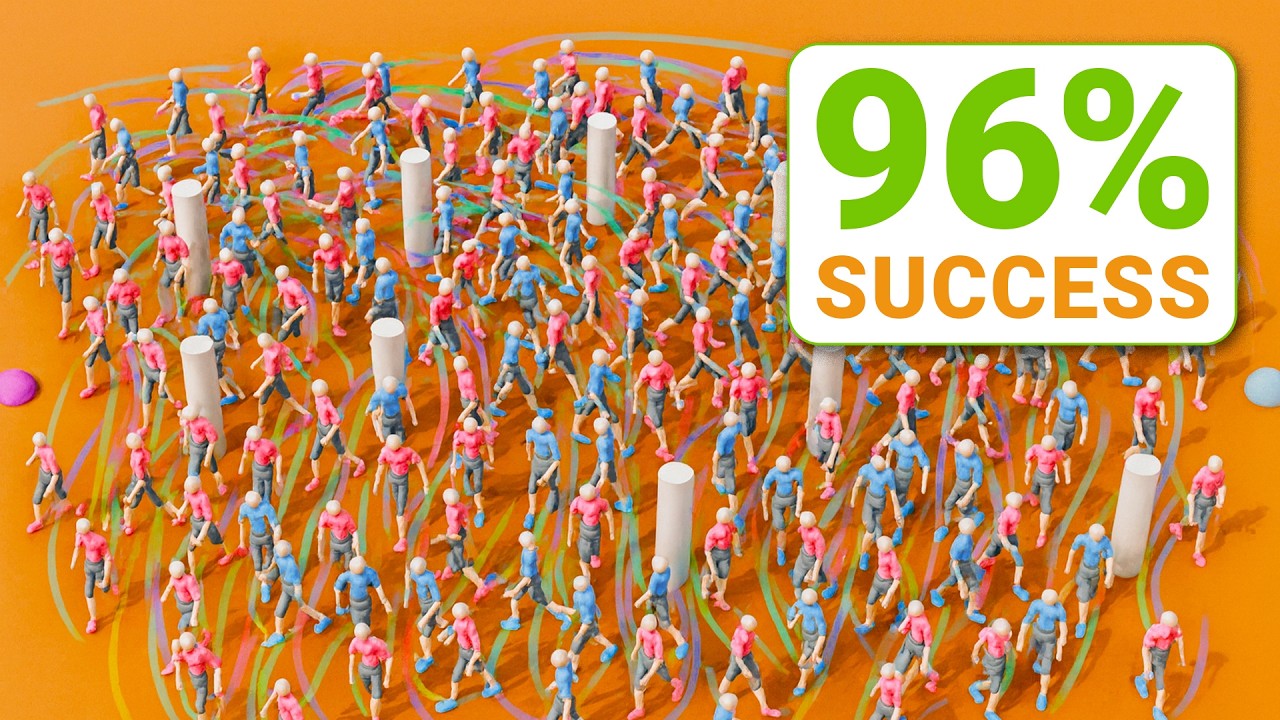
The technique also excels in several impressive capabilities. It can avoid static obstacles like walls, dynamically navigate around other moving characters to prevent collisions, and generate longer animation sequences without losing coherence. One standout feature is its ability to generalize: for example, a character trained only on ground jumps can successfully perform jumps over pillars, demonstrating the AI’s capacity to handle novel situations it has never explicitly seen before.
Another powerful aspect of Diffuse-cloc is its ability to generate smooth transitions between two or more specified poses, a feature not commonly found in other diffusion-based AI animation methods. Additionally, the system shows resilience to external perturbations, maintaining stable and realistic motion even when the character’s movement is disrupted, which is a significant improvement over previous approaches that were easily thrown off balance.
Overall, this new AI animation method represents a major leap forward in the field, offering a versatile, efficient, and highly controllable solution that can be trained quickly on a single GPU. Its zero-shot capabilities mean it requires no retraining or task-specific tuning to handle a variety of complex motions and interactions. This breakthrough opens exciting possibilities for more natural and responsive characters in video games, VR, robotics, and beyond, marking a thrilling moment for researchers and developers alike.