This week’s AI news highlights groundbreaking tools like Infinite Talk for realistic video lip-syncing, Alibaba’s multimodal Ren EC model for real-time spatial understanding, and Mirage 2, which generates playable 3D game worlds from images. Additionally, Google introduces AI-powered photo editing in Google Photos challenging Photoshop, alongside advancements in 3D mesh conversion, robotics, and AI reasoning models, showcasing rapid progress across multiple AI domains.
This week in AI news has been packed with groundbreaking advancements across various domains. One of the standout innovations is Infinite Talk by Magen, a state-of-the-art video lip-sync tool that can animate multiple people in videos or images to speak or sing with highly natural expressions and movements. Unlike traditional lip-sync tools that animate static images, Infinite Talk uses reference videos to produce more realistic results, allowing for unlimited-length talking videos. The code is open-source and compatible with consumer-grade GPUs, making it accessible for developers and creators.
Alibaba introduced Ren EC, a powerful multimodal language model capable of understanding and interacting with the world through videos and images. This AI excels in object recognition, segmentation, and spatial understanding, even predicting distances and directions between objects in shaky or brief video clips. Its compact size and open-source availability make it ideal for embedding in robots and edge devices, enabling real-time interaction and task execution in complex environments.
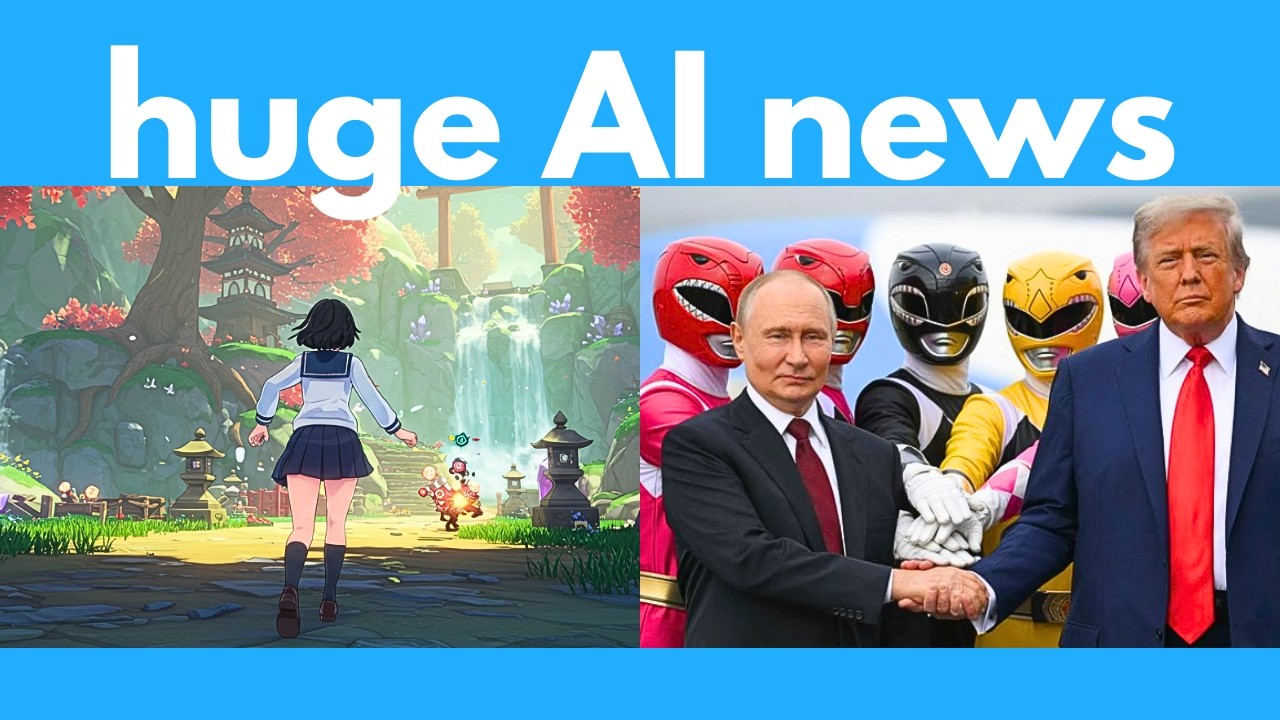
In the realm of 3D and gaming, Mirage 2 has emerged as a revolutionary real-time video game generator that transforms images or drawings into fully playable 3D worlds. Users can interact with these environments using keyboard controls and further customize scenes through AI prompts, seamlessly transitioning between diverse settings like cyberpunk cities, medieval towns, and alien planets. Although not yet open-source, Mirage 2 offers an impressive online demo showcasing its interactive capabilities and real-time scene generation.
Google has launched a powerful AI-driven image editing feature in Google Photos, allowing users to edit photos using simple text prompts. This tool can perform complex edits such as removing glare, adding clouds, restoring old photos, and swapping backgrounds without manual masking or adjustments. Rumored to be powered by Google’s stealth model Nano Banana, this feature is initially available on Pixel 10 devices and is expected to challenge traditional image editing software like Photoshop.
Finally, the video highlights several other notable AI developments, including DeepSeek’s latest model version 3.1 with improved reasoning and coding abilities, Mesh Coder which converts 3D point clouds into editable meshes for software like Blender, and Boston Dynamics’ Atlas robot demonstrating autonomous object handling. Additionally, mass production of humanoid robots in China and advanced 3D segmentation tools like Geio SAM 2 showcase the rapid progress in robotics and 3D AI applications. These innovations collectively underscore the accelerating pace and broad impact of AI technologies across industries.