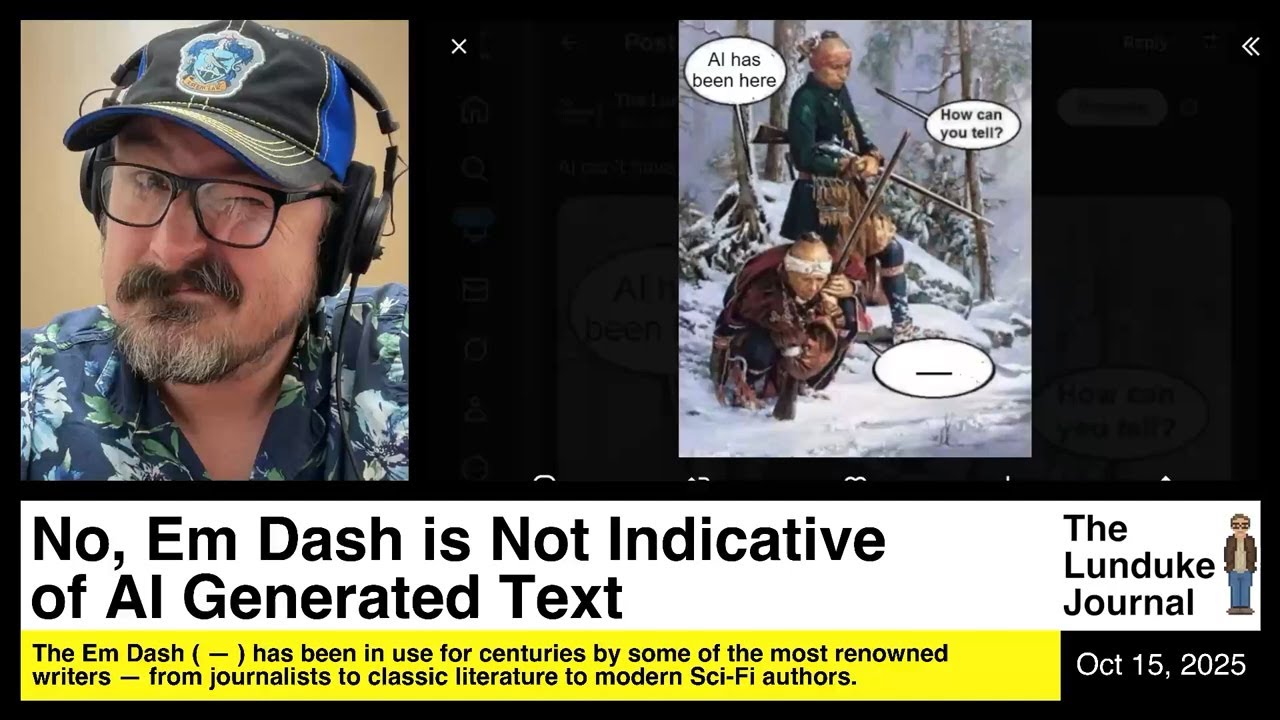
The video explains that the presence of em dashes is not a reliable indicator of AI-generated text, as this punctuation has been widely used by human authors for centuries and naturally appears in AI-generated content trained on extensive literature. Instead, it suggests focusing on factors like the volume of content and the presence of genuine mistakes to better distinguish human writing from increasingly sophisticated AI-generated text.
The video discusses the increasing difficulty in distinguishing AI-generated text from human-written content as AI technology becomes more advanced. People are eager to find simple indicators that can reliably identify AI-generated writing, much like how early AI-generated videos were easy to spot due to obvious visual glitches. One commonly suggested sign is the use of the em dash (—), a punctuation mark roughly the width of a capital “M.” However, the speaker firmly argues that the presence of em dashes is not a valid indicator of AI-generated text.
The em dash has been in use for about 500 years and is a staple of English punctuation, frequently employed by many renowned authors across genres and eras. Writers such as J.R.R. Tolkien, Mark Twain, Piers Anthony, and Robert Heinlein have all used em dashes extensively in their works. Since AI language models are trained on vast amounts of literature, including these classic and modern texts, it is natural for AI-generated content to include em dashes as well. Therefore, using the presence of an em dash to claim a text is AI-generated is misguided and reflects a lack of familiarity with literature.
The speaker emphasizes that AI-generated text is becoming increasingly sophisticated, making it nearly impossible to distinguish from human writing based on punctuation or style alone. This challenge extends beyond text to voice synthesis and image generation, where AI can convincingly mimic real people, including the speaker himself. The proliferation of AI-generated content in tech journalism and other media means that much of what people consume online may be produced by AI, often without disclosure. This trend raises concerns about authenticity and trust in digital content.
One practical way to suspect AI-generated content is by looking at quantity and quality rather than punctuation. AI can produce vast amounts of content quickly, so an unusually high volume of articles or posts, especially those lacking a clear author identity or containing no genuine mistakes, can be a red flag. Conversely, human creators tend to produce a more limited amount of content with occasional errors or imperfections, which can serve as subtle indicators of authenticity. The speaker encourages readers to pay attention to these factors rather than relying on superficial signs like em dash usage.
In conclusion, the video asserts that the em dash is not a reliable marker of AI-generated text and that the growing sophistication of AI makes detection increasingly difficult. The speaker humorously claims ownership of the em dash as a human writer’s tool and urges viewers to focus on other clues, such as content volume and the presence of genuine mistakes, to discern human from AI authorship. The video ends with gratitude to supporters who enable the production of human-created tech journalism and a call to appreciate the nuances of authentic content in an era dominated by AI.