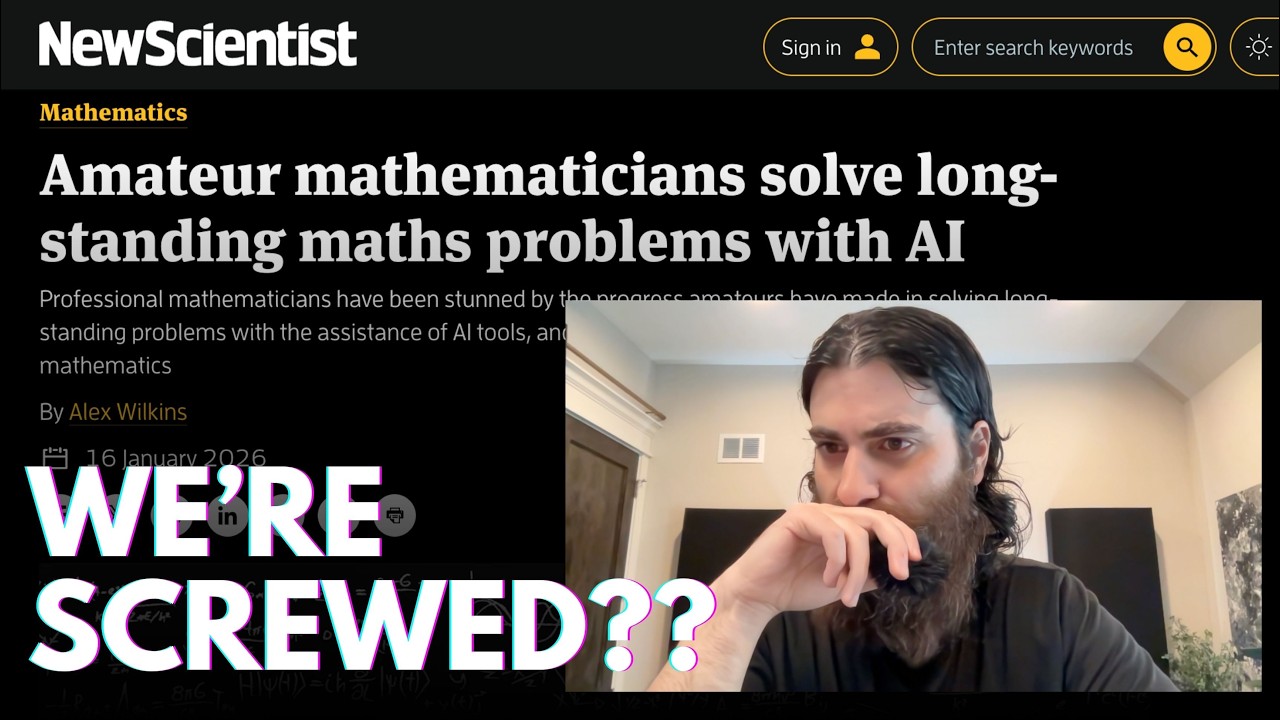
The speaker argues that large language models (LLMs) like ChatGPT have not truly solved Erdős problems, but instead excel at retrieving and connecting existing mathematical knowledge from vast literature, acting more as advanced search tools than creative problem solvers. While LLMs boost productivity by handling routine or overlooked tasks, they do not demonstrate genuine understanding or intelligence, but rather amplify human capabilities.
The speaker discusses a recent viral post they made on X (formerly Twitter), where they compared large language models (LLMs) like ChatGPT to calculators, arguing that LLMs lack true understanding and simply process input to generate output without comprehending meaning. This analogy sparked controversy, with some people claiming that LLMs must be intelligent if they can solve complex mathematical problems, specifically referencing the famous Erdős problems. The speaker expresses skepticism about these claims and seeks to clarify what LLMs are actually achieving in the mathematical community.
Drawing from a New Scientist article, the speaker explains that amateur mathematicians have begun using AI chatbots to tackle longstanding mathematical problems, particularly those posed by Paul Erdős. While these problems are not the most advanced, the use of AI has surprised professionals by demonstrating a new level of mathematical performance. However, the speaker emphasizes that LLMs are not generating novel insights but are instead exceptionally good at searching through vast mathematical literature to find relevant references and previously overlooked solutions.
The speaker notes that many of the so-called “solved” Erdős problems were actually already addressed in existing literature, but had been forgotten or were difficult to find. LLMs excel at indexing and retrieving this information, acting as powerful search engines rather than creative problem solvers. This ability to synthesize and connect information from massive datasets is valuable, but it does not equate to genuine understanding or intelligence.
Furthermore, the speaker highlights that the problems being solved by AI are generally straightforward or have received little attention from human mathematicians, often due to lack of interest or time. LLMs can tirelessly process and cross-reference information, making them ideal for tackling these neglected problems. This increased efficiency allows researchers to focus on more meaningful or challenging work, while AI handles the backlog of simpler tasks.
In conclusion, the speaker argues that LLMs are best viewed as amplifiers of human productivity rather than replacements for human intellect. They enable mathematicians and developers to address a broader range of problems by removing bottlenecks related to information retrieval and routine tasks. Rather than signaling the end of human intellectual work, the rise of AI tools marks the beginning of a new era where humans can achieve more by leveraging these powerful resources.