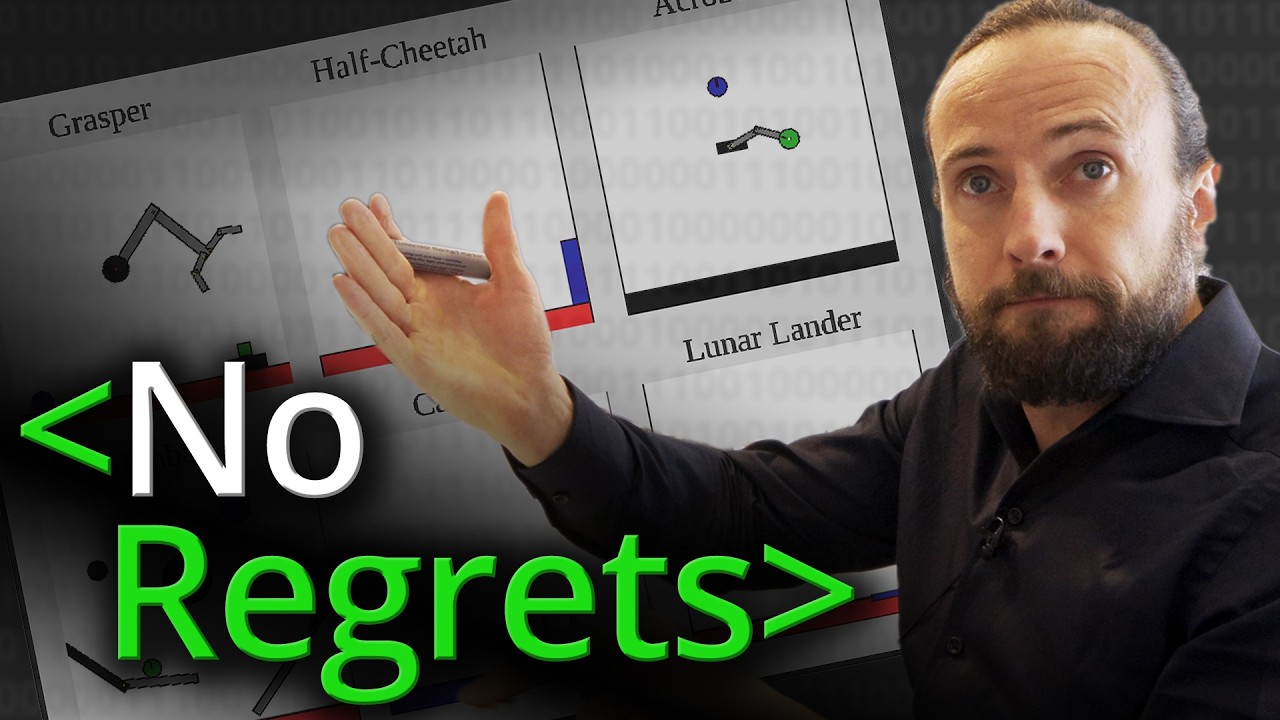
In the Computerphile video “No Regrets - What Happens to AI Beyond Generative?”, the speaker discusses the limitations of current generative AI models and emphasizes the need for AI to learn from experience in simulated environments to improve decision-making and adaptability. The focus shifts from minimizing regret to optimizing for learnability, leading to advancements in training AI agents in complex environments, which enhances their ability to generalize and perform effectively in real-world scenarios.
In the video “No Regrets - What Happens to AI Beyond Generative?” from Computerphile, the discussion revolves around the limitations of current generative AI models and the need to advance beyond supervised and self-supervised learning. Generative models excel at tasks like text generation and question answering but struggle with real-world decision-making that requires trial-and-error learning, long-term planning, and complex reasoning. The speaker emphasizes the necessity for AI systems to learn from experience, similar to humans, and suggests that this requires a shift towards training AI in simulated environments rather than relying solely on large text corpora.
The speaker introduces the concept of “compute-only scaling,” which focuses on leveraging the increasing computational power of computers to create more sophisticated AI models. This approach contrasts with the current reliance on human-generated data, which is becoming limited. By training AI in virtual environments, researchers can facilitate trial-and-error learning without the risks associated with real-world experimentation. The challenge lies in designing these environments to ensure that AI agents can generalize effectively to various real-world scenarios they may encounter after training.
A key aspect of the discussion is the concept of “regret,” which measures the difference between an AI agent’s performance in a given environment and the optimal performance achievable. The speaker explains that understanding and minimizing regret is crucial for developing robust AI systems. The video highlights the importance of training AI on a distribution of tasks that prepares them for unforeseen challenges in real-world applications. The speaker illustrates this with the example of navigating a grid world, where the AI must learn to adapt to different layouts and obstacles it has not encountered before.
The video also addresses the limitations of existing regret approximation methods when applied to more complex environments. After experimenting with these methods, the researchers found that they often failed to capture the intuitive notion of learnability, which is essential for effective training. Instead of optimizing for regret, they shifted their focus to optimizing for learnability, leading to significant improvements in the AI’s ability to generalize to new tasks. This shift in perspective allowed them to develop more effective training methods that could adapt to a wider range of environments.
Finally, the speaker discusses the advancements made in creating a 2D physics-based simulation environment called “kinetics,” which allows for diverse and complex task generation. This environment enables researchers to train AI agents on a variety of tasks while maintaining computational efficiency. The results showed that agents trained in this simulated environment could achieve zero-shot improvements on human-designed tasks, demonstrating the potential for AI systems to learn and adapt effectively. The hope is that these foundational advancements will pave the way for future developments in AI, including the transition to more complex 3D environments, ultimately leading to more capable and versatile AI agents.