The video explores the NVFP4 quantization format developed by Nvidia, demonstrating its ability to reduce model size and increase speed without sacrificing output quality. The presenter uses the Hermes Agent Desktop app and a locally quantized Qwen 3.8-27B model on a DGX Spark system to showcase NVFP4’s advantages. The video begins with an explanation of quantization basics, illustrating how reducing bit precision from 16-bit down to 4-bit and below affects model weights and introduces rounding errors. NVFP4 stands out by using a floating-point 4-bit format (E2M1) that allocates more precision near zero where most weights cluster, unlike traditional evenly spaced integer quantization (INT4).
The core innovation of NVFP4 lies in its use of floating-point representation and a fine-grained scaling mechanism. Unlike other 4-bit formats that use fixed power-of-two scales, NVFP4 employs an FP8 scale (E4M3 format) that allows smooth, precise scaling per small groups of weights (16 dials per scale). This approach minimizes quantization error and better fits the actual distribution of weights, resulting in about 47% smaller model size compared to BF16 and significantly reduced rounding errors. The format is especially optimized for Nvidia’s Blackwell GPUs, where both weights and activations remain in 4-bit precision throughout computation, enabling 2-3x throughput improvements over FP8.
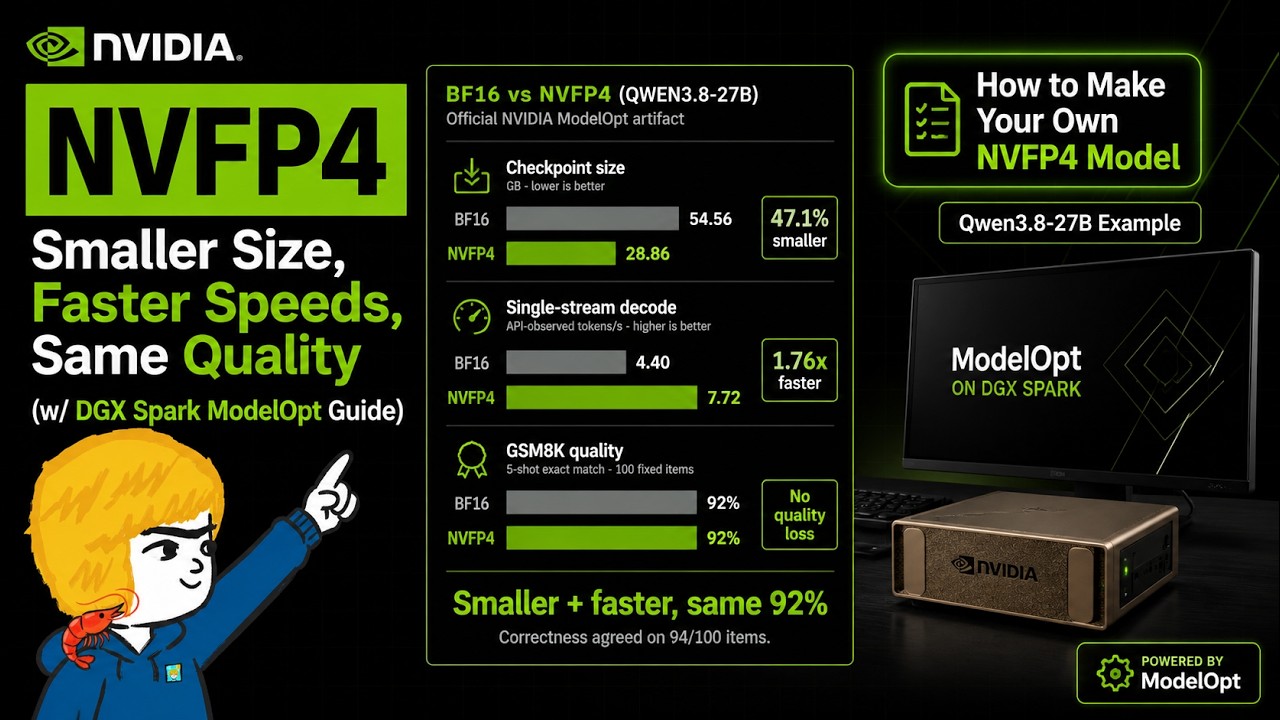
The presenter then walks through a practical demonstration of quantizing the Qwen 3.8-27B model using Nvidia’s Model Opt tool on a DGX Spark. The process involves setting up a clean workspace, cloning the Model Opt repository, verifying dependencies, and running a calibration step with representative text samples to determine optimal scaling. The quantization recipe used applies NVFP4 only to MLP layers, preserving other layers in BF16 for stability. After about 18 minutes, the quantized model is successfully generated, showing a size reduction from 54.56 GB to 28.86 GB.
Speed and accuracy tests confirm the benefits of NVFP4 quantization. The quantized model runs approximately 1.76 times faster than the original BF16 version, with median time to first token and end-to-end token generation times significantly improved. Importantly, the accuracy remains consistent at around 92% on GSM 8K benchmarks, indicating that the quantization does not degrade model performance. The presenter also demonstrates interacting with the quantized model via the Hermes Agent app, confirming that it responds coherently and quickly, suitable for practical use.
In conclusion, the video provides a comprehensive introduction to NVFP4 quantization, highlighting its technical foundations, practical implementation, and performance benefits on Nvidia hardware. The presenter emphasizes that NVFP4’s main advantage is not just storage savings but also computational speedups enabled by Blackwell GPUs’ tensor cores. The video serves as a prologue to a planned series on local model optimization and customization, inviting viewers to engage and provide feedback. Overall, NVFP4 emerges as a promising format for efficient, high-quality large language model deployment on compatible Nvidia platforms.
Useful Links