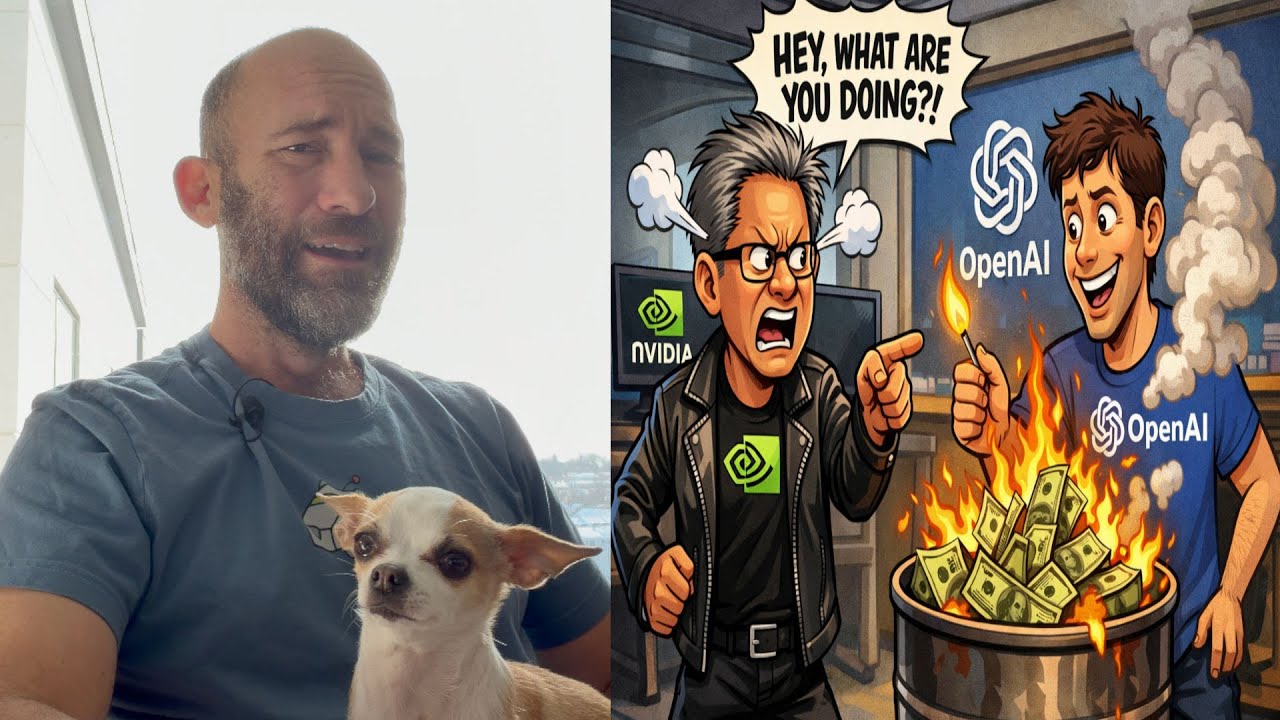
In this video, Eli the Computer Guy discusses the unraveling hype and potential fraud in the artificial intelligence (AI) investment world, focusing on Nvidia’s much-publicized but now-stalled $100 billion investment in OpenAI. He explains that back in September, Nvidia CEO Jensen Huang announced a handshake agreement to invest $100 billion in OpenAI, which would have essentially resulted in OpenAI using that money to buy Nvidia hardware—a circular and suspicious arrangement. However, as months have passed without the deal being finalized, it has become clear that Nvidia is backing away from the original commitment, despite Huang’s public insistence that he still has confidence in OpenAI.
Eli criticizes the vague and evasive language used by executives like Huang, arguing that when business leaders cannot clearly explain their decisions, it often signals underlying problems or even fraud. He points out that business should be simple: create a product, sell it for more than it costs, and communicate clearly with stakeholders. The convoluted explanations and shifting narratives around the Nvidia-OpenAI deal, he suggests, are red flags that the AI investment bubble may be bursting, with investors growing wary of the massive sums being thrown around without clear business models or returns.
He also highlights the broader context of AI industry competition, noting that OpenAI faces significant challenges from companies like Google, Anthropic, and others. Eli is skeptical of the astronomical valuations and capital expenditures being discussed—such as Sam Altman’s claims of $1.3 trillion in signed contracts—especially when OpenAI’s actual annual revenue is much lower. He believes that much of the current AI investment is driven by hype cycles and gut feelings rather than sound business fundamentals, and that investor confidence is starting to wane as reality sets in.
Eli argues that the real value in AI lies not in massive, expensive frontier models, but in practical applications like retrieval-augmented generation (RAG), vector databases, and semantic search, which can be deployed at a fraction of the cost. He predicts that the current focus on ever-larger language models is misguided and unsustainable, and that by 2026, the AI investment bubble will likely collapse. However, he reassures viewers that this does not mean AI technology itself is worthless—just that the business models and valuations of some major players are unrealistic.
Finally, Eli encourages technology professionals to focus on practical, real-world solutions that address actual business pain points, rather than getting caught up in the hype. He draws parallels to previous tech booms and busts, emphasizing that while large companies may fail, there will always be opportunities for those who can deliver tangible value. He advises viewers to build their skills, gain experience, and be ready to seize opportunities as the industry evolves, regardless of the current turmoil in the AI investment landscape.