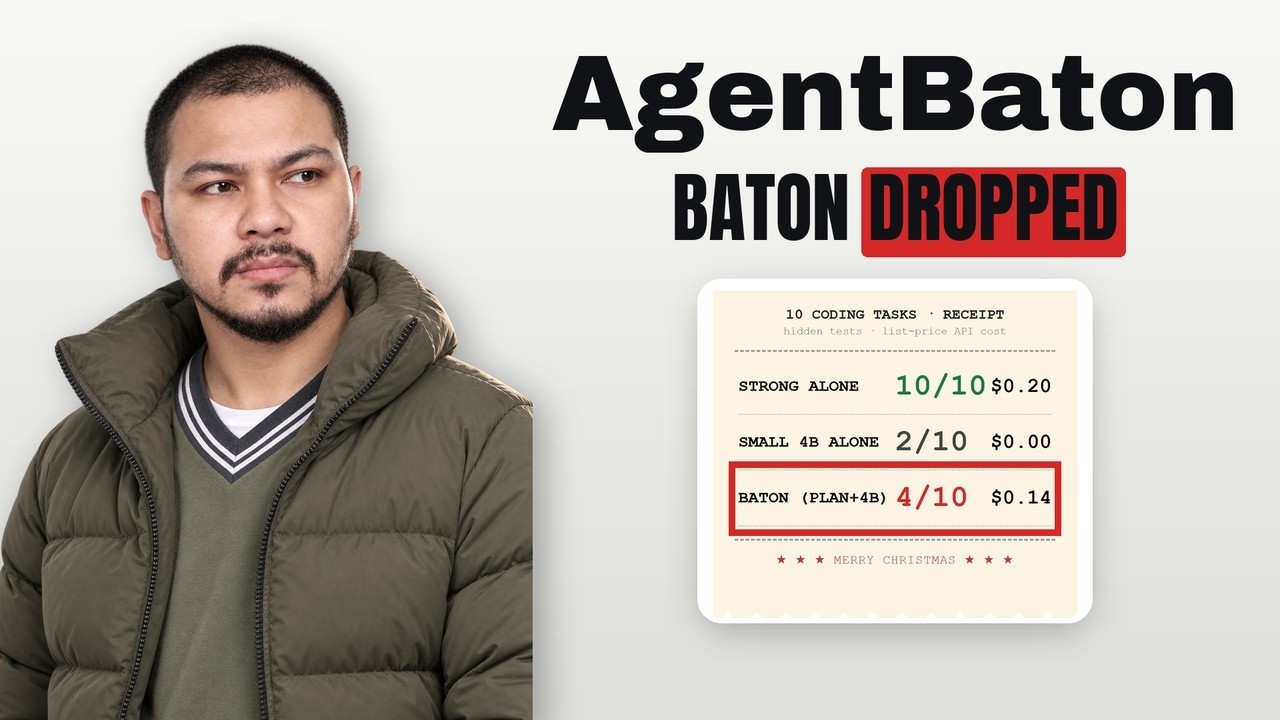
The video explores NVIDIA’s AgentBaton approach, which proposes using a strong, capable AI model to start a coding task and then handing off the work to a smaller, cheaper model to finish it, aiming to reduce costs while maintaining accuracy. The presenter tested this concept on their own laptop, using a strong cloud-based model (Claude Sonnet 5.5) and a smaller local model (Qwen 4B) across 10 Python coding tasks with hidden tests. The strong model alone passed all tasks at a cost of 20 cents, while the small model alone passed only two tasks for free but took much longer. The baton approach, where the strong model wrote a plan and the small model coded, passed four tasks and cost 14 cents, which was less cost-effective than expected based on NVIDIA’s paper.
NVIDIA’s paper claims significant cost savings by starting with a capable model and handing off to a cheaper one at the right moment, guided by a detector model that decides when to pass control. Their results showed up to 65.9% cost reduction with minimal accuracy loss across various model pairs and benchmarks. However, the presenter notes that these results rely on long, multi-turn tasks where the capable model does a substantial initial portion before handing off. The paper’s demo and code are not fully available yet, and their tests focus on software engineering tasks, excluding local compute costs.
The presenter’s own experiments revealed three main reasons why the baton approach didn’t save as much as promised. First, the tasks were small, so the planning phase by the strong model was almost as expensive as completing the entire task, limiting savings. Second, the handoff timing was too early—before any code was written or tests passed—giving the small model no running code or test feedback to learn from. Third, the small model used was only 4 billion parameters, smaller and less capable than the efficient models used in the paper, resulting in lower accuracy and longer runtimes.
From these findings, the presenter suggests that a plan alone is insufficient for a successful handoff; the small model needs more context, such as a first working implementation with passing tests, to effectively continue the task. They recommend letting the strong model reach a stable, tested state before handing off follow-up work like bug fixes, documentation, or minor edits to the cheaper model. This approach balances cost and accuracy better and avoids wasting retries on failed attempts by the small model.
In conclusion, while NVIDIA’s AgentBaton concept is promising, its practical benefits depend heavily on task size, handoff timing, and model capabilities. The presenter plans to rerun tests with the official detector and longer tasks to better replicate the paper’s conditions. They invite viewers to consider when the best moment to hand off might be—after planning, after the first passing test, or after the first failure—and emphasize measuring cost per passing task rather than just overall cost. The video highlights the complexity of multi-model collaboration and the importance of thoughtful handoff strategies in AI coding agents.
Useful Links