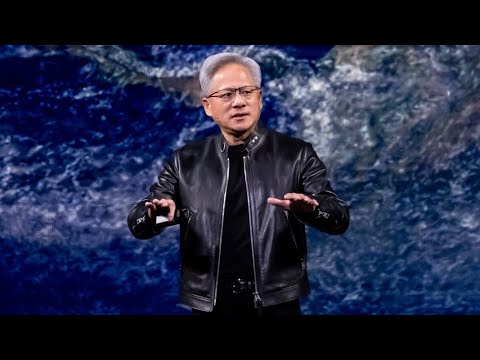
Nvidia CEO Jensen Huang predicts the company will generate at least $1 trillion in revenue from AI chips by 2027, driven by soaring global demand for AI infrastructure and Nvidia’s leadership in both AI training and inference technology. He emphasizes Nvidia’s cost-effective, versatile platform and widespread adoption as key factors behind this ambitious growth target.
Certainly! Here’s a five-paragraph summary of the transcript:
Nvidia CEO Jensen Huang projects that the company will generate at least $1 trillion in revenue from AI chips by 2027. Speaking shortly after a major company event, he emphasizes his confidence in this ambitious target, citing the rapidly growing demand for computing power driven by artificial intelligence. Huang believes that the actual demand for AI infrastructure will likely exceed even this trillion-dollar estimate.
He highlights Nvidia’s strategic focus over the past year, particularly on AI inference, which refers to the process of running trained AI models to make predictions or decisions. In 2025, Nvidia concentrated on ensuring their technology excelled not just in training AI models but also in inference, making their infrastructure highly scalable and cost-effective for customers. This approach extends the useful life of Nvidia’s systems, further reducing costs for users.
Huang asserts that Nvidia’s AI infrastructure offers the lowest total cost in the industry, making it the most attractive option for large-scale investments. He points out that the longer customers can use Nvidia’s systems, the more value they get from their investment, reinforcing the company’s competitive advantage in the AI hardware market.
The CEO also notes significant partnerships and adoption of Nvidia technology worldwide, including by major organizations and countries such as India. He mentions that a substantial portion of the world’s AI compute now runs on Nvidia platforms, and that open-source AI models have become widespread, further fueling demand for Nvidia’s hardware.
Finally, Huang underscores Nvidia’s unique position as the only platform capable of supporting every major domain of AI, from language and biology to robotics and computer vision. He assures investors and customers that Nvidia’s architecture is versatile, reliable, and future-proof, making it the safest and most effective choice for those investing heavily in AI infrastructure. This, he concludes, justifies the confidence in Nvidia’s trillion-dollar AI opportunity.