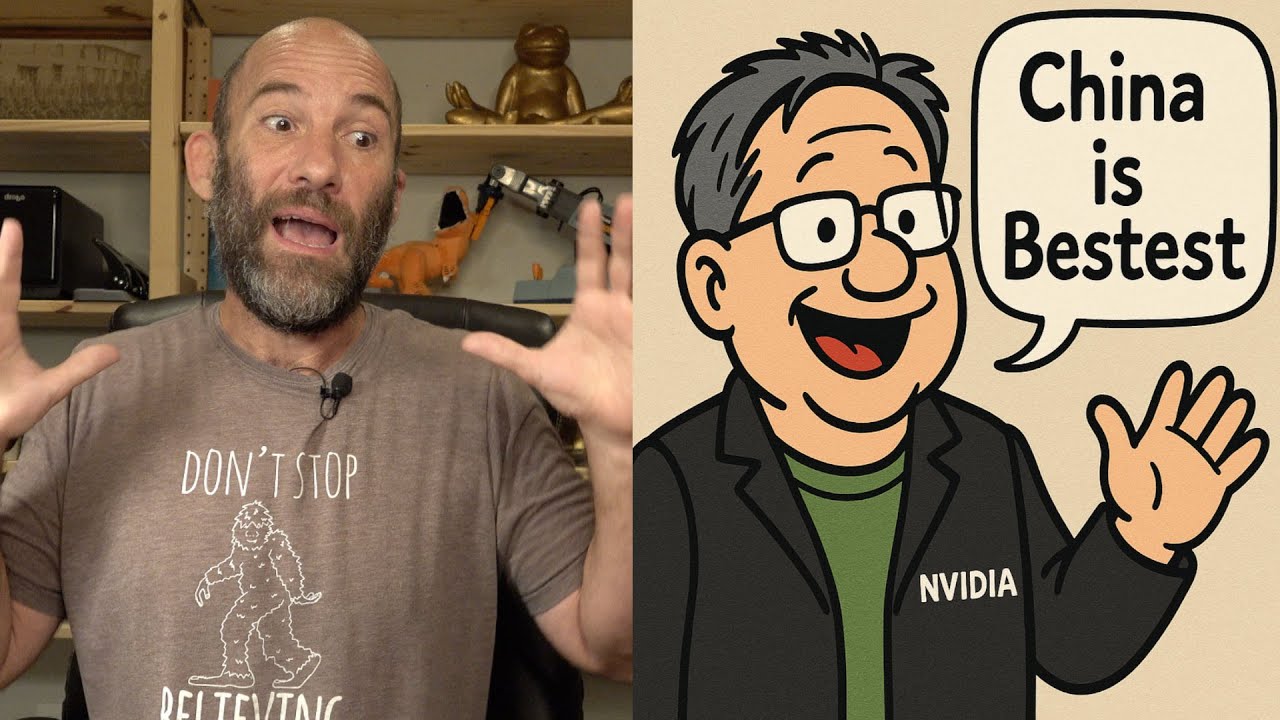
In this video, Eli, the host of The Daily Blob, discusses the current state of the AI race between the United States and China, highlighting comments made by Nvidia CEO Jensen Huang. Huang asserts that China is poised to win the AI race due to several factors, including China’s subsidized electricity pricing, which makes it easier and cheaper for companies to power energy-intensive AI data centers. Eli emphasizes that the U.S. is failing to build the fundamental infrastructure necessary for a modern society, such as a robust and reliable electricity grid, which is crucial not only for AI but also for electric vehicles, heat pumps, and other technologies. He criticizes the U.S. government’s priorities, pointing out that massive military spending has come at the expense of critical infrastructure development.
Eli reflects on the broader societal issues in the U.S., including healthcare, education, housing, and elder care, all of which he sees as pillars that are crumbling. He argues that without addressing these foundational problems, the country cannot hope to compete effectively in the global technology race. Using an analogy from his personal experience with cars, Eli illustrates how China’s aggressive investment in infrastructure and energy gives it a significant advantage, much like driving a well-powered car faster than a more prestigious but slower vehicle. He stresses that the U.S. approach, which often boils down to simply criticizing China, is insufficient for winning the AI competition.
The video also delves into the impact of export controls and trade restrictions on the semiconductor industry. Huang criticizes U.S. export bans on advanced AI chips to China, arguing that these measures are counterproductive. They force Chinese companies to develop their own semiconductor technologies, which could ultimately weaken U.S. dominance in the AI hardware ecosystem. Eli explains that once companies build their systems on a particular technology stack, migrating to a different one is costly and complicated, meaning that China’s growing self-reliance in AI chips could solidify its position in the market.
Eli further discusses the pessimistic attitude toward AI in the U.S., noting that many American tech leaders and professionals express fear and cynicism about AI’s impact on jobs and society. He contrasts this with the need for optimism and support to foster innovation and growth in the AI sector. He warns that if the industry’s thought leaders are overwhelmingly negative, it could dampen enthusiasm and investment, ultimately hindering progress. Eli also touches on the challenges of energy supply for AI infrastructure, citing examples like Microsoft having GPUs it cannot power due to insufficient electricity, underscoring the critical need for improved energy infrastructure.
In conclusion, Eli argues that the U.S. must prioritize rebuilding its infrastructure, especially its electricity grid, to remain competitive in AI and other emerging technologies. He points out that China’s focused investment in infrastructure development, including energy, transportation, and technology, positions it well for future economic growth. Eli expresses skepticism about the current U.S. political leadership’s ability to address these challenges effectively, suggesting that without significant changes, the U.S. risks falling behind. He invites viewers to share their thoughts and highlights his own educational efforts through Silicon Dojo, encouraging people to engage with technology education despite the challenges of funding such initiatives.