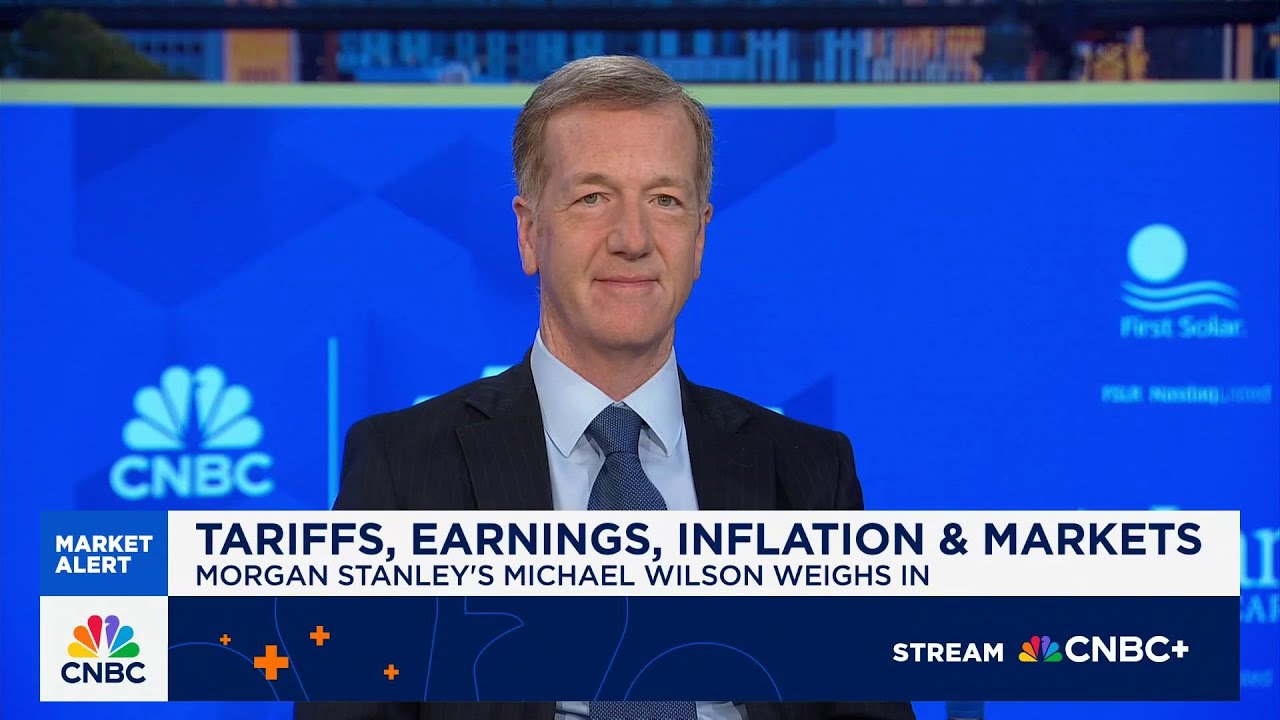
Mike Wilson of Morgan Stanley highlights that Nvidia’s return to the Chinese market and easing of sanctions will boost semiconductor profits and drive a recovery in tech capital expenditure, supported by positive legislative developments. He also notes that while tariffs remain a risk, their impact is expected to moderate into a manageable consumption tax-like scenario, with earnings growth set to re-accelerate later this year and into 2026.
In the discussion, Mike Wilson, Chief Investment Officer and Chief U.S. Equity Strategist at Morgan Stanley, highlights the positive impact of Nvidia’s return to the Chinese market on the broader technology sector, particularly semiconductor companies. He notes that the easing of sanctions and the ability to sell previously written-down chips will significantly boost profit margins for these companies. This development is seen as a positive catalyst for capital expenditure (CapEx) in the tech industry, which had been expected to slow but showed signs of recovery starting in April.
Wilson emphasizes that the market’s focus has shifted away from tariffs, which were a major headwind in the first quarter, towards more constructive factors such as the passing of what he refers to as the “big beautiful bill.” This legislation is expected to support earnings growth in the latter half of the year and into the next, marking a transition from negative to positive growth drivers. He likens the current economic policy environment to a new CEO who has already implemented the most growth-negative measures, paving the way for improvement.
Regarding earnings, Wilson expresses confidence that companies will continue to beat expectations by a typical margin of 4-5%. He points out that the full impact of tariffs on earnings has yet to be seen, as companies pre-purchased goods to mitigate costs in the first half of the year. The potential risk to earnings is likely to emerge in the third quarter, particularly in consumer goods sectors, but he anticipates a re-acceleration of earnings growth in the fourth quarter and into 2026.
Wilson also discusses the unpredictable nature of President Trump’s trade policies but suggests that when major companies like Nvidia and Apple make a strong case about the negative impact of tariffs on their business, there is a willingness to carve out exceptions. He views the administration’s approach as a negotiation strategy that involves initially tough stances followed by concessions, especially on critical materials like rare earth metals and magnets, indicating a pragmatic side to the trade discussions.
Finally, Wilson believes that the ongoing tariff situation will likely settle into a form resembling a 10% consumption tax, akin to a value-added tax (VAT), shared among exporters, importers, and consumers. This outcome would generate significant revenue—potentially $400 billion annually—while being manageable for the economy. Although there could be variations or complications with certain countries, the market appears to have accepted this middle-ground scenario as the most probable resolution to the trade tensions.