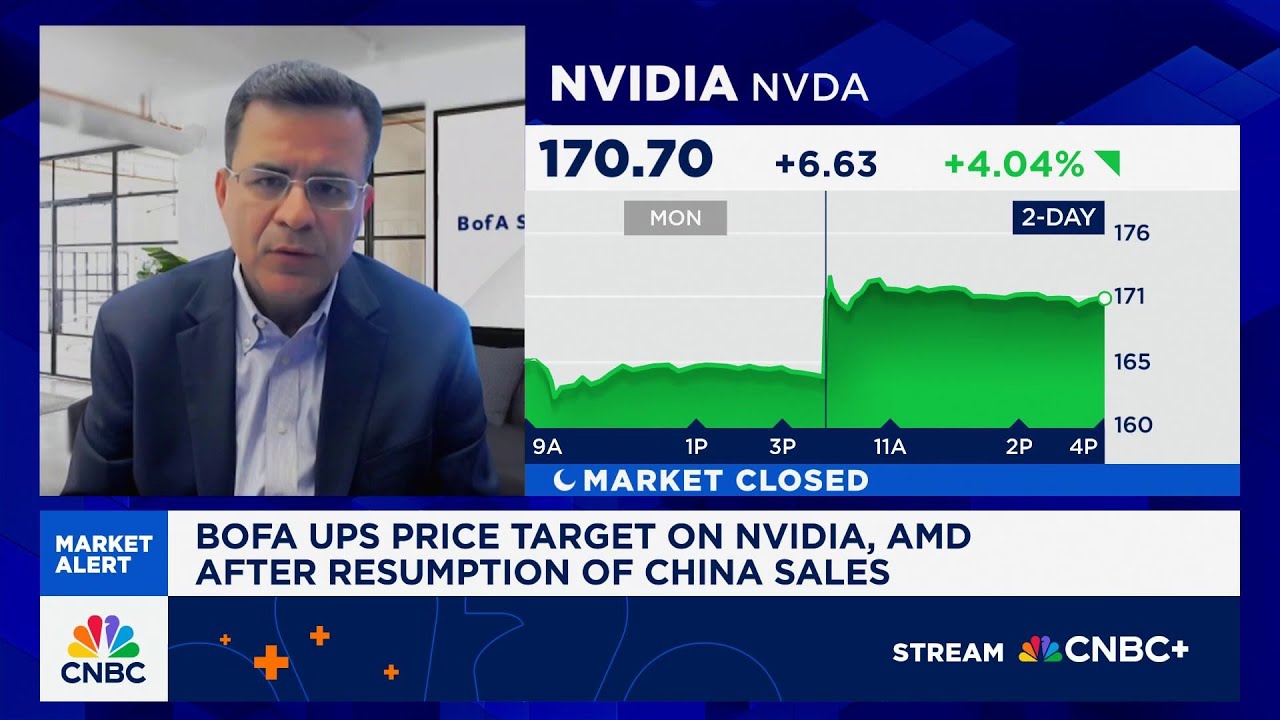
Nvidia’s stock reached a record high following its announcement to resume H20 chip sales to China, signaling easing US-China tensions and benefiting the broader semiconductor industry, including companies like AMD and Broadcom. Analyst Vivek Arya highlighted that while China remains a key AI market, global AI investment is diversifying, with significant growth in regions like the Middle East, and emphasized the substantial opportunities in AI infrastructure driven by major data center expansions worldwide.
Nvidia recently reached a new record high in its stock price following the announcement that it expects to resume sales of its H20 chips to China. This development has also propelled the semiconductor sector ETF SMH to a record level. Vivek Arya, a senior semiconductor analyst at BofA Securities, joined the discussion to provide insights into the implications of this move and the broader semiconductor industry landscape.
Arya highlighted that while geopolitical events make long-term forecasting challenging, the easing of restrictions on chip sales to China is a positive sign. He pointed out that recent relaxations, such as the approval of the Ansys deal for Synopsis and eased restrictions on chip design software, indicate a trend toward reduced tensions between the US and China. This easing is beneficial not only for Nvidia but also for AMD, as it helps maintain the US AI ecosystem’s involvement with rapidly innovating Chinese AI software developers, thereby supporting US dominance in the AI technology stack.
The discussion also touched on the broader impact on the semiconductor industry, noting that merchant silicon companies like Nvidia and AMD stand to benefit the most from resumed sales to China. However, the benefits could extend to other areas such as networking chips from companies like Broadcom and Marvell, chip design software suppliers, foundries, and memory manufacturers. Arya emphasized that while China currently accounts for about 10-15% of AI spending, its share of AI capital expenditure might stabilize around 5-10%, with significant AI investment growth occurring in other regions like the Middle East.
Arya further explained that the US continues to invest heavily in AI infrastructure, citing Meta’s plans for multi-gigawatt data centers as an example of the substantial market opportunity for companies like Nvidia. He noted that each gigawatt of data center capacity represents a $50 billion AI opportunity, underscoring the scale of investment and growth potential in the AI sector globally. This global spread of AI spending suggests that while China remains important, the AI ecosystem is becoming more diversified geographically.
Finally, the conversation addressed concerns about the routing of semiconductor sales through regions like Singapore and the potential risks of chips ending up in China indirectly. Arya acknowledged that while some shipments to these locations are driven by customer billing preferences rather than actual chip delivery, making chips more widely available globally helps invigorate the AI ecosystem. This broader availability supports innovation and growth in AI technology worldwide, reinforcing the interconnected nature of the global semiconductor and AI industries.