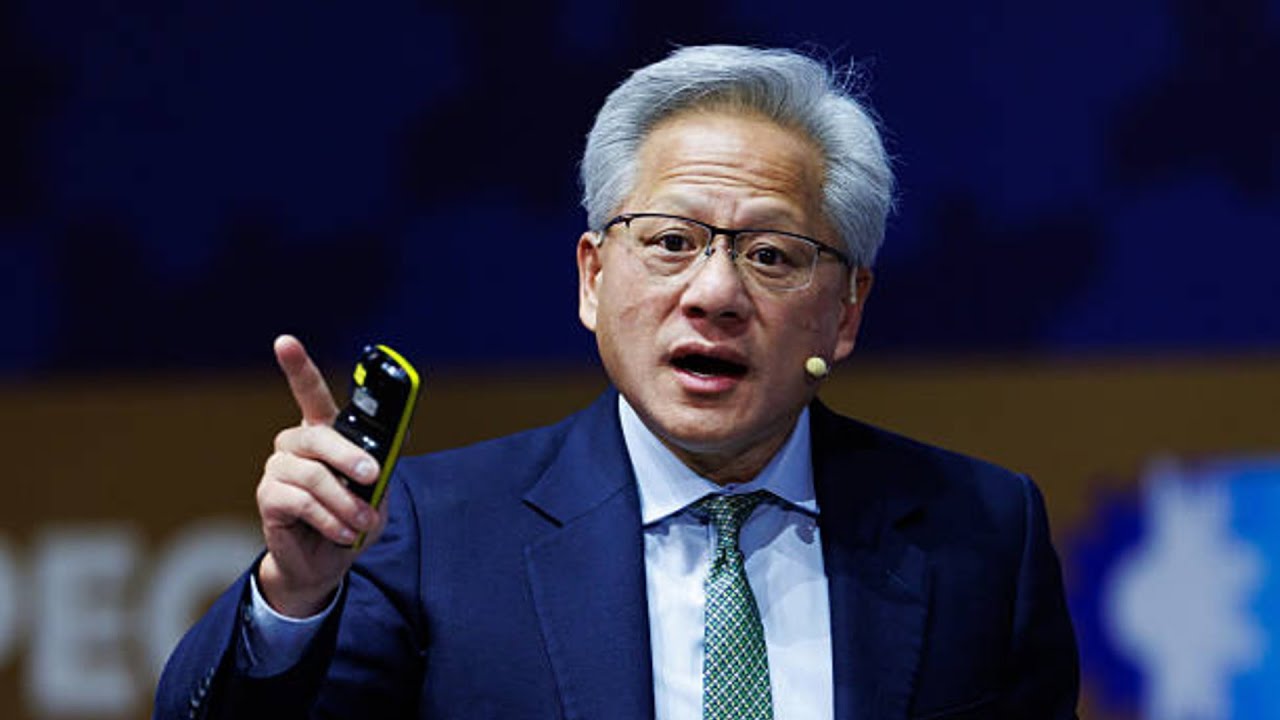
Nvidia recently reported strong financial results, meeting buy-side expectations with a top-line revenue of $57 billion and guidance for mid-sixties billion in the upcoming period. The third quarter data center revenue was particularly impressive at $51.2 billion, surpassing expectations. Jensen Huang, Nvidia’s CEO, highlighted that sales of their Blackwell GPUs are “off the charts,” indicating robust demand driven by artificial intelligence applications. The company is also targeting mid-seventies gross margins for the fourth quarter, which aligns with their previous guidance and signals strong profitability.
A key focus for Nvidia is maintaining growth despite concerns that overall spending in the sector might be peaking. The company aims to achieve this by expanding into adjacent product areas beyond their core GPUs, such as their Grace CPUs and Vera AI chips, as well as networking solutions. This diversification strategy allows Nvidia to increase revenue without relying solely on increased customer spending. Additionally, Nvidia is positioned to benefit from emerging trends like sovereign data centers and new cloud infrastructures, which are more likely to adopt Nvidia’s full stack of video and AI solutions.
Investor sentiment remains positive, with Nvidia shares rising about 4% in after-hours trading, alongside gains in related cloud companies. Looking ahead to Jensen Huang’s upcoming remarks, there is anticipation around his vision for Nvidia and the broader AI ecosystem. While some projections, such as a $3 trillion market by 2030, are optimistic and difficult to validate in the short term, key points of interest include progress on the Vera and Rubin chips and increased revenue generation from AI inference workloads, which are critical for sustaining growth.
The discussion also touched on geopolitical challenges, particularly restrictions on shipping advanced chips to China. Despite these limitations, Nvidia’s business in China does not appear to be significantly impacted at present, and the company continues to dominate markets outside China. There is concern about a bifurcated global market, where China and the U.S. operate separately, potentially limiting Nvidia’s ability to serve certain regions. However, the U.S. administration seems to be avoiding policies that would completely cut off U.S. customers from China-adjacent markets.
Overall, Nvidia is well-positioned to capitalize on the growing demand for AI technologies, with strong financial performance and strategic initiatives to broaden its product portfolio. The company’s ability to navigate geopolitical complexities and maintain innovation in AI hardware will be crucial for sustaining its leadership in the industry. Investors and analysts remain optimistic but cautious, awaiting further details from Nvidia’s leadership on execution and market expansion.