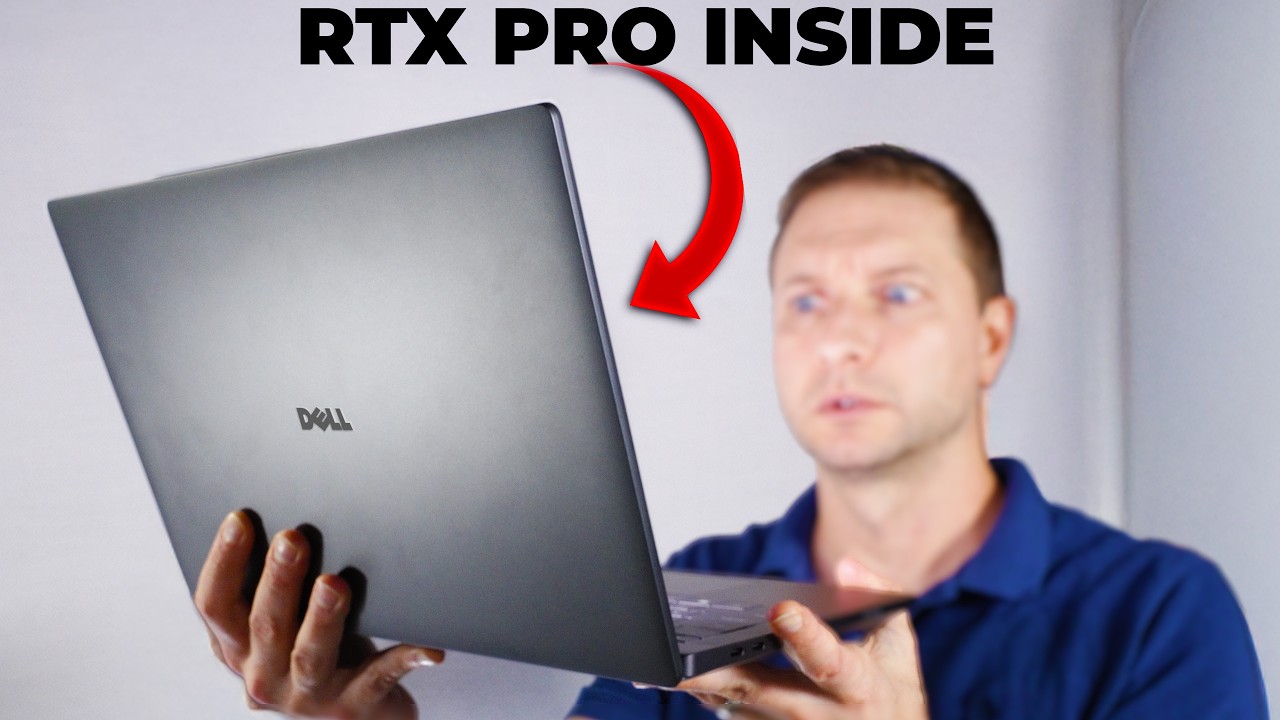
The video introduces the Dell Pro Max 14 laptop, one of the first to feature an NVIDIA RTX Pro GPU in a portable form factor. This laptop is equipped with the RTX Pro 2000, a mobile version of NVIDIA’s professional GPU architecture, alongside Intel’s powerful Core Ultra 9285H CPU. The presenter highlights the laptop’s design, praising its solid build, excellent trackpad, and physical function keys, while noting some minor keyboard layout issues and the absence of a dedicated charging port and HDMI output. The laptop weighs 1,672 grams and features a 14-inch QHD Plus Tandem OLED touchscreen with 64 GB of LPDDR5 RAM and up to 2 TB of storage, making it a premium and powerful machine priced at around $5,074.
Performance tests reveal that the Dell Pro Max 14 delivers strong results in JavaScript benchmarks and multi-core CPU tasks, with efficient thermal management and relatively quiet fan noise. However, some compilation tasks take longer than expected for a machine at this price point. The RTX Pro 2000 GPU shows its strength in AI and machine learning workloads, particularly when running local large language models (LLMs) using CUDA, which outperforms other backends like Vulkan. The presenter demonstrates running various LLMs, including the OSS GPT 120 billion parameter model, highlighting the GPU’s 8 GB VRAM limitation that restricts context size but still allows for impressive AI workloads on a laptop.
The video dives deep into LLM performance, showing that while the RTX Pro 2000 can handle models with up to 8 GB VRAM efficiently, pushing beyond this limit causes system slowdowns and increased CPU and system memory usage. Despite these constraints, the laptop manages to run large sparse models like the 120 billion parameter GPT OSS, albeit with slower token generation speeds around 10 tokens per second. Comparisons with other machines, including desktops and MacBooks with Apple Silicon, reveal that the Dell’s RTX Pro 2000 significantly outperforms integrated GPUs but falls behind high-end Apple M4 Max and upcoming M5 Max chips in raw AI processing speed.
The presenter also compares the Dell Pro Max 14 to other setups, including mini PCs with external NVIDIA GPUs, which achieve higher token generation speeds due to more powerful discrete GPUs and greater memory bandwidth. While the Dell laptop offers a solid entry into the NVIDIA CUDA ecosystem, essential for many AI production environments, its price point puts it in direct competition with high-end MacBooks. The choice between this Windows-based powerhouse and Apple’s machines depends largely on user preference and software ecosystem needs, especially for developers working extensively with AI and machine learning.
In conclusion, the Dell Pro Max 14 with the RTX Pro 2000 is a capable and well-built laptop that brings professional-grade GPU power to a portable form factor. It excels in AI workloads within the constraints of its GPU memory and offers a premium user experience with a great display and solid build quality. However, its high price and some performance trade-offs compared to desktop GPUs and Apple’s latest silicon make it a niche choice for professionals who need NVIDIA’s CUDA ecosystem on the go. The presenter invites viewers to comment if they want further comparisons with other PC laptops and hints at upcoming reviews of newer Apple silicon models.