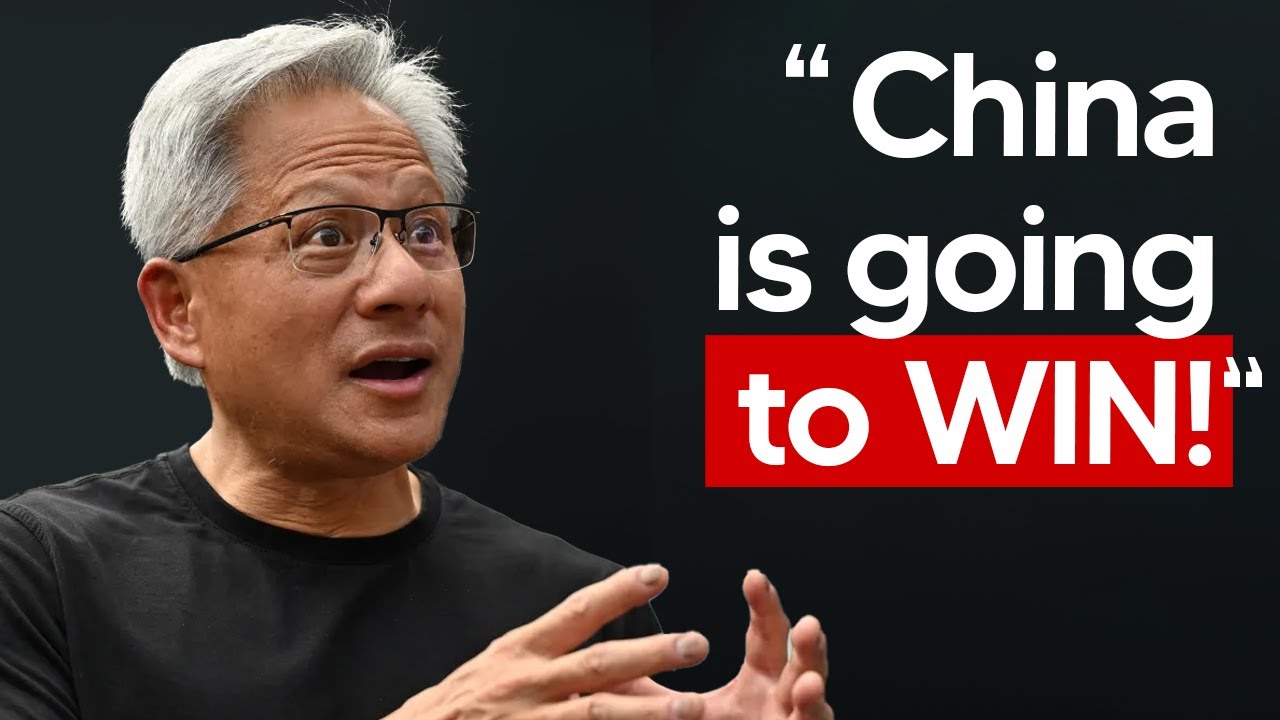
Nvidia CEO Jensen Huang warns that China is rapidly closing the AI development gap with the U.S., driven by a large talent pool, strong innovation, and superior infrastructure, and cautions that U.S. export restrictions on AI chips could hinder American leadership by cutting off access to global developers. Industry leaders highlight the intense, long-term AI competition, emphasizing the need for the U.S. to maintain technological ties and innovate swiftly to stay ahead while balancing values and strategic interests.
The video discusses a viral statement made by Nvidia CEO Jensen Huang regarding the AI race between the United States and China. Huang stated that China is only nanoseconds behind the U.S. in AI development and warned that U.S. policies restricting AI chip exports to China could backfire by cutting off access to half of the world’s AI developers, most of whom are in China. He emphasized that for the U.S. to win the AI race, it must ensure that the global AI ecosystem, including China, is built on American technology like Nvidia’s stack. This highlights a geopolitical tension where U.S. policy aims to limit China’s AI progress, while Huang advocates for maintaining technological ties to preserve long-term leadership.
Huang clarified his remarks, explaining that China has many talented AI researchers—about 50% of the world’s total—and is rapidly advancing with popular open-source AI models. He stressed that the U.S. must continue to innovate quickly to stay ahead in this highly competitive field. The video also references a Fortune report highlighting China’s superior energy grid capacity, which supports large-scale AI data centers more efficiently than the U.S., potentially giving China an infrastructural advantage in powering AI development.
Further insights from Huang reveal that China is not far behind the U.S. in AI capabilities and is working hard with strong technical skills and entrepreneurial drive. He described China as lightly regulated, fast-moving, and innovative, dispelling myths that China cannot manufacture AI chips or is years behind. Huang’s comments suggest a long-term, ongoing competition rather than a short-term race, with China positioned as a formidable competitor that the U.S. must take seriously.
The video also includes perspectives from other industry leaders, such as former Google CEO Eric Schmidt, who warned that China could win the AI race unless the U.S. acts decisively. Schmidt emphasized the importance of winning the AI race with American values like freedom of speech and expression, contrasting with China’s more controlled approach. Meanwhile, China’s strategy focuses on practical AI applications to boost efficiency and economic growth rather than solely pursuing artificial general intelligence (AGI), representing a pragmatic alternative to Silicon Valley’s ambitions.
Finally, the video touches on recent breakthroughs from Chinese AI labs, such as the Kimmy K2 model, which has achieved state-of-the-art performance at a relatively low cost, demonstrating China’s growing competitiveness. It also discusses concerns about increased surveillance in the U.S. as a trade-off for maintaining AI leadership, with some industry figures arguing that a surveillance-heavy America is preferable to China dominating AI. The video concludes by inviting viewers to consider whether Huang’s warnings are accurate or overblown, suggesting that the AI race will be close but that the U.S. could still prevail if it remains focused and innovative.