This video explores groundbreaking research from NVIDIA that teaches robots to “dream” — to simulate and predict their own physical interactions in a vivid, imaginative way that closely mirrors reality. While many recent robot demonstrations showcase impressive acrobatics like parkour and dancing, these feats occur in controlled environments with known variables, making them relatively easier challenges. The real difficulty lies in robots handling everyday, messy tasks such as grasping small or deformable objects, especially when faced with new objects, surfaces, or lighting conditions. Traditional robotics struggles here because adapting to unpredictable real-world scenarios is incredibly complex.
Typically, robots are trained in simulations before being deployed in the real world, much like learning to drive in a video game before hitting actual roads. However, simulations often fail to perfectly replicate reality, causing robots to perform poorly when transferred outside the virtual environment. NVIDIA’s new approach, called NeRD (Neural Robot Dynamics), addresses two major challenges: predicting thousands of future simulation steps and generalizing across different tasks, environments, and robot designs. Unlike traditional physics simulators that rely on slow, hand-coded equations and require tedious retuning for new setups, NeRD uses AI to learn physics by observing vast amounts of simulation footage, effectively skipping the need for explicit equations.
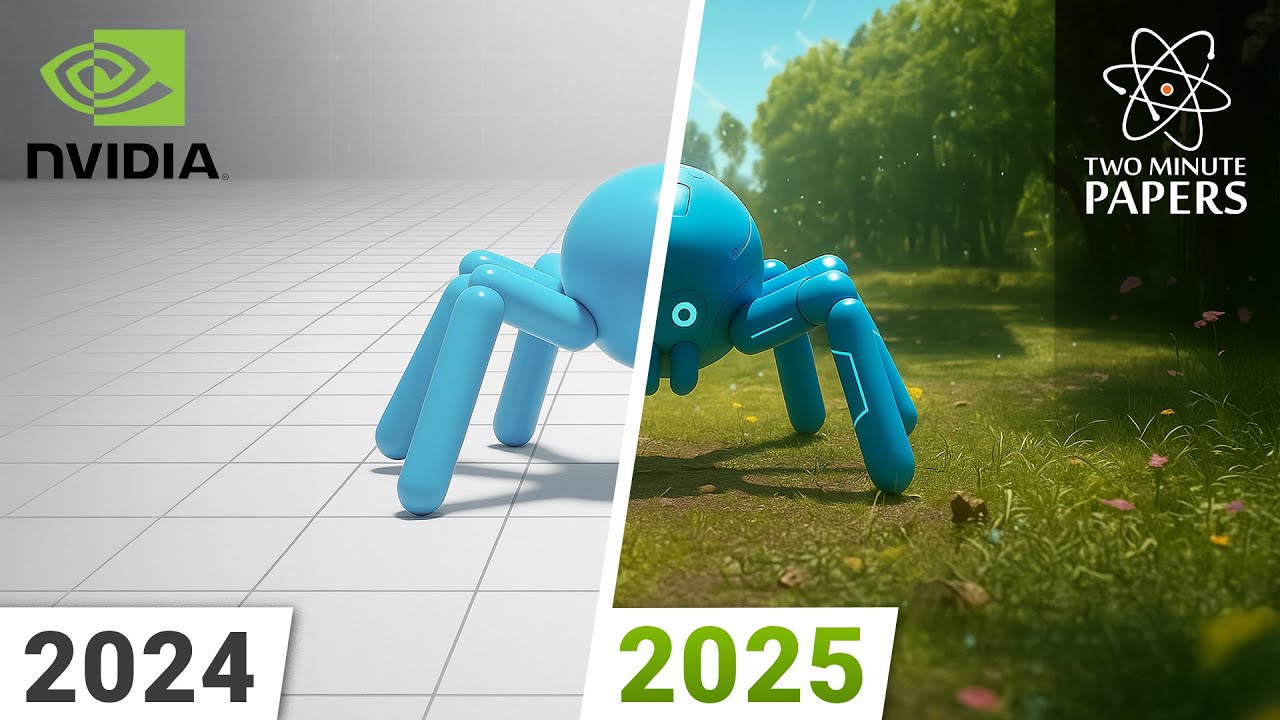
NeRD’s performance is impressive. It accurately replicates classic physics tasks like cartpole balancing and pendulum swings, and it generalizes well to more complex robotic movements such as a spider robot walking and spinning. Remarkably, robots trained entirely within NeRD’s “imagination” can be deployed in real-world scenarios without additional retraining or fine-tuning, successfully performing tasks like reaching specific points with a robotic arm. This level of transfer from simulation to reality is unprecedented and represents a significant breakthrough in robotics.
The secret behind NeRD’s success lies in how it models physics relative to the robot’s own coordinate frame, similar to how humans navigate a dark room by sensing relative movements and then figuring out their position in the world. This approach allows the AI to learn physics in a more intuitive and adaptable way. Additionally, when fine-tuned on real-world data, such as a cube being tossed and hitting the ground, NeRD outperformed the very physics simulator that generated the data, demonstrating that it can surpass its “teacher” by learning from real-world imperfections and nuances.
While NeRD is not yet perfect and has not been tested on highly complex robots like humanoids, it represents a major leap forward in robotic simulation and control. This research opens exciting possibilities for robots that can better understand and interact with the unpredictable real world, making them more useful for everyday tasks. The video encourages viewers to follow for more insights into cutting-edge AI and robotics research, highlighting the transformative potential of these advancements.