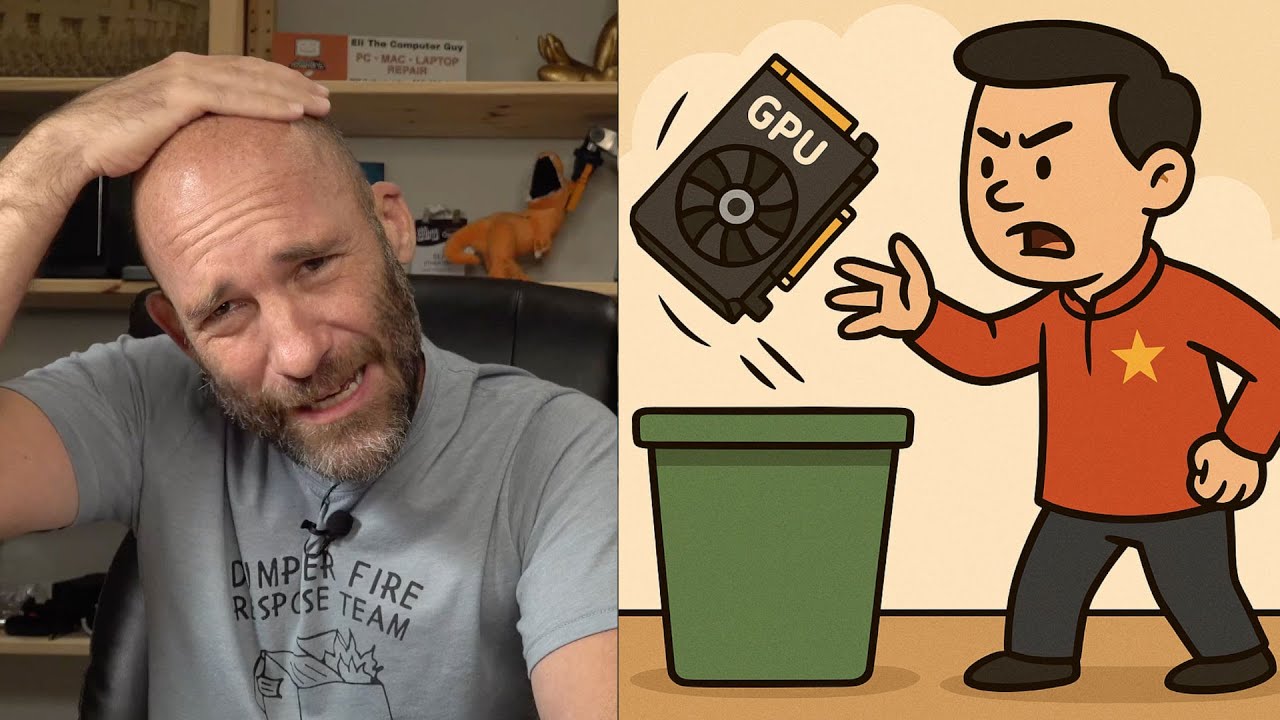
The video discusses how U.S. export controls have caused NVIDIA’s AI GPU market share in China to plummet from 95% to zero, forcing Chinese companies to develop domestic alternatives and potentially fragmenting the global AI hardware ecosystem. It highlights concerns over the geopolitical and economic impacts of this shift, including the rise of China’s independent AI technology stack and the challenges NVIDIA faces amid changing trade policies.
In this video, Eli from the Daily Blob discusses the significant decline of NVIDIA’s market share in China’s AI GPU sector, which has dropped from 95% to zero due to U.S. export controls. NVIDIA previously held a dominant position in China, accounting for 20 to 25% of its data center revenue from the region. However, recent U.S. trade policies have effectively blocked NVIDIA from selling its advanced AI GPUs in China, forcing Chinese companies to turn to domestic alternatives. This shift raises concerns about the future of global AI technology development and the potential fragmentation of the AI hardware market.
Eli highlights comments from NVIDIA CEO Jensen Huang, who confirmed during a live interview that the company is currently 100% out of the Chinese market. Huang expressed surprise and concern over the policy outcome, noting that losing access to such a large and important market is not beneficial. The export restrictions, which began in October 2022 and intensified in 2023, have made NVIDIA’s data center GPUs non-compliant for sale in China. This has led Chinese tech giants like Huawei and Alibaba to accelerate their efforts to develop and deploy domestic AI hardware solutions.
The video explores the broader implications of this market shift, emphasizing that China, with its vast population and significant share of the world’s AI engineers, is building its own AI stack independent of U.S. technology. Eli suggests that despite potential hardware quality differences, the affordability and availability of Chinese AI hardware could make it more attractive globally, especially for countries and companies wary of U.S. export restrictions. This could lead to a bifurcation in the AI ecosystem, where different regions adopt different technology stacks, potentially complicating global collaboration and innovation.
Eli draws parallels between NVIDIA’s current situation and Intel’s past struggles, noting how market leaders can lose dominance due to strategic missteps and external pressures. He questions whether U.S. trade policies might inadvertently accelerate NVIDIA’s decline by pushing China to develop competitive alternatives. Furthermore, Eli contrasts the U.S. approach with China’s strategy of supporting its technology companies through loans, engineering support, and infrastructure development, which could strengthen China’s position in the global AI race.
In conclusion, Eli invites viewers to reflect on the consequences of NVIDIA’s loss of the Chinese market and the broader geopolitical and economic dynamics at play. He expresses concern about the irrational exuberance in the stock market, given the significant challenges NVIDIA faces. The video ends with a call to action for viewers to share their thoughts and support Eli’s hands-on technology education classes, which aim to empower individuals to engage with emerging technologies like AI.