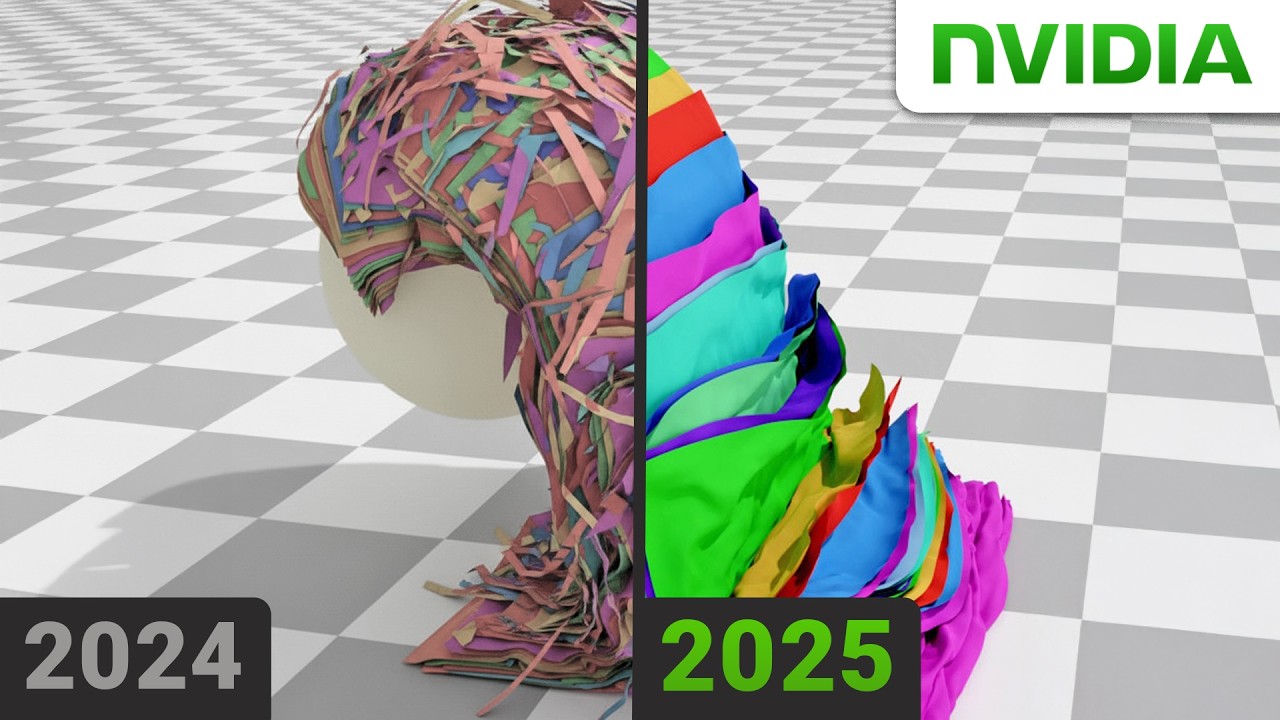
NVIDIA and top scientists have developed a groundbreaking simulation technique called Offset Geometric Contact (OGC) that enables penetration-free, realistic, and highly efficient physics simulations by giving each object localized sensors to prevent collisions, running over 300 times faster than previous methods. This advancement overcomes longstanding challenges in computer graphics, allowing complex interactions like tightening knots and natural phenomena to be simulated accurately and efficiently, paving the way for more realistic virtual worlds in movies, games, and beyond.
The video showcases an incredible breakthrough in computer simulation technology developed by NVIDIA and a team of top scientists. It features a stunning simulation of natural phenomena, such as the transition from winter to summer, rendered with nearly two million triangles and capable of running calculations ten times per second. This achievement is remarkable because it produces penetration-free simulations, meaning virtual objects behave like real-world objects and do not pass through each other, preserving the illusion of reality in digital environments.
Penetration-free simulation has been a longstanding challenge in computer graphics. Previous methods, like Incremental Potential Contact (IPC), made progress but had significant drawbacks. IPC acted like a city-wide traffic controller that would halt the entire simulation if even a tiny collision was detected anywhere, causing slowdowns and unnatural distortions in objects like cloth. These limitations made it difficult to achieve realistic and efficient simulations, especially when dealing with complex interactions and large numbers of elements.
The new technique, called Offset Geometric Contact (OGC), revolutionizes this process by giving each object its own localized sensor that detects how close it can move before colliding with another object. This decentralized approach allows different parts of the simulation to move freely and only slows down when actual collisions are imminent. OGC creates invisible force fields around objects that push outward perpendicularly, preventing penetration and avoiding the stretching artifacts seen in earlier methods. This results in clean, realistic interactions that run efficiently on GPUs.
OGC’s performance is extraordinary, being more than 300 times faster than previous methods while maintaining high accuracy and stability. The simulation can even recover from incorrect initial states and handle complex scenarios like tightening knots in yarn without unraveling. Although the method is not perfect—sometimes producing slightly rubbery cloth behavior or being slower in very specific high-speed collision cases—it represents a major leap forward in simulation technology and opens new possibilities for movies, games, and virtual worlds.
The video concludes by emphasizing that research is an ongoing process, and while OGC is a groundbreaking advancement, future papers will likely refine and improve upon it. The presenter encourages viewers to subscribe and support the dissemination of such cutting-edge research, highlighting the importance of sharing these innovations before they become mainstream. Overall, this breakthrough marks an exciting moment in computer graphics, bringing us closer to truly realistic and efficient digital simulations.