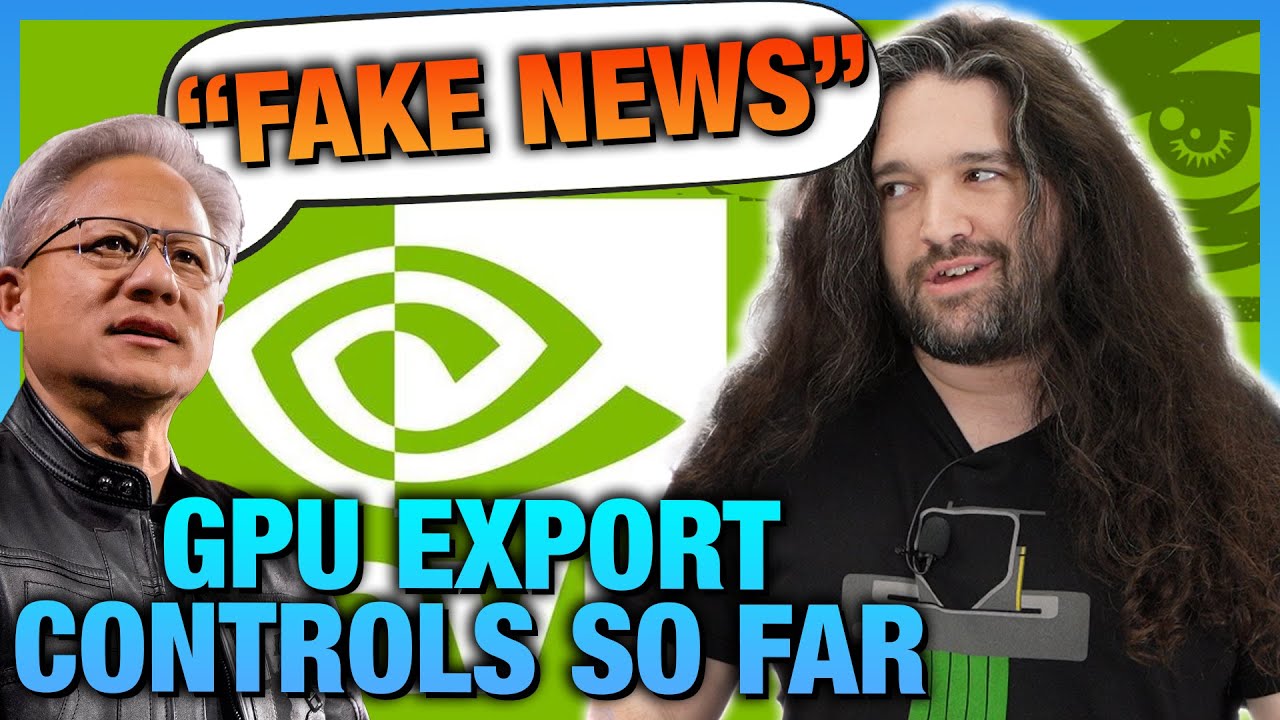
The video delves into the complex and contentious situation surrounding Nvidia, focusing on its recent communications, export controls, and geopolitical challenges. Nvidia has been accused of manipulating narratives, particularly regarding the availability of its H100 and H200 GPUs. Despite CEO Jensen Huang stating these GPUs were sold out due to high demand, Nvidia later tweeted that there was “erroneous chatter” in the media about shortages, claiming they had sufficient stock to fulfill all orders. This contradictory messaging exemplifies Nvidia’s increasingly defensive stance, where it accuses the media of spreading “fake news” and dismisses critical reporting as “doomer science fiction,” reflecting an Orwellian approach to controlling the narrative.
Nvidia’s business strategy has shifted significantly towards engaging with governments rather than consumers, navigating a complex web of export controls, tariffs, and geopolitical tensions, especially between the US and China. The company stopped producing the H20 AI chip for China and began developing a new B30A chip tailored for the Chinese market, which reportedly costs about twice as much as the H20. Despite a US government deal granting export licenses for the H20 chip with a 15% revenue share, Nvidia has yet to generate revenue from these sales due to regulatory delays. Meanwhile, Nvidia claims to have zero market share in China, a statement that is misleading given the continued presence and demand for Nvidia GPUs in the Chinese market, often facilitated through smuggling and secondary sales.
The US government has struggled with consistent export control policies, exemplified by the introduction of the Gain AI Act, which aims to prioritize US customers for AI chips and restrict exports to foreign entities while US demand remains unmet. Nvidia has publicly opposed this legislation, likening it to a previously proposed but halted AI diffusion rule, arguing that such policies would harm US leadership in AI and computing. Despite Nvidia’s lobbying efforts, the US Senate passed the Gain AI Act, with major tech companies like Microsoft and Amazon supporting it, highlighting the tension between national security concerns and commercial interests in the AI chip market.
On the Chinese side, the government has intensified scrutiny and restrictions on Nvidia’s AI chips, warning domestic companies against reliance on foreign technology and accusing Nvidia of violating antitrust laws related to its Melanox acquisition. China has banned certain Nvidia GPUs from being used by major companies like Alibaba and ByteDance and has increased border checks to curb smuggling of restricted chips. In response, China is heavily investing in domestic AI chip development, with state-backed data centers mandated to use homegrown technology. This escalating tech rivalry has led to a trade truce but ongoing tensions, with both countries imposing export and import controls that complicate Nvidia’s operations and market access.
The video concludes by highlighting Nvidia’s broader ambitions to embed its AI technology globally, despite the geopolitical headwinds. Jensen Huang emphasizes the mutual benefits of Nvidia serving both US and Chinese markets, though the reality is fraught with challenges. Nvidia’s aggressive narrative control, dismissive attitude toward critics, and the opaque nature of GPU smuggling underscore the complex interplay of technology, politics, and economics shaping the AI chip industry. The channel also promotes its ongoing investigative series and crowdfunding efforts to continue covering these critical issues beyond corporate and government spin.