Certainly! Here’s a five-paragraph summary of the video, with spelling and grammar corrected:
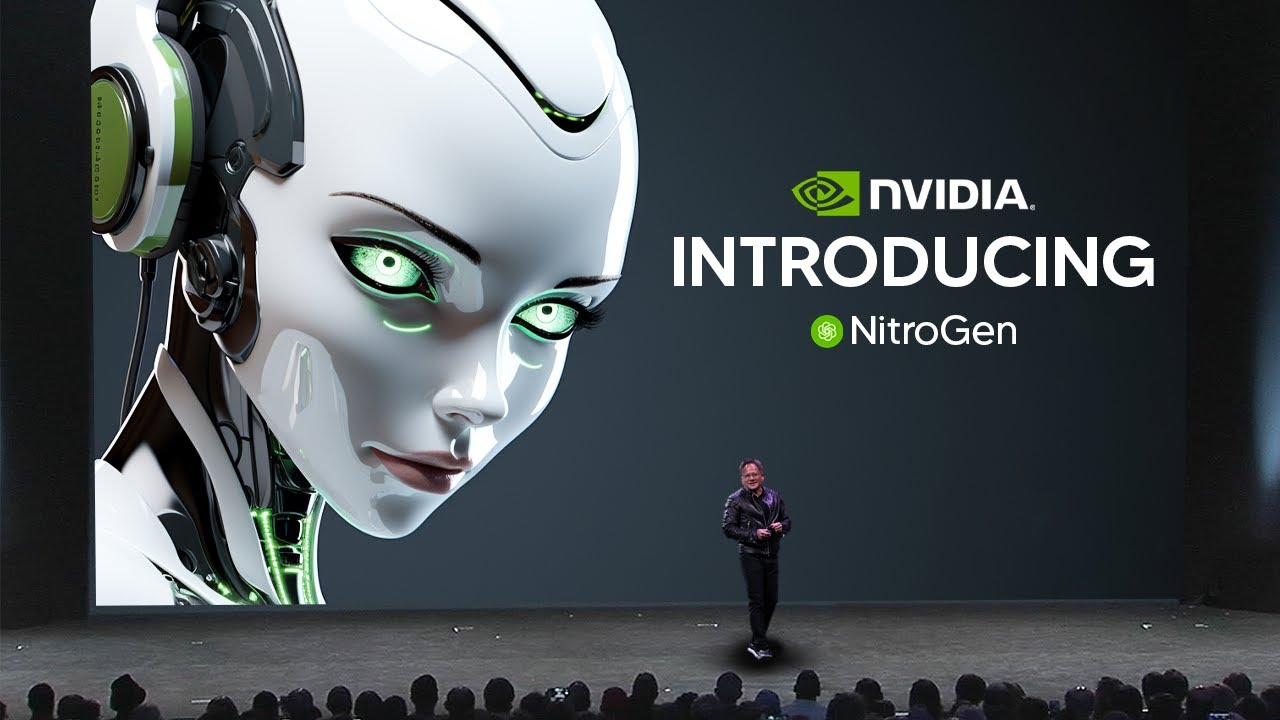
NVIDIA has introduced Nitrogen, a groundbreaking open foundation model designed to act as a generalist gaming agent. Unlike previous AI agents that are trained specifically for individual games, Nitrogen can be dropped into virtually any video game—regardless of whether it has seen it before—and play it to a reasonable degree of success. This represents a significant leap in AI generalization, a key challenge on the path to Artificial General Intelligence (AGI), as most AI systems struggle when faced with scenarios outside their training data.
Nitrogen’s architecture is built on three main pillars: the universal simulator, the multi-game foundation agent, and an internet-scale video action dataset. The universal simulator allows any commercial game to be treated as a research environment, feeding only raw pixel data to Nitrogen, just as a human player would see. The multi-game foundation agent serves as the AI’s “brain,” using visual encoders to process game frames and generate sequences of controller actions, resulting in smooth, human-like gameplay. The internet-scale video action dataset is sourced from thousands of hours of gameplay videos with controller overlays, enabling the AI to learn by observing real human actions across a thousand different games.
What sets Nitrogen apart is its ability to generalize across a wide variety of games without any game-specific training, reinforcement learning, or hand-tuning. The model is pre-trained using imitation learning at scale, similar to how large language models are trained on vast amounts of text. Nitrogen’s performance is impressive: it achieves 40–60% success rates across all game types, with particularly strong results in 3D games, thanks to the dataset’s bias toward action-heavy titles. Its ability to transfer skills between games demonstrates that it is learning generalizable behaviors rather than memorizing specific scripts.
This development marks a paradigm shift in AI research. Previously, each new game required custom reinforcement learning and massive computational resources. With Nitrogen, a single pre-trained model can be fine-tuned for new games with minimal additional data, echoing the transformative impact that foundation models have had in computer vision and natural language processing. The model’s generalization capabilities are reminiscent of the breakthrough moment when large language models first succeeded at zero-shot prompting.
While some critics question the value of AI agents playing games, the video emphasizes that games are a safe, complex, and cost-effective training ground for developing AI skills such as perception, control, and decision-making. These skills are directly transferable to real-world applications like robotics, autonomous vehicles, and industrial automation. Nitrogen’s open-source release aims to accelerate research in these areas, with the ultimate goal of building AI systems that can adapt and operate effectively in diverse, real-world environments. The implications, if successful, are profound for the future of AI and robotics.